AI Development for Customer Experience Platforms: Building Intelligent, Responsive, and Scalable CX
- April 14, 2026
- What Are AI Customer Experience Platforms?
- Why AI for Customer Experience Is Gaining Ground
- How AI Improves Customer Experience
- AI Customer Experience Tools for Businesses
- Examples of AI Customer Experience Platforms
- Benefits of AI for Customer Experience
- AI Driven Customer Engagement: Moving Beyond Support
- Artificial Intelligence for Customer Support: Practical Use Cases
- Building AI CX Solutions: What Businesses Need to Consider
- Cost of Building AI Customer Experience Platforms
- Future Trends in AI Customer Experience
- Challenges in AI Customer Experience
- How to Get Started with AI for Customer Experience
- Conclusion
- About iProgrammer Solutions
- FAQs

A customer opens your app at 11:47 PM with a billing issue. They are already frustrated. They expect clarity, speed, and resolution in minutes. Not a ticket number. Not a generic reply. That moment defines your brand more than any campaign ever will.
Customer experience today is shaped in these micro-interactions. Every delay, every irrelevant response, every disconnected touchpoint chips away at trust. Businesses are not losing customers because of one big failure. They are losing them through a series of small, preventable frictions.
This is where AI for customer experience is changing the rules. It is not simply about automation. It is about constructing intelligent systems that can decipher intent, make predictions, and react accordingly.
This blog looks at the impact of artificial intelligence on the development of contemporary customer experience platforms, the elements necessary for their development, and future directions in the field.
What Are AI Customer Experience Platforms?
The AI customer experience platform is a tool that employs artificial intelligence technologies such as machine learning and natural language processing skills in handling customers’ engagements.
The AI customer experience platform does not operate in isolation but operates through several communication channels like chat, email, phone, and mobile apps. They continually analyze users’ behavior and past data.
At a practical level, they handle three key responsibilities:
- Understand customer intent in real time
- Deliver relevant responses or actions
- Improve outcomes through continuous learning
In contrast to conventional CRM tools, these systems keep improving every time they interact.
For instance, a question raised by a consumer on account of the delivery delay is answered by not only finding tracking information but also identifying signs of irritation and offering compensation.
It is the transition from passive response to active communication that characterizes all modern AI CX applications.
Why AI for Customer Experience Is Gaining Ground
Consumers’ requirements are evolving more quickly than many businesses can adapt to them.
According to PwC research, 73% of consumers think that experience is crucial when making a buying decision. In addition, 32% of consumers may cease cooperation with a company after just one negative experience.
The gap between expectation and delivery is where AI creates value.
Traditional customer support models rely on human bandwidth. They struggle during peak demand and often lack consistency. AI bridges this gap by scaling without compromising response quality.
Another factor is data. However, there is a lot of customer data that is available for companies to use, but they do not utilize all of this data. That is where AI could help out.
And that is why investing in AI-powered customer services is worth considering instead of making incremental changes.
How AI Improves Customer Experience
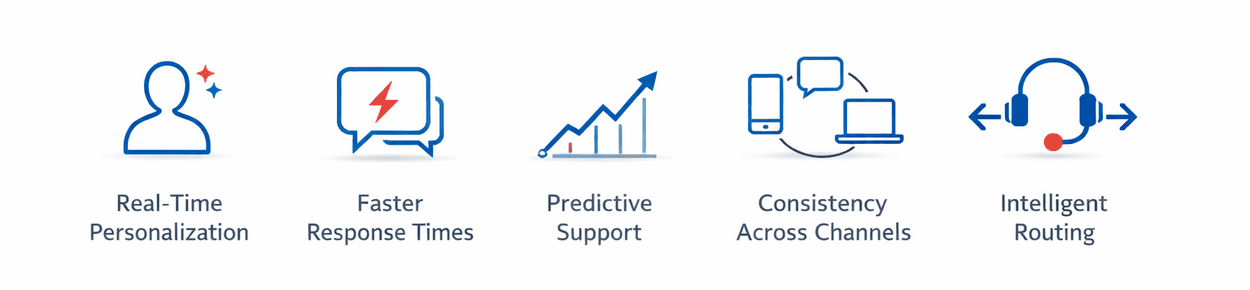
AI adds value to customer experience in ways other than just through automation.
1. Real-Time Personalization
AI analyzes customer behavior, preferences, and history to deliver tailored responses. A returning customer does not need to repeat context. The system already knows their past purchases and interactions. This reduces friction and improves satisfaction.
2. Faster Response Times
The chatbots and virtual assistants respond to customer inquiries immediately. They work round-the-clock without any lags. As Gartner reports, by 2027, chatbots will be used by a quarter of all companies as their primary customer service channel.
3. Predictive Support
AI analyzes customer behavior and anticipates possible problems that could happen in the near future. If multiple failed login attempts occur, the system would help the customer or even contact the support service. It helps reduce tickets and increase trust.
4. Consistency Across Channels
Customers expect the same treatment and responses regardless of the channel they choose. AI guarantees the consistency in terms of tone and response quality.
5. Intelligent Routing
AI determines the kind of request from customers and how urgently it should be handled, routing the query to the appropriate agents.
AI Customer Experience Tools for Businesses
The ecosystem of business customer experience tools powered by AI is constantly expanding. Such technologies perform various roles throughout the entire CX lifecycle.
Below is a simplified view:
| Category | Function | Example Use Case | Business Impact |
|---|---|---|---|
| Chatbots & Virtual Assistants | Handle customer queries | Answer FAQs, guide onboarding | Faster responses, reduced support load |
| Sentiment Analysis Tools | Understand customer emotions | Analyze support tickets or reviews | Better decision making |
| Recommendation Engines | Suggest relevant products | Personalized product suggestions | Increased conversions |
| Voice AI Systems | Process voice interactions | Call center automation | Improved call handling |
| Predictive Analytics Tools | Forecast customer behavior | Churn prediction | Retention improvement |
| Knowledge Management AI | Organize support content | Smart search for help centers | Reduced agent dependency |
When applied together, these tools will produce better results.
Examples of AI Customer Experience Platforms
A number of platforms have already incorporated AI in their customer experience systems.
Salesforce
Salesforce provides AI functionalities via its Einstein product line. This includes predictive analytics, automation, and personalization services.
For instance, Einstein is able to analyze customer information to identify high-potential leads for conversion. It also assists support teams by suggesting responses.
Zendesk
Zendesk integrates AI to improve ticket resolution and customer engagement.
Its AI features include:
- Automated ticket classification
- AI-powered chatbots
- Intelligent knowledge base suggestions
Zendesk’s strength lies in combining AI with structured support workflows.
These platforms are not just adding AI features. They are redesigning how customer experience systems operate.
The takeaway for businesses is clear. AI needs to be built into the core system, not layered on top.
Benefits of AI for Customer Experience
AI brings measurable improvements across customer experience metrics.
| Metric | Without AI | With AI |
|---|---|---|
| Response Time | Delayed during peak hours | Instant, 24/7 availability |
| Customer Satisfaction | Inconsistent experiences | Personalized and consistent |
| Agent Productivity | Limited by workload | Augmented with AI assistance |
| Cost per Interaction | High due to manual handling | Reduced through automation |
| Resolution Rate | Dependent on agent skill | Improved with data insights |
| Customer Retention | Reactive engagement | Proactive and predictive engagement |
| First Contact Resolution | Moderate | Significantly higher with intelligent routing |
| Personalization | Generic interactions | Context-aware and individualized |
| Self-Service Adoption | Limited | Expanded through AI assistants |
Key Benefits
1. Scalability Without Linear Cost Increase
AI allows businesses to deal with increasing customer interaction without a linear growth of workforce involved. Automation of routine tasks makes the process more efficient and effective.
2. Improved Customer Retention
Through the utilization of artificial intelligence, companies get to know what their customers want and need. This leads to better customer retention and customer relations in general.
3. Data-Driven Decision Making
AI is capable of analyzing customer data. Therefore, business owners acquire some meaningful insights that can be used to make better decisions concerning the interaction with customers.
4. Enhanced Agent Performance
With AI, agents can benefit from recommendations made regarding particular customer contacts, as well as the steps they should take next in the conversation process. This improves agent efficiency and consistency in service delivery.
5. Omnichannel Experience
Through this AI, it is ensured that all customers receive the same level of assistance irrespective of whether they contact the company through live chat, email, telephone, or social media channels.
6. Hyper-Personalization at Scale
With the help of AI, organizations are able to provide customized services for the customer depending upon their interests and interaction with the organization.
7. Predictive and Proactive Support
Thanks to predictive analysis techniques, artificial intelligence-driven CX solutions can predict possible problems before they occur. Thus, proactive interventions help build better relationships with customers.
8. Sentiment and Emotion Analysis
The ability to analyze customer sentiment with natural language processing gives AI-driven CX support systems an advantage in understanding the emotions of the customers.
9. Increased First Contact Resolution (FCR)
Intelligent routing and contextual intelligence enable the resolution of customers’ questions in the very first attempt, saving time by minimizing the need for contacting customer service again.
10. Empowered Self-Service
Knowledge bases created with the help of AI and smart assistants give customers easy access to necessary information.
AI Driven Customer Engagement: Moving Beyond Support
Customer experience is no longer limited to support. It extends across the entire customer journey.
AI driven customer engagement focuses on:
- Pre-purchase interactions
- In-product experiences
- Post-purchase support
For example, AI can:
- Recommend products based on browsing behavior
- Guide users during onboarding
- Trigger personalized follow-ups
This creates a continuous engagement loop.
Artificial Intelligence for Customer Support: Practical Use Cases
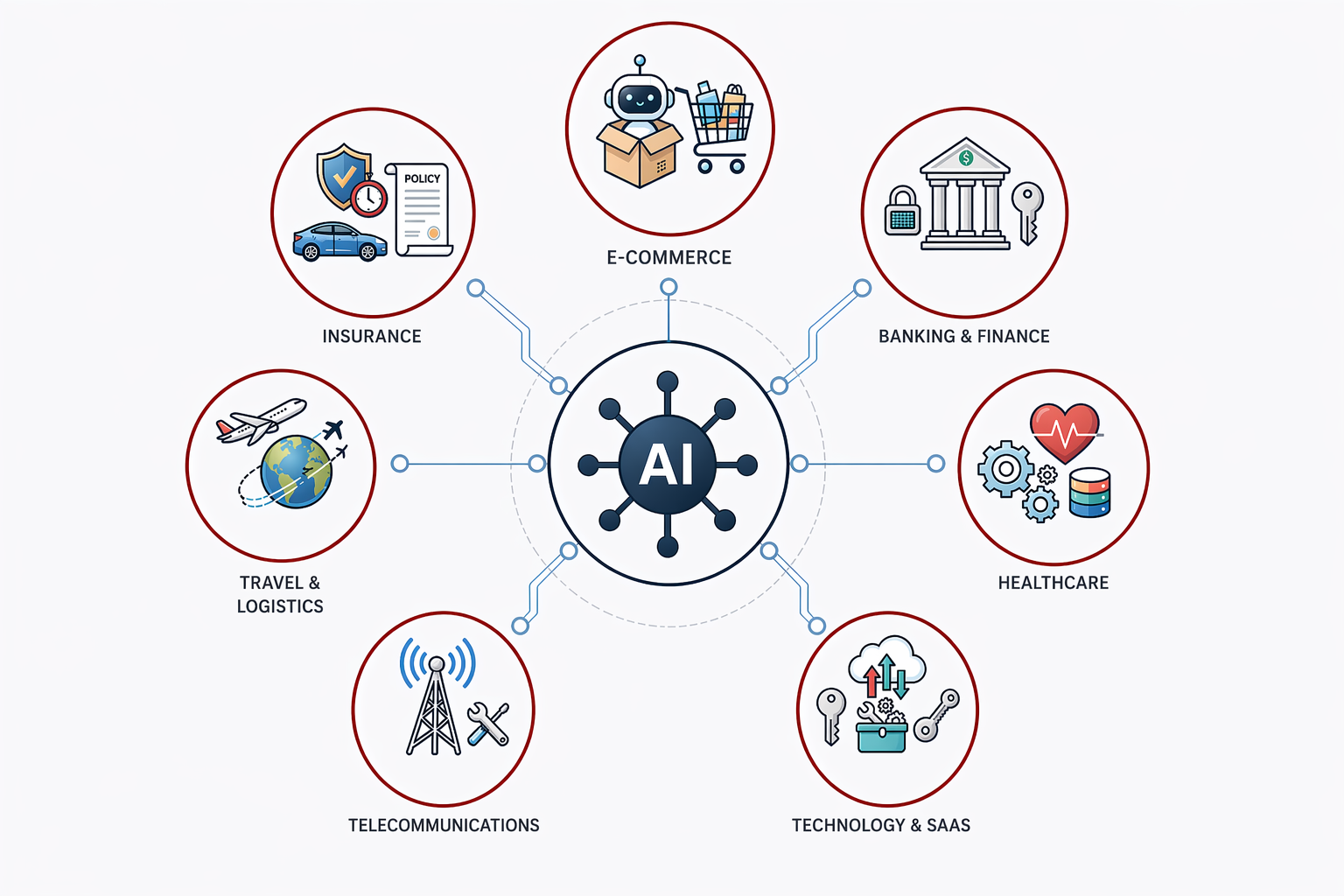
Let’s move beyond theory and look at how businesses apply AI in real scenarios.
- E-Commerce and Retail: AI allows companies to monitor the orders of their customers, facilitate returns, and make product recommendations according to their preferences.
- Banks and Financial Services: The following benefits of applying artificial intelligence can be listed for the banking sector – fraud detection, virtual assistants, customer onboarding.
- Healthcare: AI makes patients’ interaction more convenient and easier as it is involved in booking of appointments, answering customer questions, and billing processes.
- SaaS Platforms: AI improves the process of onboarding and troubleshooting, as well as the prediction of churn to facilitate fast adoption and retention of customers.
- Telecommunications: Alerts on potential network breakdowns, handles billing concerns independently, personalizes services to customers, and makes sure communications are actively managed.
- Travel and Hospitality: Assists customers in organizing their bookings efficiently and alerts travelers on their flight schedules. Also available in various languages.
- Insurance: Makes the claim process quick and easy, detects insurance fraud, and recommends personalized insurance packages to clients.
Building AI CX Solutions: What Businesses Need to Consider
Developing AI CX solutions requires more than selecting tools. It involves strategic decisions.
Key Considerations
- Availability of Data: Right data needs to be made available to ensure building an accurate model and analysis of customers’ experience.
- Integration with Existing Technologies: There is a need for integration with existing technologies like CRM, ERP, and customer service technologies.
- AI Training: AI solutions require training constantly because it is crucial to address the changes in the behavior of customers.
- Collaboration between Humans and AI: AI should act as an aid to humans and not take over their roles when performing monotonous and repetitive actions; however, human intervention should be there for dealing with complex scenarios.
- Security Measures: There is a requirement for providing security and ensuring compliance with GDPR along with national regulations.
Cost of Building AI Customer Experience Platforms
The cost varies based on complexity, scale, and customization.
| Factors That Influence Cost | Approximate Cost Range |
|---|---|
|
|
These are indicative figures. Actual costs depend on business needs.
Future Trends in AI Customer Experience
AI in customer experience is still evolving. Several trends are shaping its future.
- AI in CX for Customer Experience (CX): Generative AI will enable contextually aware human-like interactions along with personalized conversations.
- Hyper-personalized Interactions: AI systems do not just segment users, but offer personalized interactions to each individual user based on their actions and context.
- Voice AI: Use of voice AI becomes vital when you have to contact customers without having to type or use the telephone.
- Emotion AI: Advanced emotion detection using text and voice analytics will make businesses excel in connecting with their clients.
- Autonomous CX Solutions: Evolution of AI will be characterized by autonomous solutions in CX without any human intervention.
- Proactive CX Solutions: Proactive and predictive CX solutions mean foreseeing the needs and issues of customers to help them immediately.
- Omni-channel CX Solutions: The concept of omnichannel CX demands a solution through which AI can manage the customer journey through all channels.
- Ethical and Responsible Use of AI: In future, AI in CX will demand greater effort towards responsible and ethical implementation.
Challenges in AI Customer Experience
- Customer Data Silos: The customer data is dispersed across various systems. This implies that the customers cannot have a comprehensive approach to AI, resulting in inefficiencies of the latter.
- Customer Data Problems: Poorly structured or erroneous customer data may create misleading results and even impact the functioning of AI.
- Over Automation: An over-reliance on automation may make the experience impersonal, making human interaction necessary.
- Technological Constraints: Creating and deploying AI-powered CX platforms require expert skills and adequate technology infrastructure.
- Ethical Considerations: Ethical use of AI in CX requires transparency in terms of informing customers regarding data usage.
- Bias and Ethical Concerns: AI models must be carefully designed and monitored to prevent unintended bias and ensure fairness.
- Change Management: Successful adoption depends on employee training and organizational readiness to work alongside AI systems.
- Security and Compliance: Protecting sensitive customer data and adhering to regulatory standards are critical for maintaining trust and avoiding legal risks.
- Measuring ROI and Scalability: Demonstrating tangible business value and ensuring scalability are essential for long-term success.
How to Get Started with AI for Customer Experience
A structured approach helps reduce risk.
Step-by-Step Approach
- Identify customer pain points by analyzing journeys to find areas where AI can deliver immediate value.
- Define clear objectives with measurable goals such as faster responses, higher satisfaction, and reduced costs.
- Develop a strong data strategy by ensuring clean, structured, and integrated data for effective AI performance.
- Align stakeholders across the organization to ensure readiness and shared ownership of AI initiatives.
- Choose the right AI capabilities and technology partner that support business needs and future scalability.
- Start with pilot projects to validate effectiveness before scaling AI across the enterprise.
- Establish governance and ethical frameworks to ensure data privacy, transparency, and responsible AI use.
- Measure outcomes continuously and refine models to sustain long-term business value.
- Plan for scalability by designing AI solutions that support future growth and expansion.
This ensures controlled and effective implementation.
Customer experience is no longer a support function. It is a defining factor in business success. AI has changed how businesses approach this space. It brings speed, intelligence, and scalability.
But the real value lies in how it is implemented.
Businesses that treat AI as a strategic capability will see better outcomes. Those that view it as a tool may struggle to realize its full potential. The difference is not in the technology. It is in the approach.
Great customer experiences are shaped not just by technology, but by how thoughtfully it is applied. At iProgrammer Solutions, we focus on building AI solutions that deliver real business impact. Every implementation is designed to align with operational needs and evolving customer expectations.
From intelligent chat systems to predictive analytics, our AI CX solutions help businesses create meaningful, data-driven customer interactions that scale with growth.
If you are looking to elevate your customer experience with AI, explore our AI development services.
Through APIs, enabling seamless connection with CRM, ERP, and support tools.
Rule-based bots follow scripts; AI chatbots understand context and learn from interactions.
Using metrics like CSAT, NPS, First Contact Resolution, and cost per interaction.
No. It automates routine queries while humans handle complex or sensitive cases.
By using language models to deliver accurate, real-time responses across languages.