AI Defect Detection in Manufacturing:
How Machine Vision, Image Processing & Computer Vision Work Together
- Oct 31, 2025
- What is AI Defect Detection?
- Why Defect Detection in Manufacturing (and beyond) Matters
- The Role of Machine Vision, Image Processing and Computer Vision in Defect Detection
- How AI Defect Detection Works
- Training AI Models
- Applications Across Industries
- Benefits of AI Defect Detection
- Future Trends
- Implementation Considerations: What to Watch Out For
- Real life Implementation of AI Defect Detection System
- Conclusion
- About iProgrammer Solutions

As production lines become faster and more complex, even a minor defect can ripple across supply chains, costing millions in rework and lost trust. That’s why precision AI defect detection has become a strategic priority, not a routine process. When we talk about AI defect detection, we’re talking about far more than a static inspection station or a manual check. We’re talking about systems that use image recognition, machine learning, and predictive analytics to automatically spot flaws, anomalies or deviations in real time. At iProgrammer Solutions, we believe this evolution is central to the next wave of industrial productivity and quality assurance.
This blog will explore this evolution in detail. It will explore what AI defect detection really means, how machine vision and image processing power it, the algorithms that make it work, where it’s being used across industries, and the results businesses are seeing. By the end, you’ll have a clear sense of how to approach defect detection in manufacturing and beyond.
What is AI Defect Detection?
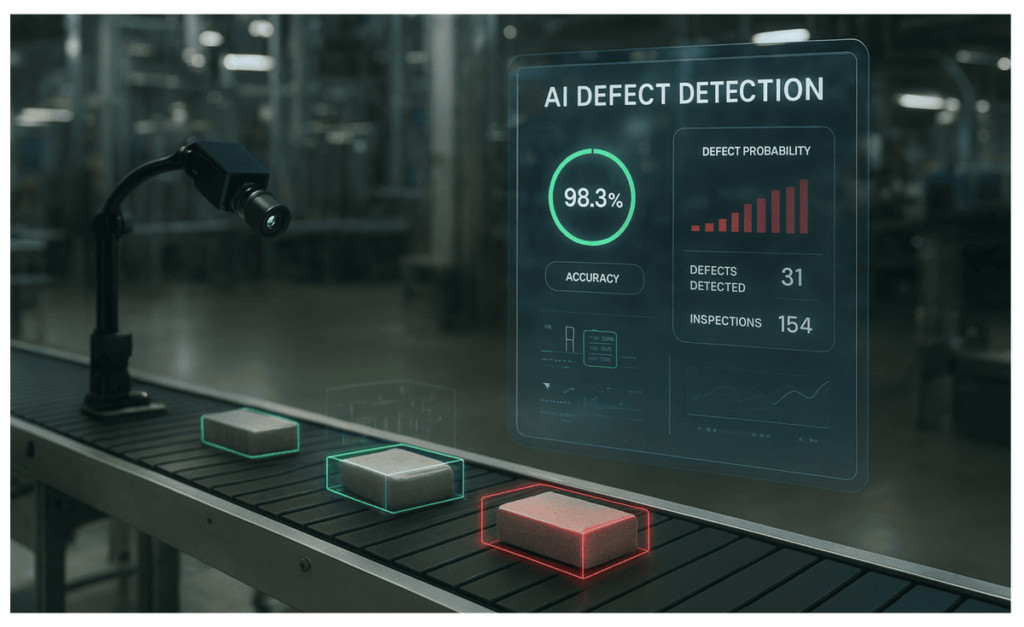
AI defect detection is a process where machine learning and computer vision collaborate to detect defects in materials, components, products or processes—autonomously, with minimal human interaction. Instead of a human inspector looking at a product, the process utilizes cameras (or sensors), image- or video-based information and trained algorithms that can scan for abnormalities, deviations, omissions or anomalies and signal them for analysis or action.
In simple terms: imagine a production line where a camera observes every unit, the system has previously learned what a ‘good’ unit looks like and what various ‘bad’ units might look like (or at least how they deviate), and then—live—alerts when a unit doesn’t meet the criteria. That’s AI defect detection in action.
For most organizations, particularly manufacturing ones, the change from manual or semi-automatic inspection to full-blown AI-based systems is a giant step. But the payoff is definitely worth it: fewer defects, less waste, higher throughput, more customer satisfaction.
Why Defect Detection in Manufacturing (and beyond) Matters
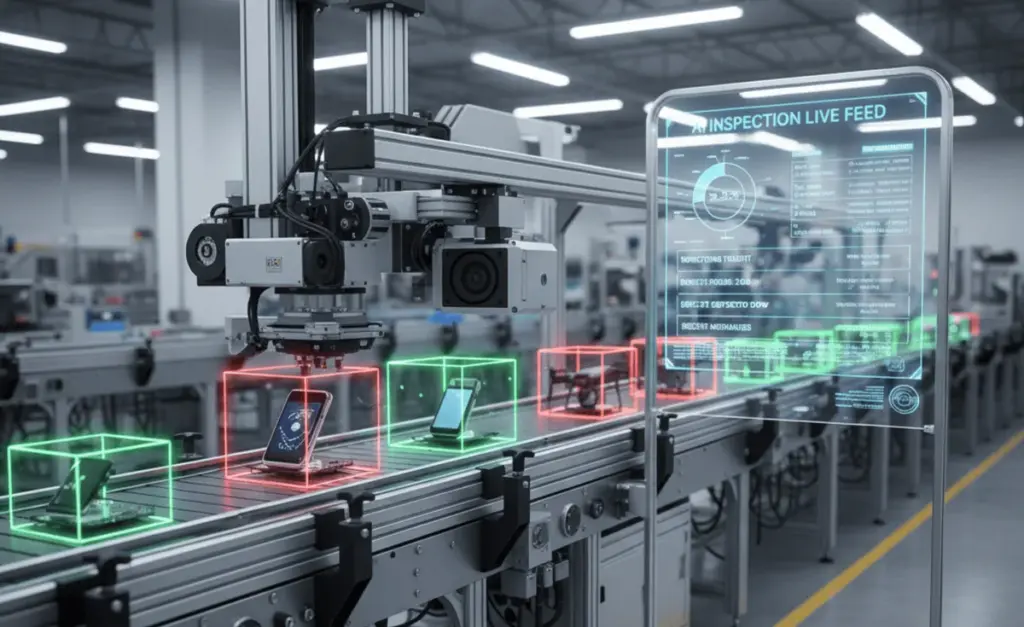
In manufacturing defect detection, the stakes are high. Not only does a defect that gets through cause rework or scrap, it can harm brand reputation, generate warranty expense, pose safety risks, or in regulated industries, result in compliance or liability issues.
Traditionally, the standard has been manual inspection: certified technicians or inspectors eyeball parts, assemblies or products. Human eyes do have limitations: fatigue, variation in inspectors, subtleties gone unnoticed, and sheer volumes of units can make 100 % inspection impossible. Automated optical inspection (AOI) systems improved the situation, but many are rule‐based and constrained by the types of defects they can detect.
Today, AI facilitates the transition from intermittent inspection to continuous, intelligent inspection. By combining machine vision, image processing, and learning algorithms, companies can detect flaws as and when they happen, reducing last-minute surprises, recalls, and quality trade-offs.
The Role of Machine Vision, Image Processing and Computer Vision in Defect Detection
This section explores the fundamental layers of AI defect detection—how the systems function and where their true value lies.
Role of Machine Vision
Machine vision refers to the hardware and systems (cameras, lighting, sensors, optics, conveyors, etc.) that enable visual inspection by machines. In the context of defect detection, machine vision is the “eyes” of the system: correctly capturing images or video of the product or process under consistent, controlled lighting and positioning. Without robust machine vision, an AI system will suffer from poor data quality—which means poor outcomes.
For example: ensuring uniform lighting, correct focus, consistent background, minimal reflections or shadows—these are machine vision concerns. Good machine vision design is critical to deploy a defect inspection system that yields reliable results, day in and day out.
Image Processing in Defect Detection
After capturing images, comes image processing: methods that ready, clean, manipulate, and extract features from images so that algorithms can read them. Operations include noise removal, contrast adjustment, segmentation (image splitting into regions), detection of edges, shape extraction, colour filtering, etc.
In defect detection, image processing might highlight cracks, scratches, pits, missing components, mis-alignment, surface texture irregularities or colour deviations. For example, edge detection algorithms may highlight a scratch’s outline; segmentation may isolate a product region from the background. Without the right image processing pipeline, the “raw camera image” may not be usable for accurate classification.
Role of Computer Vision Defect Detection
Computer vision goes beyond image processing—it refers to the automated interpretation of images/videos: object detection, classification, localisation, segmentation, pattern recognition. When we speak of computer vision defect detection, we mean systems that look at images and decide: “this is a defect” (and often “what type of defect” and “where it is”).
Work in this domain increasingly uses deep learning-based models—especially convolutional neural networks (CNNs)—to learn features from images rather than relying purely on manually engineered image processing filters. According to academic surveys, machine-vision and image recognition for defect detection have achieved high accuracy in many manufacturing applications.
In short, machine vision supplies the data, image processing refines it, computer vision (often via AI) interprets it. All three together are essential for an effective AI defect detection system.
How AI Defect Detection Works
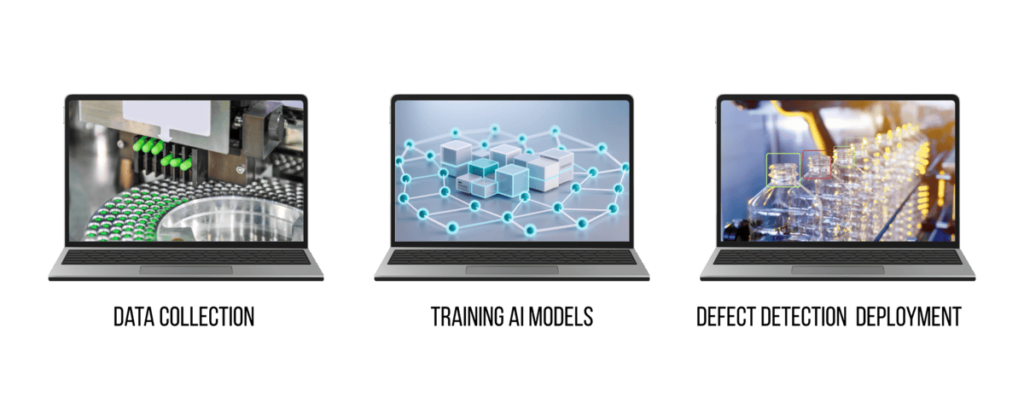
The development and deployment of an AI defect detection system usually progress in three phases: data collection, model training, and real-time defect detection on the shop floor.
Data Collection
Any AI system is only as good as the data it trains on. For defect detection, this means gathering high-quality images (and sometimes video) of both “good” and “defective” units/components/processes. The data must be representative of real-world conditions: lighting, camera angles, production line variation, variant parts, defect types, background clutter, etc.
According to industry practitioners, a key step is to label defect images—indicating defect presence, defect type, location (bounding boxes or segmentation masks), etc. MobiDev+1 In many manufacturing use-cases the challenge is imbalance: far fewer defective images than good ones, and large variety of possible defect classes. Some academic work has proposed data-augmentation or synthetic-data generation to overcome this.
Good data collection is also about controlling environmental variables (consistent lighting, camera positioning), and ensuring your dataset covers the range of expected product/defect variations (sizes, angles, textures, colours). As one article puts it: “The more unique your product’s defects are … the more extensive dataset is necessary.”
Training AI Models (Algorithms like CNNs, Image Recognition, Predictive Analytics)
Once the dataset is ready (labelled, cleaned, well-balanced), the next step is training algorithms that can recognise defects.
Key algorithmic frameworks
- Convolutional Neural Networks (CNNs): these are a core work-horse for image based tasks – classification, localisation, segmentation. Many defect detection systems leverage CNNs to learn hierarchical image features automatically (rather than hand engineering features).
- Image Recognition / Object Detection: In most defect detection applications, you have to determine if an object (unit, component) is faulty, and ideally find the location of the defect area (bounding box) or even delimit the defect (pixel-level). YOLO (You Only Look Once), Faster R-CNN and their variants are employed.
- Predictive Analytics: Beyond identifying present defects, modern systems increasingly incorporate predictive analytics: using historical data, process data, sensor data (beyond just images) to predict which units or systems might develop defects. This blends computer vision with analytics and machine-learning features beyond pure image models.
In practice, training consists of dividing data into training, validation and test datasets. One decides on an architecture, specifies loss functions (for classification, detection, segmentation), trains the model until performance (accuracy, precision, recall, mean average precision (mAP) etc.) is reasonable, and then iterates.
Challenges in training
- Imbalanced datasets (few defects vs many good units)
- Variability of defects (size, shape, texture, background)
- Real-world conditions (lighting changes, camera variability)
- Annotation quality and consistency
- Integration with historical systems, and robustness to new types of defects
Real-time Defect Detection & Deployment
After the model is trained and validated, the system transitions to deployment onto the production line (or inspection station) for real-time defect detection. This stage covers hardware, software, workflows, integration, feedback loops.
Key considerations:
- Hardware: cameras, lighting, computing (GPUs, edge devices), interfaces to production line, networking/cloud vs on-premise.
- Software Integration: the model has to be incorporated into the inspection system, typically including user interface, alert/notification workflow, data logging, traceability.
- Latency and Throughput: Can the system keep up with production speed? Real-time means minimal delay between image capture and defect flagging. Some systems process dozens of frames per second.
- Feedback and Learning Loop: Post-deployment, new defect types may emerge; models may require retraining, or data may be fed back for continuous improvement. Also oversight and human-in-the-loop may still be necessary.
- Maintenance and Monitoring: The system must be monitored for drift, performance degradation, camera/lens changes, lighting changes, etc.
- Workflow: What happens when a defect is flagged? Does the unit get diverted? Who reviews the alert? Does the system trigger repair, re-inspection or scrap? These downstream workflows matter.
When all these pieces come together—good machine vision, robust model, proper deployment, feedback loops—you get a completely automated defect inspection system that reduces human error, increases consistency and enables scale.
The power of AI defect detection is not limited to one sector—it spans manufacturing, electronics, construction, healthcare and more. Let’s look at a few key use-cases.
Manufacturing: Detecting Product Flaws
In typical production lines (automotive, consumer products, heavy machinery), common pain-points include defects like surface scratches, missing parts, misalignments, weld defects, cracks, pits, or texture anomalies. Using AI-powered machine vision, manufacturers are able to inspect all units instead of sampling. For instance, one study in additive manufacturing realized 91.7% mAP50 at 71.9 fps with a YOLOv8 model tailored to their needs.
Electronics: Circuit Board Inspection
In PCB manufacturing, accuracy is crucial. PCBs contain small components, solder joints, thin traces, and defects that are very hard for human inspectors to consistently identify at high speed and volume. AI-powered quality control systems in the manufacture of PCBs have demonstrated higher defect detection rates, lower inspection times and enhanced accuracy.
Construction: Identifying Structural Defects
In construction or infrastructure inspection (tunnels, pipelines, buildings, bridges) defects like cracks, corrosion, leaks or structural defects are expensive if overlooked. With the application of drones or fixed cameras along with computer vision and AI, these defects can be identified earlier, preventing failure or significant repair bills. The broader domain of machine vision based defect detection is increasingly applied beyond traditional manufacturing.
Healthcare: Detecting Anomalies in Medical Imaging
Though somewhat distinct from “manufacturing defects”, defect detection in healthcare (for example in imaging—X-rays, MRIs, scans) follows a similar pattern: capture image data, use AI models to recognise anomalies (lesions, fractures, tissue irregularities). These systems help improve detection speed, consistency and often highlight suspicious areas for review. The same underlying principle—image data + algorithmic detection = early alert—applies.
Across all these industries, the underlying benefits of implementing AI defect detection remain consistent: catch the defect earlier, correct it faster, reduce waste or rework, and maintain high quality.
Benefits of AI Defect Detection
Let’s now summarise why deploying AI defect detection matters to organisations embracing modern quality control.
Reduced Human Error
Human auditors are prone to tiredness, variability, distractions, varying skill levels, and inconsistency. A computerized AI system does not get tired, does not miss in error (if well calibrated), and uses the same rules each time. That consistency reduces the risk of escape defects (undetected defects) and decreases expensive downstream problems.
Faster Detection and Response
Since AI defect detection systems run in real-time (or near real-time) on production lines or inspection stations, defects are detected immediately. As a result, the unit can be rerouted, fixed, or discarded prior to further downstream operations (assembly, boxing, shipping). The detection speed thus minimizes rework, minimizes line downtime, and maximizes throughput.
Cost Efficiency
Although the initial investment in cameras, light, compute, software and integration is substantial, the downstream cost savings can be substantial: reduced scrap units, reduced warranty claims, reduced external failures, reduced manual inspection headcount, reduced rework, and reduced delayed shipments. And the cost per unit inspected decreases as volume increases.
Improved Product Quality
Maybe the most obvious advantage: improved quality. With early and persistent catching of defects, the overall quality of manufactured goods increases. That translates into more satisfied customers, lower returns, improved reputation, and enhanced market position. In businesses where regulation or safety come into play (automotive, aerospace, medical devices), enhanced quality from AI defect detection can also provide compliance and lower risk.
What’s next for AI defect detection? As with many advanced technologies, we’re just at the beginning of the journey. Here are some of the emerging trends to watch.
AI + IoT for Predictive Maintenance
Integration of AI defect detection with IoT sensors means not only identifying visible defects but predicting when a component or process is likely to fail. For example, combining image-based inspection with vibration, temperature, pressure or acoustic sensors can unlock predictive maintenance. This moves an organisation from “inspect after defect” to “predict before defect”. Several studies highlight the rising importance of predictive analytics in defect-free manufacturing.
Edge AI for Real-Time Defect Detection
Instead of transmitting all image data to a central cloud or server, many systems now deploy models on edge devices (on the line, in the factory) which enables ultra-low latency, reduced bandwidth demands, greater resilience and scalability. As hardware (GPUs, neuromorphic chips, embedded devices) becomes more capable, edge AI deployment of defect detection becomes more economical and powerful.
Combining AI with Robotics for Automated QC
Rather than just using a fixed camera to inspect a unit, many systems are now coupling AI vision with robotics: robots position the camera or component, manipulate parts, inspect from multiple angles, and even perform corrective actions. This “closed-loop” automation—from detection to repair—is increasingly feasible, and represents the future of fully autonomous quality control.
Beyond these, we might see:
- More use of explainable AI (XAI) in defect detection so that models don’t just flag a fault, but can explain why.
- More self-learning systems that adapt to new defect types without full retraining.
- More 3D vision / depth sensing to catch non-surface defects (internal cracks, subsurface faults) which traditional 2D vision fails to catch.
- Higher adoption in small and midsize manufacturers as cost of entry falls.
While the benefits are compelling, it’s important to recognise that deploying AI defect detection is not “plug-and-play”. If you get the implementation wrong, you risk disappointing performance, cost overruns or missed ROI. Here are key considerations:
- Data readiness: Do you have sufficient “good” and “defective” image data that reflect real production variation? Are your cameras and lighting stable and well-designed? Without good data, even the best algorithms will struggle.
- Change management: Inspection workflows change, roles may shift. Operators need training, new alerts/flows must be incorporated.
- Integration with production systems: The defect detection system needs to tie into existing line controls, ERP/MES, traceability systems. If it stands alone, it may become a disconnected silo.
- Model robustness and maintenance: Over time, product variants, lighting conditions, camera changes, or defect types may change. A proactive plan for model retraining and monitoring is critical.
- Latency, throughput and cost trade-offs: If the inspection slows the line, it defeats the purpose. Edge vs cloud, camera resolution vs processing power, number of inspection angles—all must balance cost and speed.
- False positives / false negatives: A defect detection system with many false alarms creates disruption; one that misses too many defects creates risk. Ensuring a good trade-off between sensitivity and specificity is crucial.
- Scalability: A pilot is one thing; scaling to multiple lines, multiple sites, multiple product types is another. Design for scale from the start.
- Governance, standards and traceability: Especially in regulated industries (medical, aerospace, automotive), the inspection system needs to log events, provide audit-trail, meet certification requirements.
- Cross-functional collaboration: Quality, manufacturing engineering, IT/OT, data science teams must work together—not in silos.
By bearing these considerations in mind, organisations will significantly increase their chance of successful, high-impact deployment of AI defect detection.
Real life Implementation of AI Defect Detection System
A Queensland-based metal components manufacturer was struggling to maintain consistent product quality. Manual inspection teams were missing minor defects—such as scratches and uneven edges, especially during peak production. These lapses led to rework, delayed deliveries, and customer complaints.
Solution
iProgrammer implemented an AI Defect Detection system that combined computer vision with deep learning to automatically identify and classify surface defects in real time. The solution was integrated with the client’s existing camera infrastructure and quality control dashboard, providing operators instant feedback and defect trend analysis. Edge-based deployment ensured low latency and uninterrupted inspection across production lines.
Results
- Detection accuracy improved by 90%, minimizing manual dependency.
- Inspection time reduced by nearly 60%, increasing throughput.
- Rework costs dropped by 35%, improving overall production efficiency.
AI defect detection empowers organisations to transition from reactive, labour-intensive inspection to proactive, intelligent, automated quality assurance. From the foundational layers of machine vision and image processing, through the algorithmic muscle of CNNs, object detection and predictive analytics, to edge-deployed systems and integrated robotics, this is the future of defect inspection.
Whether you’re manufacturing millions of units a week, inspecting complex printed-circuit boards, scanning large infrastructure for structural faults, or seeking to apply vision-based anomaly detection in another field entirely—embracing AI driven inspection gives you a competitive edge in cost, quality, scale and speed.
And for organisations ready to take that step, partnering with a specialist that understands both the technological and operational dimension is important. That’s where iProgrammer Solutions comes in.
At iProgrammer Solutions, we bring together deep expertise in AI, computer vision and manufacturing systems to deliver tailored automated defect detection and inspection solutions. Whether you need a full end-to-end deployment or augmentation of an existing inspection line, we offer:
- Custom design of machine-vision systems (cameras, lighting, optics)
- Data collection, annotation and model training with best-in‐class CNN and object-detection architectures
- Real-time deployment on edge or cloud, with integration to your production workflows
- Continuous monitoring, model retraining and evolution so your system remains effective as your products, line or defects evolve
- Industry-specific experience across automotive, electronics, consumer goods, construction, healthcare and more
Discover how iProgrammer’s AI Defect Detection can transform your quality control.