Choosing the Right AI Development Partner in Australia: A Practical Guide for Enterprise Leaders
- Feb 10, 2026
- What Makes a Strong AI Development Partner for Enterprises
- Why Australian Enterprises Face AI Partnering Challenges
- When Should an Enterprise Start Looking for an AI Development Partner
- Step-by-Step Checklist for Hiring an AI Development Partner in Australia
- What to Expect from a Mature AI Development Partner
- Common Mistakes Enterprises Make When Hiring AI Partners
- How to Compare AI Development Partners Effectively
- The Role of AI Software Developers Within a Partner Team
- Engagement Models That Work for Enterprise AI
- Measuring Success Beyond Technical Metrics
- Managing Risk, Accountability, and Failure in Enterprise AI Programs
- How AI Partnerships Scale Across the Enterprise
- The Importance of Long-Term Support and Evolution
- Understanding Cost and Return on Investment in Enterprise AI
- Why Thought Leadership Matters in AI Partnerships
- Future Trends in AI Agent Development Enterprises Should Watch
- Final Thoughts
- About iProgrammer Solutions

Most enterprise leaders do not wake up wanting to hire an AI partner. They arrive there after something else stops working. A reporting process becomes too slow to support growth. A customer operation starts missing patterns that humans once caught. A competitor launches a smarter product with fewer people involved. At that point, AI becomes a responsibility.
In Australia, this shift is happening quietly across logistics firms, banks, retailers, healthcare networks, and SaaS companies. Leaders are expected to “use AI” without clear guidance on what success actually looks like. They are asked to invest, but also to justify risk. They are told speed matters, but reliability matters more. This is where the choice of an AI development partner starts to shape outcomes. Not the model. Not the algorithm. The partner.
A strong AI development partner helps an enterprise think clearly before building anything. A weak one accelerates complexity without control. The difference shows up months later, when systems scale or fail under pressure. This guide is written for decision makers. It focuses on how to evaluate, select, and work with an AI development partner in Australia with confidence and intent.
What Makes a Strong AI Development Partner for Enterprises
Many enterprises misunderstand what an AI development partner actually does. They assume the role is limited to building models or writing code. That assumption leads to poor outcomes. AI success depends less on raw development and more on alignment with business reality. An experienced partner operates at three levels simultaneously.
- First, they translate business problems into solvable AI use cases.
- Second, they design systems that fit existing operations and data maturity.
- Third, they ensure long-term usability, governance, and scalability.
This means the partner must understand operations, not just technology. For example, deploying AI in a supply chain environment is not a data science exercise alone. It involves forecasting accuracy, vendor dependencies, exception handling, and decision ownership. A capable partner asks questions before proposing solutions.
This is where AI Software Developers alone are not enough. Developers execute. Partners guide. Enterprises should expect their AI development partner to challenge their assumptions, point out risks early, as well as propose alternatives when AI is not a solution. Such restraint is often a sign of maturity more than anything else.
Australia presents a distinct enterprise environment for AI adoption.
- Data privacy regulations are strict.
- Industry compliance expectations are high.
- Talent availability varies by region.
- Many enterprises operate across APAC while complying with local standards.
This causes friction when working with offshore or less-experienced vendors. An excellent AI development partner will also understand Australian compliance requirements, data residency concerns, and enterprise procurements. They will be familiar with working with the internal legal team, IT security teams, etc., in the enterprise.
They also understand that Australian enterprises value reliability over experimentation. Proof of concept is important, but production readiness matters more.
When Should an Enterprise Start Looking for an AI Development Partner
Timing matters more than most leaders realize. Some enterprises wait too long, trying to force AI initiatives through internal teams without support. Others start too early, before data or processes are ready. The right moment usually appears when three signals align.
- One, data volume is growing faster than decision quality.
- Two, operational teams struggle to act consistently at scale.
- Three, leadership demands measurable efficiency or intelligence gains.
At this stage, internal capability gaps become visible. This does not mean replacing internal teams. It means extending them. The right AI development partner works alongside internal stakeholders.
Step-by-Step Checklist for Hiring an AI Development Partner in Australia
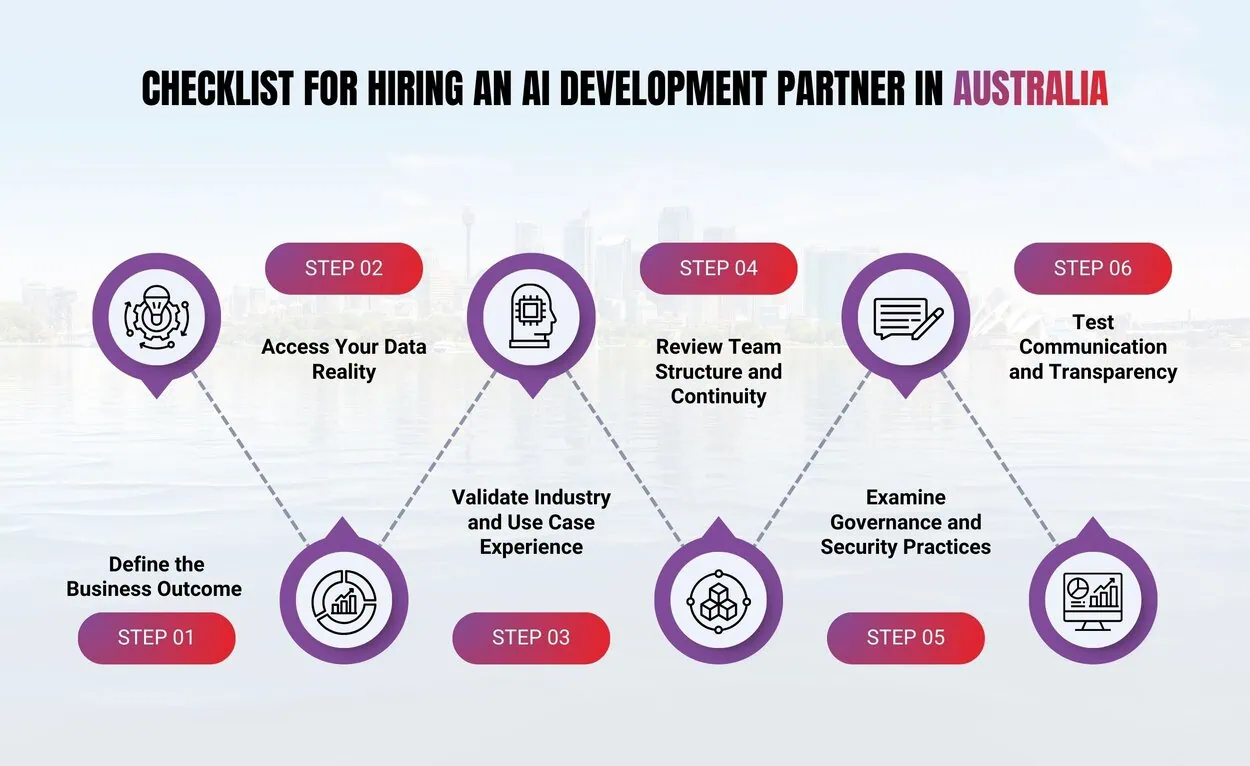
This checklist reflects how successful enterprises structure their evaluation process.
What this step is about
Start with the problem you want to change, not the technology you want to use.
What to clarify internally
- Which operational outcome needs improvement
- How success will be measured
- Who owns the outcome across teams
Examples include faster case resolution, better forecasting accuracy, reduced manual intervention, or improved customer relevance.
What a partner does
A capable AI development partner helps sharpen the objective before discussing tools or models. If the conversation jumps straight to algorithms, pause and reassess.
What this step is about
Understanding whether your data can support the outcome you defined.
What to examine
- Where your data lives across systems
- Who owns and governs it
- How clean, complete, and accessible it is
What a partner does
A strong partner asks for this information early. They factor constraints into timelines and scope. They never guarantee results without reviewing data quality.
What this step is about
Ensuring your partner understands your operational environment.
What to look for
- Experience with similar business complexity
- Case studies from production environments
- Evidence of solutions running beyond pilots
Ask how their solutions performed six months after deployment, not just at launch.
What a partner does
They talk authoritatively about trade-offs, adoption issues, and post-launch optimization.
What this step is about
Understanding who will actually design, build, and maintain your AI systems.
What to verify
- Presence of solution architects and data engineers
- Involvement of ML engineers and domain specialists
- Clarity on who stays post-deployment
AI initiatives require more than AI Software Developers alone. Continuity protects knowledge and system stability.
What a partner does
They define roles clearly and commit senior talent beyond the build phase.
What this step is about
Reducing long-term risk in enterprise AI deployments.
What to ask
- How models are monitored and updated
- How bias and model drift are detected
- How explainability and auditability are handled
What a partner does
They have governance frameworks, not just technical fixes. Vague answers here signal future exposure.
What this step is about
Ensuring alignment across technical and business teams.
What to evaluate
- Ability to explain decisions in plain language
- Openness about assumptions and limitations
- Regular, structured communication processes
What a partner does
They translate complexity into clarity. They keep stakeholders informed before issues escalate. Clear communication becomes a strategic advantage.
What to Expect from a Mature AI Development Partner
A mature AI development partner demonstrates their value through consistent behavior, not promises.
- Invests time in discovery before proposing solutions: They study existing workflows, decision points, and constraints. Discovery is treated as real work, not a sales step.
- Documents assumptions and trade-offs early: Data limitations, operational risks, and dependencies are stated upfront. This prevents misalignment later.
- Shows restraint in applying AI: If a problem is better solved through rules or process changes, they say so. This protects long-term outcomes.
- Designs are intended for real use, not demo code: Architecture must consider scale, retraining, ownership, failure handling, etc. from the beginning.
- Measures success beyond model performance: Model adoption, reliability, and effects on workflow are more important than simply measuring model accuracy.
- Maintains accountability after deployment: This helps to track changes and update systems to meet ever-changing business demands.
- Communicates clearly with technical and business teams: Decisions are explained without ambiguity. Risks are surfaced early.
Many enterprises repeat the same mistakes.
- They over-prioritize cost over capability.
- They underestimate data preparation effort.
- They treat AI as a one-time build.
These decisions create fragile systems that struggle to scale.
Another error is that there is often a tendency to believe that because people are familiar with tools. Knowing a framework does not mean knowing how to deploy responsibly. A credible AI development partner demonstrates judgment, not just speed.
How to Compare AI Development Partners Effectively
Comparisons should go beyond proposals and pricing. Ask partners to walk through a past failure. Ask what they would do differently now. Ask how they manage stakeholder expectations.
These answers reveal more than polished presentations. Below is a practical comparison framework.
AI Partner Evaluation Criteria
| Evaluation Area | What to Look For | Why It Matters |
|---|---|---|
| Business Understanding | Ability to reframe your problem | Prevents misaligned solutions |
| Data Strategy | Realistic data assessment | Avoids stalled implementations |
| Industry Experience | Relevant production use cases | Reduces operational risk |
| Governance | Monitoring and compliance plans | Ensures long-term reliability |
| Team Stability | Consistent core team | Maintains knowledge continuity |
This framework helps separate strategic partners from transactional vendors.
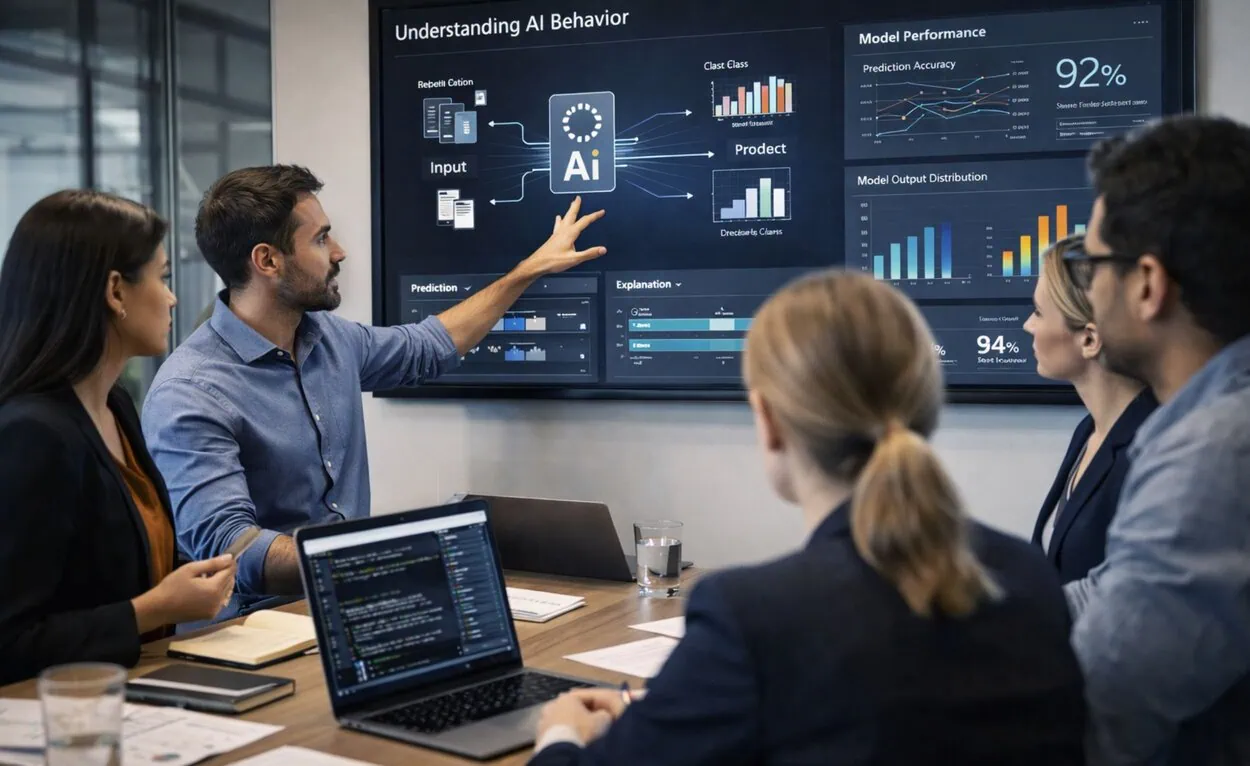
AI Software Developers play a vital role in the implementation process, yet they do not exist in a developed AI relationship alone.
In high-performing enterprise teams, developers are expected to:
- Build within a clearly defined architectural blueprint
- Understand the business purpose behind each model
- Design for integration with existing workflows and systems
- Anticipate Scale, Retraining, and Operational Considerations
When this context is missing, enterprises typically see:
- Fragile data pipelines that break with small changes
- Models that are difficult to retrain or explain
- Increased dependency on specific individuals
- Higher maintenance costs over time
What enterprises should evaluate
- How developers collaborate with solution architects and data engineers
- Whether business analysts are involved in translating requirements
- Who remains accountable after deployment
AI initiatives demand engagement models that reflect uncertainty, iteration, and scale.
Why common models fall short
- Fixed-scope projects struggle as data and insights evolve
- Pure staff augmentation increases capacity but dilutes ownership
- Early commitments lock enterprises into assumptions that rarely hold
What successful enterprises do instead
- Phase 1: Discovery and Strategy
Validate use cases, assess data readiness, and define measurable outcomes - Phase 2: Controlled Pilot
Test feasibility against real KPIs tied to operational impact - Phase 3: Scaled Deployment
Expand only what works, with governance, monitoring, and retraining built in
Why this model works
- Incentives remain aligned across phases
- Risk is contained before scale
- Decisions are informed by evidence, not optimism
High-performing enterprises do not evaluate AI by model accuracy alone. Accuracy shows whether a system works in isolation. It does not show whether it works in the business.
Enterprise leaders track success through operational signals such as:
- Adoption rates across intended user groups
- Reduction in decision turnaround time
- Measurable cost savings or productivity gains
- Decrease in manual reviews and exception handling
These metrics reflect whether AI has been embedded into daily workflows.
A responsible AI development partner helps define these measures before development begins. This forces alignment between technical design and business intent.
Equally important, these metrics are revisited after deployment. As usage patterns change, success standards change too. A mature program should think of measurement not as a finish line, but a loop.
AI systems influence decisions that carry real business impact. These decisions affect operations, costs, and compliance. Failure cannot be treated as an exception. It must be planned for from the start.
Enterprise AI programs need clear accountability. Leaders must know who owns outcomes. They must know who steps in when results drift. They must know how decisions can be paused or reversed. Ambiguity increases risk and delays response.
A mature AI development partner designs for controlled failure. Human review is added where judgment matters. Escalation thresholds are clearly defined. Rollback paths are planned and tested. These safeguards protect the enterprise and its users.
Risk management does not block innovation. It keeps innovation under control. Enterprises that define accountability early move faster later. They adopt AI with confidence, not caution.
AI initiatives rarely remain limited to a single team or use case. Once value becomes visible, adjacent departments seek similar capabilities. This is the point where early architectural decisions either support growth or constrain it.
Scalable AI partnerships plan for expansion by design:
- Reusable components that can support multiple use cases
- Consistent data pipelines that reduce duplication
- Shared governance models that maintain control as adoption spreads
Without this foresight, enterprises accumulate disconnected systems. Each new initiative increases complexity rather than capability.
A scalable AI development partner anticipates this trajectory. They code for reuse, consistency, and visibility across an enterprise. This allows AI to be developed as a platform, not as a series of isolated projects.
AI systems change as data changes. Models drift. Business priorities shift. Regulations evolve.
An AI development partner should offer ongoing monitoring, retraining, and optimization. This is not optional for enterprise systems. Support models should be clear from the start.
Lifecycle of an Enterprise AI Partnership
| Phase | Partner Responsibility | Enterprise Involvement |
|---|---|---|
| Discovery | Use case validation | Strategic alignment |
| Design | Architecture planning | Data access and review |
| Build | Model and system development | Stakeholder feedback |
| Deploy | Integration and testing | Change management |
| Optimize | Monitoring and improvement | Performance evaluation |

AI cost is rarely confined to development. The larger costs appear after deployment.
- Data preparation, monitoring, retraining, and infrastructure often outweigh initial build expenses. Enterprises that ignore this reality misjudge ROI early.
- Return on investment should be linked to operational outcomes. Faster decisions. Lower manual effort. Reduced error rates. Improved throughput. These are the signals that matter.
The right AI development partner connects use cases to measurable impact. They also highlight where returns may take time.
The trick is to choosing a partner who designs systems that remain efficient over years, not quarters.

In enterprise AI, capability is not always visible at the proposal stage.
This is why thought leadership matters.
Partners who consistently publish and share insights reveal how they think when they are not selling. Their perspectives reflect patterns observed across real implementations, not isolated success stories.
Thought leadership signals three things that enterprises care about.
- First, depth of experience. Partners who articulate trade-offs, limitations, and lessons learned have operated beyond pilot environments.
- Second, intellectual discipline. Clear thinking in public often translates to structured decision-making in delivery.
- Third, long-term commitment. Partners who invest in knowledge tend to invest in relationships, not just projects.
For enterprises, this content becomes a proxy for maturity. It shows how a partner approaches complexity when no contract is on the line.
Future Trends in AI Agent Development Enterprises Should Watch
AI agents are becoming more autonomous. But autonomy alone is not the real shift. The real change is how agents interact with systems, data, and people.
- Enterprises are moving from single-task models to multi-step agents. These agents reason across workflows, not just predictions. They trigger actions, request human input, and adapt based on outcomes.
- Another clear trend is tighter system integration. AI agents are no longer standalone tools. They sit inside ERP systems, customer platforms, and operational dashboards. This increases value but also increases responsibility.
- There is also growing focus on controllability. Enterprises want agents that can explain decisions, pause actions, and operate within defined boundaries. Blind automation is losing trust.
A capable AI development partner design agents that evolve without rewriting foundations. This foresight prevents constant rebuilds as technology advances.
Choosing an AI development partner is less about technology and more about confidence. Confidence comes from clarity. Clarity about goals. Clarity about data. Clarity about responsibilities. When these are aligned, partnerships thrive.
The right AI development partner acts as an extension of leadership intent. They balance innovation with discipline. They help enterprises move forward without losing control.
At iProgrammer Solutions, we work with enterprises across Australia to design, build, and scale AI systems that operate reliably inside real-world environments. Every engagement begins with understanding how decisions are made, where friction exists, and what outcomes truly matter.
Why enterprises trust iProgrammer
- Business-first AI strategy: We start with operational goals, not models. Use cases are shaped around measurable impact.
- Experienced AI Software Developers within structured teams: Our developers work alongside solution architects, data engineers, and domain specialists. This ensures systems are scalable and maintainable.
- Governance built into delivery: Monitoring, explainability, and accountability are designed upfront. Risk is managed, not deferred.
- Clear communication and continuity: Senior team members remain involved beyond deployment. Decisions are explained clearly to both technical and business stakeholders.
- Long-term value focus: We design AI systems that evolve with data, regulation, and business change, without constant rework.
Learn more about our approach to enterprise AI development.