
AI Defect Detection for Better Quality Control
Let your production line run with smarter quality, detecting even the minute flaws before they cost you time, money, or reputation.
- 98% Defect Detection Accuracy
- 65% Faster Quality Control Cycle
- 40% Reduction in Manual Inspection Efforts
- 70% Improvement in First-Pass Yield
What is AI-powered Defect Detection?
Why is it necessary?
"In a world of automation, quality isn’t optional—it’s expected." The manufacturing industry has heavily relied on manual inspection and testing methods where a human being can identify flaws, damages, or irregularities in the product, but what about the defects that are not visible to the human eye, such as minute scratches or cracks, incorrect dimensions, wrong labelling and non-working products? These traditional methods can result in human errors, time consumption, non-use of resources and lengthy reporting. Here, the use of Artificial Intelligence (AI) and Machine Learning (ML) in the new era of quality control has revolutionized how manufacturers ensure product excellence.
AI-driven defect detection systems make use of image processing, machine vision, computer vision, and neural networks to capture products on the assembly line with speed and consistency. Whether you are inspecting food items, automotive parts, electronic items, chemical mixtures, or metal surfaces, AI ensures defects are caught in an early stage, preventing product recalls, reducing waste, and enhancing customer satisfaction.
With 3.3% growth compared to last year, Australian manufacturing, agriculture, utilities, arts and recreation and administrative and support services show remarkable growth which is why defect detection in manufacturing using AI is not just an innovation—it’s a competitive necessity to stand with western markets, especially those with high-volume production lines.
Types of AI-Based Defect Detection for Quality Control

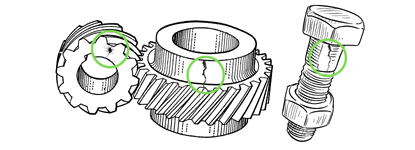
- Cracks
- Scratches
- Dents
- Corrosion
- Paint issues
- Bumps
- Moist/wet
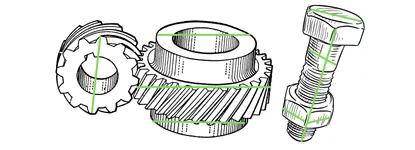
- Wrong shape
- Wrong size
- Fitment area check
- Specific malfunction
- Symmetry against design
- Position
- Connection with other parts
- Product sequence
- Alignment readiness
- Missing patterns and components
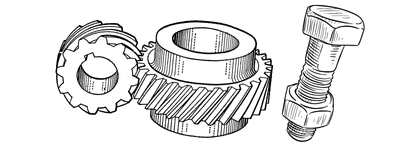
- Printing anomaly
- Packaging anomaly
- Faded labelling
- QR codes
- Product safety
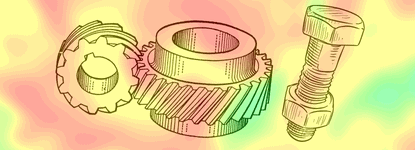
- Overheating
- Leaks
- Insulation gaps
- Temperature issues
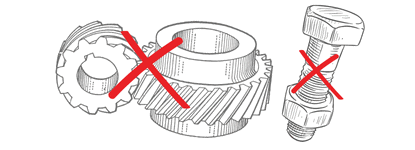
- Slight variation in shade
- Inconsistent surface texture
- Edge quality
- Outline symmetry
- Sharpness symmetry
- Product finishing
Machine Vision Defect Detection Systems
We Safeguard

- Steel
- Aluminium
- Copper
- Alloys

- Thermoplastics
- Polymers
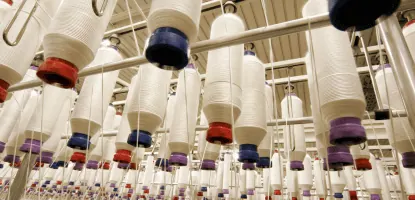
- Woven
- Non-woven
- Composite fabrics
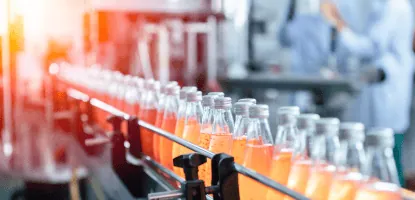
- For lenses
- Tiles
- Tab equipment
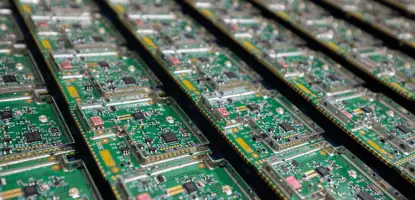
- Shorts
- Missing components
- Soldering defects
Custom AI Defect Detection Solution for Your Product
We have ready models already deployed in various manufacturing units in Australia and India, but we understand NO TWO PRODUCTS ARE IDENTICAL. If your product falls into a niche category and has some specific requirement related to quality compliance, we can build a customized AI defect detection solution for you.
Let's say, for example, Factory A manufactures chocolate and Factory B manufactures Medicines; both factories have different lighting, camera angles, assembly line speed, positioning, security measures, types of workers, and quality compliance. The standard systems installed at factory A cannot cater to the needs of defect detection in factory B because of their own laws and quality control measures, which is why for each instalment we take a deep dive in the consultation and understanding the characteristics of the assembly line and the product to train the machine learning and vision models to achieve high accuracy.

Various Types of Visual Data
The success of any AI system depends upon its adaptability to existing factory devices rather than procuring more hardware and computer vision devices, which disturbs the cost of the project. Our system is built to seamlessly integrate with your existing visual data systems, which means you don't need to overhaul your current infrastructure.
Ideal for high resolution inspection or to check the minute details like scratches, breaks, or oil spills on the product.
Ideal for analysing heat-related problems like insulation issues, overheating, burnt items, spillage, chemical leaks etc.
Ideal in semiconductor, precision electronics, and medical device manufacturing.
Ideal for detecting non-visible defects.
Ideal for mobile inspections in hard-to-reach areas.
Defect Detection
We take a deep dive in the client’s product specifications, assembly lines, factory setup, defect detection requirements, and safety laws. This phase finalizes the iProgrammers scope, tech stack, performance metrics, integrations needed, and workflow.
We collect the data in the form of videos, images to train the machine to identify the defective or OK products. The accuracy of the AI model is only as good as the quality of the data it’s trained on.
Then, we develop AI and ML model designed specifically for your product. Depending on the complexity, we may use convolutional neural networks (CNNs), anomaly detection models to create a high-precision AI system.
We create a small and similar test-model that runs in your real-world factory conditions. The performance is validated according to your requirements, and we make sure it is adhered to detect subtle and minute defects in your products.
Once the system is ready, we integrate it with your assembly line. We try to integrate your system with your existing systems so that no additional cost is incurred. We also enable real-time monitoring dashboards and automated alerts.
By integrating feedback mechanism, the AI system can learn from new types of defects or new product specifications. This versatility is especially important in dynamic industrial contexts, where product designs and materials change often.
Computer Vision - The HERO in AI Detection
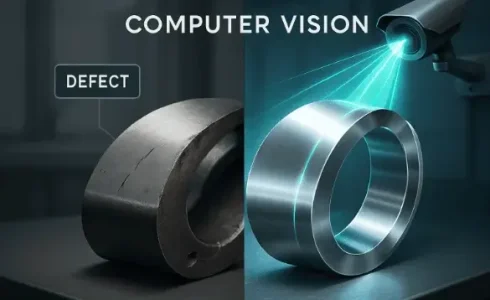
This is the part where automation meets intelligence! Unlike machine vision which only captures real-time images and sends the data to the dashboard in fixed patterns, computer vision understands the data and uses deep learning for more perfection. Based on a constant learning module with more and more variation in the images, more products the system becomes smarter, faster, and more accurate. The computer vision system operates 24/7 without any human intervention and adapts quickly to new products or designs. In the world of AI defect detection, computer vision isn’t just a component—it’s the hero that never blinks. It empowers manufacturers to make data-driven decisions, shorten time-to-market, and meet the rising demand for flawless products in competitive markets.
Why iProgrammer for
AI Defect Detection?
We know no two products are the same, that's why we develop different solutions for different products if the specific requirement is to be met. We dive into your factory structure, product specification, and product nature and develop a solution that exactly matches your needs.
We have a deep knowledge of the manufacturing ecosystem in Australia. We build solutions that allign with the local compliance, and with an implementation team in India as well as Australia we provide support wherever needed.
With a team of more than 50 AI developers in India as well as Australia, we can quickly transform your MVPs into high quality AI applications. With a decade of experience in manufacturing and working closely with the Fortune India 500 brands, our AI developers have a deep understanding in the nuances of defect patterns.
iProgrammer doesn't only detects defects, it also gives you better insights for decision making. We create intuitive dashboards with real-time data, which can be customized as per your inventory management procedures.
- Low Labour Cost
- Less Manual Intervention
- Superior Product Quality
- Competitive Advantage
- Scalable
- Reducing Waste
- Proper Material Management
