Headcount Systems Explained:
How AI and Computer Vision Deliver Real-Time Accuracy
- Aug 28, 2025
- What is a Headcount System?
- Why Accurate Head counting Matters Across Industries
- Key Features of an Effective Headcount System
- The Technology Behind Modern (AI ) Headcount Systems
- Headcount Systems in Emergency Scenarios
- Headcount Systems for Workforce & Resource Planning
- Challenges in Deploying Headcount Systems
- Privacy and Compliance in AI Headcount Systems
- The Future of AI Headcount Systems
- Cost-Benefit Analysis of AI Headcount Systems
- Choosing the Right Headcount System Partner
- Conclusion
- Trusted AI Partner for Headcount Systems
For any organization—be it a global enterprise, a busy airport, or a stadium hosting tens of thousands—the question of “how many people are here right now?” is far from trivial. It’s a matter of safety, compliance, and efficiency. From having an accurate headcount of all workers in case of an emergency to controlling traffic flow during high-traffic hours, the precise headcount has become core to modern operations.
This is precisely the role of a Headcount System. In short, it counts and keeps track of the number of individuals in real time. Manual methods—clickers for security personnel, swipe cards, or old-fashioned books—functioned to some degree but were slow, prone to errors, and could not match the size and complexity of today’s environments. The consequences are huge. In a fire drill, even a momentary miscount can slow down evacuation; in factories, a faulty headcount can exceed safety parameters; in event spaces, bad crowd data can result in bottlenecks and safety risks.
AI-powered headcount systems are solving these challenges. By combining computer vision, intelligent algorithms, and automated reporting, they give organizations fast, precise insights—transforming head counting from guesswork into reliable intelligence. In this blog, we’ll explore what headcount systems are, how they work, and why AI is redefining accuracy and trust.
A headcount system is a tool to understanding how many individuals are at a specific place at a specific time. It sounds simple, but implementation makes all the difference. In offices, schools, factories, airports, or stadiums, it’s not merely about numbers—it is about complying, being safe, handling resources, and being in control of overall operations.
Traditionally, companies used manual means to monitor headcount. Security personnel may employ hand-held clickers at gates, HR professionals used paper records of attendance, or employees waved their cards across access control systems. In restricted areas, the systems had a function, but they had some limitations:
- Human error – Manual counting is easily misreported or duplicated.
- Delays in reporting – Tallying and reconciling data usually occurs after the event, not in real-time.
- Limited accuracy in dynamic spaces – Turnstiles or access cards monitor entries, but they can’t always verify that a person remains within the premises or has left.
- Scalability challenges – What is effective for a single office falls apart with multi-location facilities or large events.
These discrepancies become essential in high-stakes situations. Consider attempting to verify that all workers have evacuated a factory safely following an alarm or being certain that a stadium has reached its safe capacity during a match. In both cases, depending on manual or outdated systems can create unnecessary risk.
Using computer vision and intelligent automation, contemporary platforms can accurately count people—separating people from objects, removing errors, and delivering updates in real time.
The real value of a headcount system extends well beyond knowing the number. An error can have serious consequences—monetary, compliance, or even human.
Manufacturing and Warehousing
The stakes are high within manufacturing environments. Headcount data aid managers in planning shifts to make effective plans, avoiding overstaffing and understaffing, and adhering to safety limitations on factory floors. For warehouses, in-time visibility ensures operations remain not only efficient, but safe, reducing downtime due to surprise crowding and under-staffing.
Workplace Compliance and Safety
In offices, factories, and large complexes, organizations are mandated by law to have safe levels of occupancy and report employees in case of emergencies. Fire drills and evacuation procedures, for instance, are based on correct headcounts. However, research indicates that manual processes may overcount or undercount headcounts by 18–40%, leaving organizations vulnerable to compliance breaches. In a genuine emergency, that error margin might translate to unaccounted lives.
Smart Buildings and Campuses
Today’s buildings face considerable pressure to save energy and increase sustainability. Facilities can dynamically optimize lighting, heat, and cooling by having real-time occupancy data. A recent market report discovered that smart occupancy monitoring in buildings saves energy costs of up to 30% per year. Accurate headcounting, therefore, isn’t just about compliance—it’s also about reducing waste and assisting in meeting sustainability goals.
These emergency headcount systems are critical in crisis situations—fire, gas leaks, or security threats.
Not all headcount solutions are created equal. The systems that truly deliver value share a set of defining features.
Real-Time Visibility
The one key characteristic of a modern headcount system is real-time visibility. Rather than waiting for an end-of-day report or depending on delayed access logs, managers can immediately view how many individuals are in a location at the instant. That immediacy facilitates quicker decision-making—anything from opening secondary points of entry at an event to setting off alarms when a workplace reaches its capacity for safety.
Integration with Access Control and Emergency Response
A successful headcount system is only worthwhile when it is not used in isolation. Synchronization with implemented access control systems, fire alarms, and emergency response strategies guarantees that compliance and safety protocols are entirely synchronized.
Scalability for Multi-Location Enterprises
Businesses do not often operate from one building. Scalability across offices, campuses, warehouses, or even global locations is thus critical. A well-crafted system provides central control, providing decision-makers with both local detail and a worldwide perspective. This scalability carries directly over into consistency, maintaining safety standards and occupancy procedures as the same on all locations.
Data Analytics for Workforce Trends
Beyond counting, effective systems act as intelligence hubs. They create historical information that can uncover trends—when spaces are most occupied, how long rooms are utilized, or if a given shift is routinely overstaffed. This information helps with more effective workforce planning, enabling organizations to eliminate inefficiencies and allocate resources more efficiently.
Mobile Dashboards and Alerts
Important decisions are rarely made behind a desk. Mobile-enabled dashboards enable facility managers and safety officers to access real-time headcount data anywhere, anytime. Automated alerts and push notifications provide yet another level of responsiveness that lets leaders respond prior to escalation.
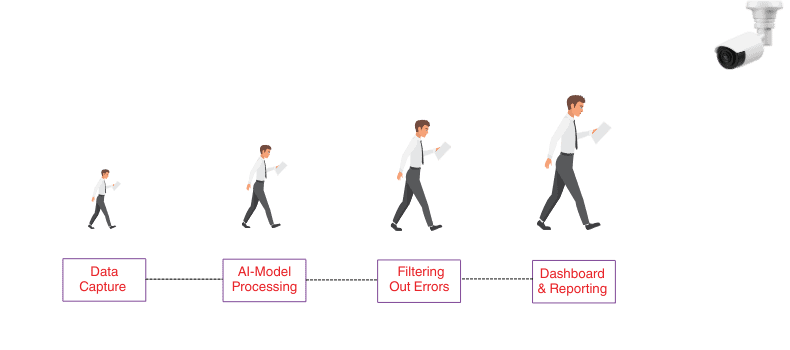
The jump from labour-intensive headcounting to today’s smart platforms is driven by three technologies combined: AI, computer vision, and IoT. They collaborate to convert what was once an imprecise, after-the-fact process into an actual real-time stream of actionable intelligence. To understand how the systems provide real-time accuracy, it is important to look at the workflow sequentially.
1. Data Capture
The flow starts with data gathered from cameras, sensors, or installed CCTV hardware. In contrast to old-fashioned turnstiles or access cards that can merely monitor the entries, current systems record a stream of information on who is entering a space—without interfering with the natural flow of people.
2. AI Model Processing
The raw video is then run through AI software developed on the foundation of computer vision. These models learn to recognize human forms, detect motion patterns, and separate individuals even in difficult situations like low light or dense spaces. Crucially, they don’t merely count heads—they read context. For example, they can detect group movement versus individual entries, ensuring accuracy that static systems can’t achieve.
3. Filtering Out Errors
A common challenge with older monitoring systems was false counts—confusing objects, reflections, or repeated entries for people. AI-based platforms overcome this by filtering data in real time, removing duplicates, and discriminating humans from objects. This kind of accuracy is a considerable upgrade from the usual methods, in which the error rate could go as high as 10–20%.
4. Dashboard and Reporting
Lastly, processed data streams into a smart dashboard. Safety personnel, facility administrators, or event coordinators can see occupancy in real-time, generate automated reports, and even receive notifications when occupancy occurs. Numerous systems integrate with mobile devices, providing critical information at their fingertips.
Headcount Systems in Emergency Scenarios
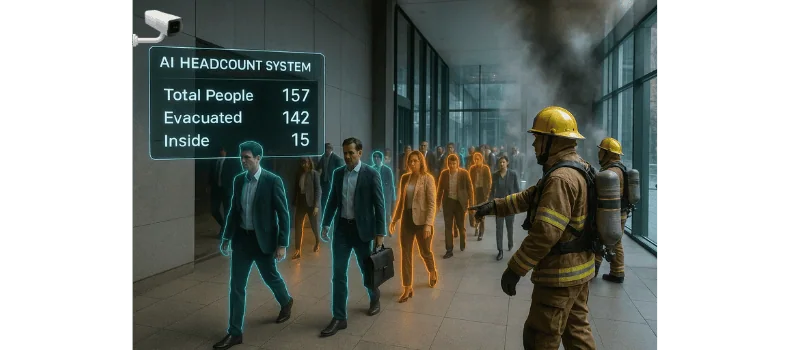
Emergencies are the ultimate proving ground for any organization’s readiness. In times of crisis—be it a fire, smoke incident, chemical spill, or security breach, leaders need to know one fundamental question: “Is everyone accounted for?” This is where emergency headcount systems come into play.
Conventional evacuation processes tend to use manual roll calls, clipboards, or turnstiles data. Although these methods may suffice in small environments, they prove inadequate under genuine pressure. Employees may exit through unmonitored doors, access cards will not track an exodus, and manual head counts are slow and inaccurate. To the contrary, several post-incident analyses at industrial plants and office towers have found inconsistencies between headcounts reported and individuals on site—delays that can lose valuable minutes when seconds count.
AI-powered emergency headcount systems change this equation. By integrating data in real time from cameras, sensors, and access points, they provide safety officers with a real-time, up-to-date understanding of who is still inside and where they were last seen. Rather than reconciling paper rosters or old logs, managers can open a dashboard and instantly see if evacuation is finished. This ability shortens response times and makes sure rescue teams can be directed exactly, concentrating their efforts where individuals are most likely to be.
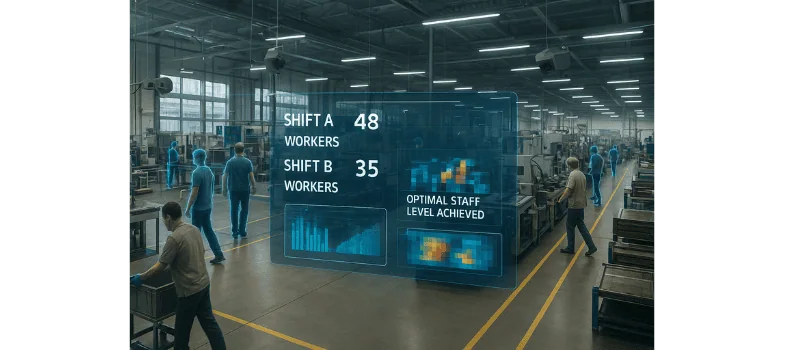
While safety and compliance are often the first reasons organizations adopt a headcount system, the value of accurate people data extends much further. One of the most impactful applications lies in workforce and resource planning. Tools such as headcount planning software and headcount management software collect data to identify number of people and their time and location.
Predicting Staffing Needs
Occupancy trends reflect demand fluctuations over the course of the day, week, or month. For example, a retail chain will find that traffic is greatest on weekends between 2–6 PM. With this knowledge, managers can assign more staff precisely during those hours, providing better service without unnecessarily paying for labour during slow periods.
Optimizing Schedules
Precise headcounting also assists in planning shifts more effectively. In an industrial factory, knowing workers’ movement between several shifts ensures that the production lines are never undermanned—or on the other hand, not wasted on unnecessary staffing. By coordinating headcount information with scheduling, organizations can operate leaner without sacrificing output or security.
Avoiding Overstaffing or Understaffing
Overstaffing drives up costs, while understaffing can cause burnout, ineffectiveness, or compliance issues. A headcount system, reporting into management software, gets it just right by giving decision-makers a data-driven picture of real requirements. This eliminates guesswork and makes workforce planning a forward-looking activity instead of one that is driven by events.
As with any enterprise technology, implementing a headcount system has its own unique set of issues.
Privacy and Data Security
The question most asked centres on privacy. Given that headcount systems tend to use cameras and sensors, staff will be concerned with being constantly watched. Top solutions, though, are designed to centre on counts, not faces. Instead of tracking people, the technology uses responsible AI models that anonymize information and comply with privacy standards such as GDPR. This enables organizations to gain real-time visibility without violating personal privacy.
Integration with Legacy Systems
Companies tend to use legacy access control or HR systems that are not AI-platform compatible. This can bring about compatibility concerns. Contemporary headcount systems, however, are designed to be flexible. They can integrate easily with current infrastructure via APIs and adaptable integrations—making deployment much less invasive than most expect.
Privacy and Compliance in AI Headcount Systems
AI-powered headcount systems are only effective when they protect both people’s safety and their trust. Modern solutions embed privacy and compliance as core principles:
- Privacy by Design – Systems are built to count without identifying. Computer vision models detect occupancy and movement while anonymizing data, ensuring individuals are never personally tracked.
- Regulatory Alignment – Compliance with standards like GDPR, HIPAA, and ISO ensures organizations meet global data protection requirements across offices, factories, or public venues.
- Automated Audit Trails – Instead of manual logs, headcount systems generate real-time occupancy records, evacuation confirmations, and compliance reports that are audit-ready on demand.
- Workforce Confidence – Employees and visitors know monitoring is for safety, not surveillance. This transparency builds trust and encourages adoption.
- Governance Advantage – By embedding privacy safeguards and compliance automation, enterprises not only mitigate risk but also demonstrate accountability to regulators, employees, and stakeholders.
The evolution of headcount systems is still in its early chapters. What began life as a simple compliance aid is now quickly becoming the bedrock of smart enterprise operations—and the rate of innovation is only speeding up.
One of the strongest trends is Edge AI, in which information is handled locally instead of exclusively on cloud servers. This will cut down on latency, enhance privacy, and make real-time counts uninterrupted even if connectivity is lost. For densely trafficked venues such as airports, stadiums, or large campuses, edge-enabled systems will be a must.
Integration with smart city projects is another coming frontier. As cities invest in smart infrastructure, AI-powered headcount systems will be involved in traffic flow management, public safety, and energy optimization on a citywide level.
Predictive modelling is another promising trend. By looking at past occupancy patterns, headcount systems will be soon able to predict crowd buildup ahead of time—whether on a factory floor shift change, commuter station, or festival ground. Predictive power turns headcounting from reactive observation into proactive management.
Lastly, closer integration with HR systems and compliance software will make workforce control more streamlined. Imagine a single platform that not only monitors occupancy in real-time but also automatically updates HR attendance, payroll, and compliance records for safety without the need for manual intervention.
Cost-Benefit Analysis of AI Headcount Systems
Initial Costs
- Infrastructure setup (cameras, sensors, IoT devices)
- Integration with legacy HR or access control systems
- Training & change management
Tangible Benefits
- Safety & Compliance → Faster evacuations, reduced liability, stronger audit scores
- Operational Efficiency → 10–20% savings from optimized workforce planning, less overtime, smoother scheduling
- Energy & Resource Savings → Smart occupancy monitoring reduces energy costs by up to 30%
- Scalability → Multi-site visibility prevents duplication of systems and staff
- Reputation & Trust → Safer environments enhance brand credibility with employees, visitors, and regulators
Net Impact
Most enterprises recover their investment within 12–24 months, with ongoing savings and risk reduction far outweighing initial costs.
Choosing the Right Headcount System Partner
Picking a headcount system is like selecting a partner who can provide accuracy, flexibility, and long-term value. Decision-makers need to find:
- Proven AI & Computer Vision Expertise: Precise headcounting involves sophisticated models that learn to work in changing environments, light levels, and crowd behaviours.
- Strong Integration Capabilities: The platform must integrate flawlessly with access control, HR software, and emergency response systems to deliver the most value without business disruption.
- Scalability & Enterprise-Grade Support: From single-site installations to multi-location deployments, the partner needs to accommodate growth while meeting reliability and security at all levels.
- Consultative, Client-Centric Approach: More than technical implementation, the ideal partner assists organizations in developing adoption plans that harmonize innovation with pragmatism.
Conclusion
Computer vision and AI have turned headcounting from a laborious, human-oriented task into a smart, efficient system with the ability to offer real-time insight, predictive analytics, and easy integration into business workflows. Whether it’s planning emergency evacuations, optimizing workforce planning, or enhancing visitor experience, the effect is real.
The takeaway is clear: adopting a future-proof headcount system is not a choice. It is an investment in safety, efficiency, and operational excellence that will shape the way organizations grow in the years to come.
iProgrammer is a reliable partner for businesses seeking to leverage the potential of AI, computer vision, and intelligent automation. With extensive experience in developing and implementing headcount systems that merge real-time visibility with enterprise-level integration, we enable companies to make people safety and operations efficiency a tangible reality.
As part of our broader AI Safety & Security Solutions, our headcount system is designed to scale—from standalone facilities to multi-site businesses—and is architected with responsible AI practices for protecting privacy, accuracy, and compliance. By combining technical excellence with a collaborative strategy, we provide solutions that not only resolve today’s issues but also foresee tomorrow’s requirements.