Live RAG Model Building for FinTech: What Decision-Makers Can Learn from the 2025 GenAI Meetup
- Sep 16, 2025
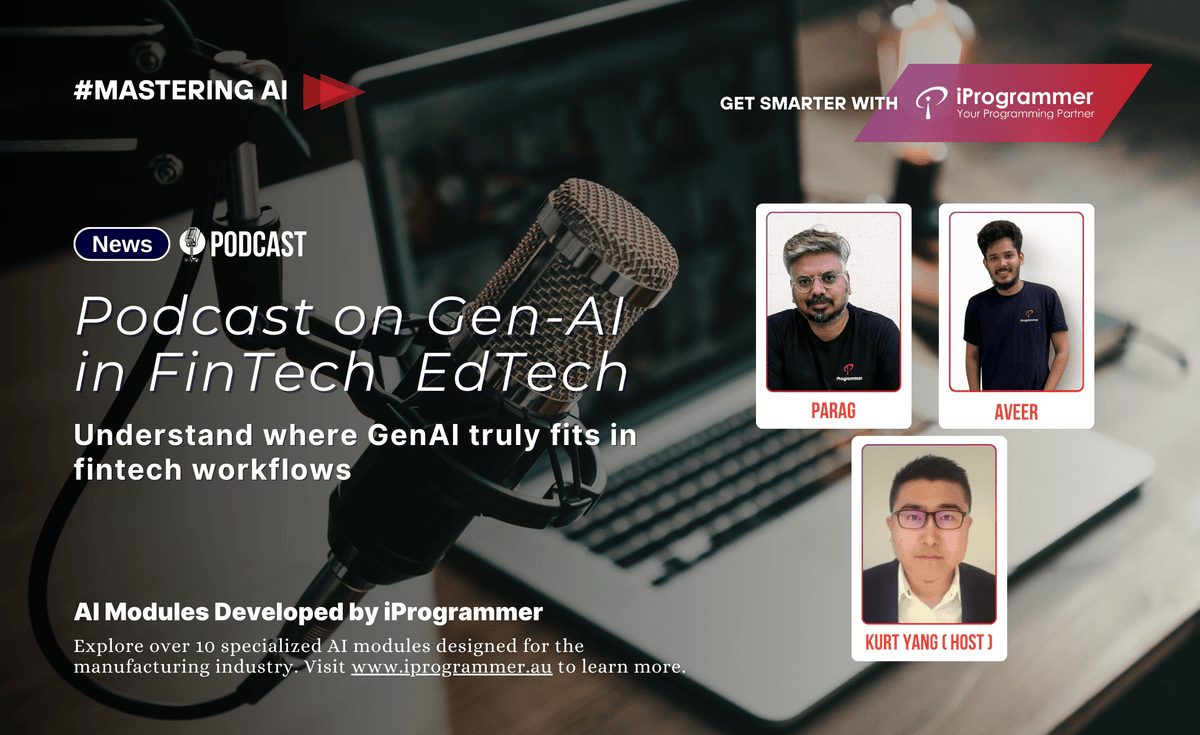
When it comes to financial technology, timing is everything. The pace of regulation, the scale of customer expectations, and the complexity of data all converge to create a unique challenge: innovation must not only be fast but also compliant, explainable, and resilient. This is where Retrieval-Augmented Generation (RAG) is quietly beginning to reshape the conversation. Not, not as a futuristic promise, but as a practical enabler of real-world FinTech workflows.
The recent 5th virtual session of the “Gen AI in FinTech & EdTech” meetup brought this shift into focus with a live RAG model demonstration tailored for a FinTech use case, hosted by product leader Kurt Yang. The event was not about hype; it was about clarity — showing founders, product heads, and industry professionals where GenAI fits in financial services, and what separates projects that succeed from those that remain on slides.
Financial services is not a playground for experimentation. The stakes are high: fraud prevention, regulatory compliance, secure transactions, and customer trust. Traditional AI solutions often fell short because they were either too generic or too opaque for regulators. GenAI, when combined with retrieval methods, changes that balance.
Instead of relying solely on large language model training data, RAG anchors outputs in verified internal sources — policies, compliance manuals, transaction histories, or KYC documentation. For leaders in FinTech, this means:
- Audit-ready explainability: every AI-generated answer can be traced back to its source.
- Reduced hallucinations: responses are rooted in actual data, not approximations.
- Operational efficiency: compliance and reporting processes can be reduced by up to 40%, freeing teams to focus on growth.
The message was clear: GenAI is not here to replace decision-making, but to accelerate it responsibly.
The session moved beyond theory into practice, with participants watching a Retrieval-Augmented Generation (RAG) model being set up, queried, and refined in real time. What stood out was not technical complexity but accessibility — the realization that GenAI can be piloted in lightweight, practical ways without multi-million-dollar infrastructure.
The walkthrough emphasized three lessons:
- Readiness matters: Start small with low-cost pilots. Even free GPT tools used for 30 minutes a day can sharpen prompting skills and reveal use cases worth scaling.
- Clarity beats complexity: The demo broke RAG into clear steps — chunking files, generating embeddings, storing them in vector databases, and retrieving answers in context.
- Scale is a choice: The same framework can expand into enterprise-ready setups on Azure or AWS, with orchestration layers deciding when the LLM should pull from databases versus respond directly.
Participants quickly connected these lessons to real-world needs. Several use cases stood out:
- Compliance lookups and regulatory queries
- Customer service automation without retraining full models
- Audit readiness and faster document search
A familiar analogy captured the sentiment well: “AI is today’s Excel” — not a job taker, but a force multiplier for those who learn how to use it.
The interaction itself reinforced this shift. Questions cantered on:
- Regulatory guardrails and audit alignment
- Costs of scaling from pilot to production
- Integration with existing enterprise systems
The engagement was evident: more than forty participants stayed well past the scheduled close, with many requesting a follow-up session focused purely on the technical side of custom RAG models.
The session closed with iProgrammer situating this learning in their own journey — 17 years of delivery, 350 engineers, and 500+ clients worldwide — while inviting participants to collaborate on pilots that start small, scale fast, and stay compliant.
Together, these moments moved the conversation from “what is RAG?” to “how do we make it work in our business context?” — the precise pivot many organizations need to translate interest into impact.
The Voices Behind the Conversation
The event gathered a thoughtful mix of expertise:
- Parag Agrawal, a co-founder and product engineering leader with 15+ years in enterprise AI, emphasized demystifying GenAI and making it accessible to regulated industries. His perspective was particularly relevant for founders wary of compliance bottlenecks.
- Aveer Revankar, with deep experience in machine learning and multi-agent orchestration, spoke to the spectrum of solutions. From lightweight RAG models to advanced automation ecosystems, his message was reassuring not every problem demands a complex system. Sometimes, the simplest model creates the most value.
- Kurt Yang, as host, grounded the discussion in lean product management principles. For startups, his framing was critical: technology decisions should always be tethered to solving tangible customer and operational problems, not chasing trends.
For decision-makers in FinTech, three lessons stood out from the evening:
- Validate before you build – AI projects fail most often because they chase the wrong use case. A readiness checklist and pilot-first approach save both time and credibility.
- Anchor AI in your own data – FinTech demands accuracy and auditability. RAG ensures that AI is not an abstract layer but a grounded tool that learns directly from your environment.
- Think adoption, not just development – The real measure of success is whether your teams and customers embrace the tool. Integration, explainability, and trust are as important as accuracy.
As the FinTech landscape evolves in 2025, the conversation is shifting from “what can GenAI do?” to “what should we do with GenAI, responsibly?” The live demonstration was a reminder that the next wave of AI in financial services is not about spectacle but about substance: compliance-ready insights, scalable workflows, and customer experiences that feel personal without compromising trust.
At iProgrammer, we see this not as a passing trend but as part of a broader movement — where AI becomes an operational partner, not just a technological experiment. The challenge is no longer about whether to adopt GenAI, but about adopting it with foresight, discipline, and clarity. Because in financial services, the winners will not be those who rush first, but those who build responsibly and last longest.