AI Fire & Smoke Detection Reimagined: Multi-Hazard Recognition from a Single Lens
- Aug 20, 2025
- Why Multi-Hazard Awareness Is Now a Safety Imperative
- From Single Threat to Multi-Hazard
- How AI Works in Fire & Smoke Detection
- The Multi-Hazard Recognition Breakthrough
- A Relationship Built on Milestones and Momentum
- Technical Blueprint: Inside a Single-Camera Multi-Hazard System
- Beyond Detection: The Control and Response Layer
- Use Cases Across Industries
- The Role of Web Applications & Dashboards
- Emerging Trends & The Road Ahead For Fire & Smoke Detection
- Conclusion
- About iProgrammer
Every second counts when it comes to fire safety. The National Fire Protection Association (NFPA) estimates a fire doubles in size every 30 seconds, and smoke inhalation is the number one cause of deaths due to fire globally. In high-hazard environments—warehouses, factories, hospitals—those few seconds can represent a controlled event vs. a catastrophic loss.
But for decades, fire monitoring has been a one-trick pony business. A smoke detector might detect smoke, and a thermal imager might pick up heat, but both worked in solitude, without the larger context. Such systems were reactive, and they would often wait until tangible flames or copious amounts of smoke were evident—by which point damage and risk were already escalating.
AI Smoke Detection and AI Fire Detection are revolutionizing that equation today. Using computer vision, thermal imaging, and deep learning, AI-based systems can identify the earliest signs of danger, eliminate false alarms, and send alerts in seconds. And now, the boundary has moved again—towards multi-hazard detection, where a single smart camera can sense not only fire and smoke, but also gas leaks, chemical spills, and even intrusions in real-time.
The global risk environment has moved beyond conventional fire monitoring. Urbanization, industry, and energy consumption growth have increased fire frequencies and complexities of danger. What used to be a single warehouse blaze now can involve poisonous vapours from plastics, combustible vapours from chemicals, or electrical overloads due to machinery automation—all at once.
These scenarios are no longer rare. International safety data shows over 40% of industrial fires in the past five years came with at least one secondary hazard, from gas leaks to chemical releases. Every additional risk mounts the peril, overloading human responders and hampering timely action.
The financial and regulatory risks are escalating as well. Insurers are restricting risk models, while regulators require greater compliance—particularly in manufacturing, logistics, energy, and public infrastructure.
In that kind of environment, fire detection can’t be an afterthought—it has to be intelligent, unbroken, and able to identify multiple hazards in real time. AI-powered solutions are not a bolt-on anymore; they’re a strategic protection against the loss of business, reputational harm, and regulatory exposure.

Fire detection equipment has evolved from the first battery-powered smoke alarm of the mid-20th century. The original devices were only able to detect visible particulate smoke, tending to activate late during a fire. Later, technology introduced monitored smoke detectors—interconnected systems tied to control panels and the emergency system, facilitating quicker response and centralized monitoring.
The next giant step was taken with specialized cameras and sensors. Heat detectors would sense sudden rises in temperature, and flame detectors detected special wavelengths of radiation that burning objects emitted. But even these were one-purpose devices, each detecting only a specific range of hazards. In emergency situations—where fire, smoke, leakage of gas, or chemical spill could occur together, these single-purpose systems often created dangerous blind spots.
AI entered the fire safety domain as a unifying force. Using computer vision, cameras could visually confirm flames; with thermal imaging, they could spot heat sources invisible to the human eye; and with sensor fusion, they could integrate data from multiple devices for faster, more accurate detection.
But the demands of modern industry have pushed even further. Companies today demand solutions that not only identify AI Fire Detection and AI Smoke Detection threats with accuracy but also identify and rate multiple threats in real time. Single-threat detection has given way to all-encompassing, multi-hazard capability—no longer an innovation but a business and safety imperative, guaranteeing continuity of operations and safeguarding people and assets.
How AI Works in Fire & Smoke Detection

AI Fire Detection begins with computer vision—the ability of algorithms to interpret and analyse visual data from cameras in real time. Current systems are trained with enormous databases of flame forms recorded under different lighting, directions, and distances. Recognizing the unique flicker frequency, colour range, and movement dynamics of fire, these systems identify ignition points in just a few seconds even in big or complicated spaces.
AI Smoke Detection adds another layer of protection. In contrast to traditional optical sensors in a monitored smoke detector, AI systems visually monitor smoke plumes, examining density, dispersion rate, and direction of movement. This entails that they can recognize dangerous smoke prior to visible flames, gaining valuable time to respond—particularly important in situations where smouldering materials emit harmful fumes long before they ignite.
Thermal and infrared imaging also add precision. Detecting minute temperature changes, these systems can identify overheated machinery, chemical reactions, or hotspots concealed within walls. Coupled with visual information, they enable early alerts that are more trustworthy than any singular detection technique in isolation.
The foundation of these capabilities is deep learning. Neural networks not just learn to identify actual hazards but also to exclude false alarms—differentiating between the smoke of an industrial process and actual smoke, or between sunlight glare and genuine fire. This significantly minimizes nuisance alarms, which can otherwise cause “alert fatigue” and delayed emergency responses.
By integrating visual, thermal, and algorithmic intelligence, AI converts what was once reactive detection into proactive hazard detection. It guarantees that the instant a hazard arises—whether seen or unseen. The right individuals and systems are notified immediately for swift, concerted action.
For years, hazard detection systems have run in isolation—one appliance for smoke, a second for gas leaks, a third for perimeter intrusion. It sounds sensible on paper, but the reality is that it generates blind spots, latency, and increased operational expense. A fire alarm may go off, but a concurrent gas leak may not be detected until it’s too late.
Today, AI-driven multi-hazard detection changes that. With the help of multimodal models, hardware that is fed by visual cameras, thermal imagers, and chemical detectors can identify and classify multiple threats in real-time from a single stream of data.
This jump in ability makes sense when contrasting traditional and AI-driven methods:
| Feature/Capability | Traditional Fire & Smoke Systems | AI Fire Detection & AI Smoke Detection | Multi-Hazard AI in a Single Camera |
| Hazards | Detected Fire or smoke only | Fire and smoke | Fire, smoke, gas leaks, chemical spills, intrusions |
| Detection Speed | 30–60 seconds after ignition | 5–10 seconds after hazard onset | 1–5 seconds, predictive alerts before escalation |
| False Alarm Rate | High (steam, dust trigger alarms) | Low (AI filters visual noise) | Very low (cross-validates visual, thermal, and chemical data) |
| Integration with Control Systems | Limited | Moderate | Full automation — suppression, ventilation, evacuation |
| Data Insights | None | Incident logs | Predictive analytics and hazard probability scoring |
| Hardware Requirements | Multiple sensors for multiple hazards | Cameras + some sensors | Single AI-enabled camera with optional sensor add-ons |
| Operational Cost | High (multiple devices, maintenance) | Moderate | Lower (one device, multi-tasking capability) |
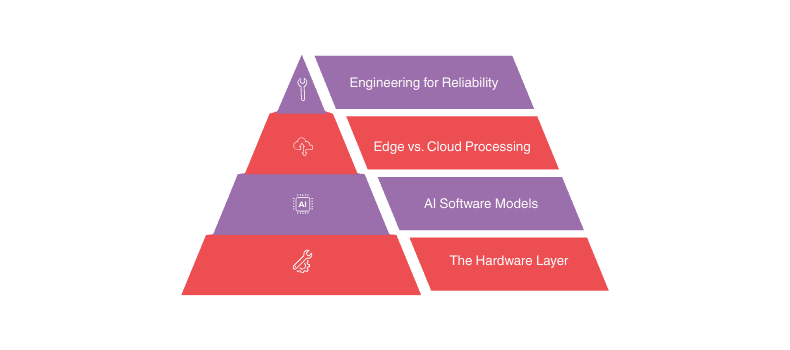
One AI-powered camera that detects fire, smoke, gas leaks, and intrusions may sound like science fiction—but it’s built on real advances in hardware, AI modelling, and real-time processing. Its power lies in what’s inside.
1. The Hardware Layer: Precision in Every Frame
At its core is an industrial- grade camera that can operate around the clock in harsh conditions.
- Resolution: High-definition (commonly 4K or higher) to register fine visual details like slight flame flickers or minute wisps of smoke.
- Thermal Capability: Integrated infrared sensors to see heat signatures undetectable to the human eye—vital to identify overheating equipment before it ignites.
- Environmental Tolerance: IP66/IP67-rated enclosure against dust, water, and extreme temperature tolerance, ensuring 24/7 operation in warehouses, factories, or external sites.
2. AI Software Models: Multimodal Intelligence
A multi-hazard system employs several forms of AI models executed concurrently:
- Object Detection: Identifies hazard-specified shapes and patterns—flames, smoke plumes, intruders.
- Anomaly Detection: Points out unusual conditions like inexplicable temperature spikes or strange vapour density.
- Image Segmentation: Splits each frame pixel by pixel to ensure precise isolation of threats from background noise.
This eliminates false positives while enabling context-dependent rapid decisions.
3. Edge vs. Cloud Processing: The Latency Advantage
For sub-second alerting, the system will typically process data on the edge—right on the camera or an adjacent edge gateway.
- Edge Processing: Unparalleled ultra-low latency, no reliance on internet connectivity, and enhanced privacy since sensitive video remains onsite.
- Cloud Processing: Best for huge-scale analysis, overall monitoring, and model retraining, but a bit slower.
Most deployments adopt a hybrid method—mission-critical alerts processed at the edge, extended analysis in the cloud.
4. Engineering for Reliability: Why Expertise Matters
The effectiveness of a multi-hazard camera does not rest in hardware specifications, but in the training, calibration, and integration of its AI models. Computer vision, multimodal sensor fusion, and industry-specific hazard profiles expertise are necessary to maintain accuracy under real-world conditions.
Advanced multi-hazard AI solutions are more than just alarm-calling systems. They orchestrate a synchronized, near-instant response that can significantly mitigate destruction and preserve human life. This “control layer” fills the gap between hazard detection and automatic and manual intervention so that each second between detection and response is maximized.
A fire control and detection system based on AI is directly integrated with Building Management Systems (BMS), industrial safety controllers, or emergency response systems. After an AI model verifies a threat—fire, smoke, gas leak, or intrusion—it can immediately initiate pre-defined safety responses without awaiting human verification.
Automated suppression mechanisms can include:
- Sprinkler activation in the affected zone.
- Deployment of chemical fire suppressants in sensitive environments such as data centres or laboratories.
- Ventilation and exhaust fans for spreading smoke or toxic gases.
Apart from machine-initiated actions, these systems are designed to operate in conjunction with human crews. On-the-ground staff receive real-time alerts on mobile and web-based dashboards, control room monitors, and even smartwatches of on-ground responders. Alerts come with accurate hazard location, type, severity, and suggested response protocols, allowing safety personnel to make quick decisions.
This avoids any time loss. While the AI takes care of the initial containment, human teams concentrate on evacuation, manual firefighting, or technical repairs.
Multi-hazard AI solutions are architected to scale across industries with distinct risk profiles, operating limitations, and infrastructure needs. With a single smart platform, they bring measurable safety gains and quantifiable ROI increases.
Manufacturing Plants
Where there’s hot equipment, welding procedures, or flammable materials, a small spark can expand into a considerable danger. AI-powered video analytics can identify sparks, smoke plumes, or abnormal heat signatures in real time, which can initiate autonomous shutdowns or fire suppression. Chemical processing facilities are complemented by integrated gas leak detection—preventing toxic exposure or explosion hazards before they happen. The outcome: fewer production shutdowns, lower insurance rates, and better protection of workers.
Warehousing & Logistics
Extensive storage spaces are challenging to monitor with traditional systems because they are large and frequently rearranged. Multi-hazard detection based on AI spans the broad space with fewer devices by utilizing camera-based sensing, IoT sensors, and embedded intrusion alarms. Not only does it avoid loss of inventory due to fire but also protects goods against theft or sabotage. Quick response times reduce operating disruption, having a direct effect on bottom-line performance.
Oil & Gas
AI technologies here combine infrared flame detection, gas concentration sensors, and pressure monitoring into one decision-making layer. The platform senses both visible and concealed dangers, like methane leaks, and can close isolation valves or trigger safe evacuation procedures immediately. Such an integrated strategy greatly minimizes environmental liabilities and regulatory fines.
Smart Cities
When installed as part of urban infrastructure, multi-hazard AI networks connect straight to public safety command centres. Street cameras, environmental sensors, and fire detection devices exchange live intelligence, allowing a city to respond more quickly to fires in public buildings, underground structures, or transportation nodes. The same infrastructure can identify crowd irregularities, traffic accidents, or toxic air quality—maximizing the value of public investment.
The Role of Web Applications & Dashboards
While AI-driven detection systems are the “eyes and ears” of contemporary fire protection, web applications serve as the command centre—centralizing real-time data, historical trends, and actionable controls into a single secure interface.
Dashboards aggregate threat information from several locations, providing safety managers with a consistent, real-time picture across locations. A facility manager, for instance, can view camera streams, thermal images, and smoke detection from warehouses in various cities—all from one browser window.
Advanced development provides alert threshold customizable by user, map-based incident display, and integration with access control or suppression systems. Under multi-hazard scenarios, fire, smoke, gas leak, and intrusion alerts are shown in parallel, facilitating quicker, more informed decisions.
In addition to monitoring, these platforms provide remote control, initiating suppression systems, turning off equipment, or venting immediately. They also enable automated reporting and compliance, delivering audit-ready records of incident, response, and system tests.
Wherever they are installed, the combination of AI-driven detection with simple-to-use dashboards enables immediate response, coordination, and full compliance with safety regulations.
Emerging Trends & The Road Ahead For Fire & Smoke Detection
AI-powered hazard detection is changing fast, fuelled by data science, computer hardware advancements, and growing regulatory recognition of its life-saving potential. Several trends are transforming multi-hazard recognition systems—and rewriting the rules for how organizations deal with safety.
A major leap is AI model training with synthetic data. Rare but high-impact hazards—such as chemical vapour ignition or simultaneous multi-point fires—are difficult to capture in real-world datasets. Synthetic data allows AI models to “learn” from thousands of simulated scenarios, improving accuracy on edge cases that existing systems may miss.
Hardware is being enabled by sensor miniaturization and low power consumption for high-sensitivity detection within small, battery-driven devices. This enables broader deployment in remote, temporary, or infrastructure-scarce locations.
Predictive safety analytics are driving the shift from reactive to proactive safety. Through the combination of past events, environmental factors, and operational data, AI can generate hazard probability scores—supporting action prior to threats unfolding.
Interoperability is also critical. Compatibility with IoT and intelligent building systems facilitates hazard detection to trigger adaptive responses from HVAC, lighting, access control, and emergency communications.
Tracking and responding to multiple risks using one AI-enabled camera is no longer a luxury—it’s a necessity. By consolidating fire, smoke, gas leak, intrusion, and other detection features into a single platform, organizations now have an always-available safety net that is faster, smarter, and cheaper than single-purpose configurations.
AI’s speed and precision mean threats are caught at the earliest moment—often before human observation or standard alarms could react. The impact is clear: fewer false positives, faster interventions, reduced losses, and stronger compliance. To realize this potential, partnering with a trusted AI development company like iProgrammer ensures solutions that are both accurate and enterprise-ready.
iProgrammer, a leading AI development company, combines expertise in AI model development, computer vision, and enterprise integration. Its solutions deliver proven reliability—whether in demanding industrial environments or high-traffic commercial spaces.
Our track record includes delivering advanced hazard detection platforms for manufacturing plants, logistics hubs, oil & gas facilities, and smart city infrastructures—combining edge intelligence with centralized monitoring to deliver actionable insights in real time. Every solution is tailored, from camera hardware optimization to cloud and on-premise integration, ensuring seamless fit with your existing infrastructure.
For organizations ready to elevate safety to a predictive, multi-layered standard, iProgrammer offers more than technology—we offer a partnership built on trust, precision, and proven results. Speak to our team to explore a custom consultation or schedule a live demo of our AI-powered safety solutions.