AI Governance in Australia: A Complete Guide on Regulations, Policies, Law and Principles
- Mar 25, 2026
- Why AI Governance Is Becoming Central to Business Strategy
- The Current State of Australia AI Regulation
- Key Laws Governing AI in Australia
- Australia’s AI Ethics Principles
- National AI Policy in Australia
- AI Technical Standards in Australia
- How AI Regulation in Australia Compares Globally
- Emerging Trends in Government Regulation of AI
- Practical Challenges in Implementing AI Governance
- A Practical Framework for AI Compliance
- The Role of Ethical AI in Business Growth
- Industry-Specific Implications of AI Regulation
- What Businesses Often Get Wrong
- The Future of AI Regulation in Australia
- Conclusion
- About iProgrammer Solutions

A product team ships an AI feature after months of work. It works well in testing. Early users respond positively. Then a question comes from a client’s legal team. How is the model trained. What data is used. Can decisions be explained. Who is accountable if something goes wrong.
That is where most AI conversations are heading now.
Not toward capability, but toward responsibility.
In all industries, leaders are no longer discussing whether AI can be utilized to enhance things. They are instead discussing whether AI can be trusted, audited, and made compliant with regulatory requirements. This shift is clear in Australia. The focus is moving from guidelines to enforceable expectations under Australia AI Regulation.
The challenge is not only legal. It’s operational. Businesses need to ensure that products, data use, and governance are aligned to changing laws. This document provides an overview of the major laws, policies, and standards that are guiding government AI regulation in Australia, including how they all tie into global standards like AI and GDPR.
Why AI Governance Is Becoming Central to Business Strategy
AI has evolved from experimentation to production. It’s used in hiring, credit approval, medical diagnosis, industrial automation, etc. This evolution has led to a widening risk profile.
Three forces are driving the urgency around regulating artificial intelligence:
- Scale of impact: AI decisions can affect thousands of users instantly
- Opacity of models: Many systems lack clear explainability
- Data sensitivity: AI often uses personal data or sensitive data
In Australia, regulators are developing structured approaches to AI regulation rather than a traditional compliance approach. The intent is not to hold up innovation but to ensure accountability, fairness, and safety. For businesses, it means that AI governance is no longer a compliance issue. It is part of product design.
The Current State of Australia AI Regulation
Australia does not have a unified AI law. Instead, it follows a layered system of laws. The laws that exist are applicable to AI systems, and this is further supplemented by national policies and ethics.
This structure includes:
- Privacy and data protection laws
- Consumer protection regulations
- Anti-discrimination laws
- Voluntary and emerging AI-specific laws
Furthermore, discussions regarding the regulation of risky AI systems have commenced. This is a major move toward the stricter regulation of AI systems in key sectors.
This evolving model reflects a balance. It avoids overregulation while preparing for future risks.
Key Laws Governing AI in Australia
1. Privacy Act 1988
The Privacy Act 1988 is the basis for artificial intelligence laws and regulations in Australia. It is applicable to how personal data is collected, stored, and used.
For AI systems, this creates direct obligations:
- Data must be collected with consent or lawful basis
- Usage must align with the original purpose
- Individuals have rights to access and correct their data
AI models based on personal data must follow this principle. It is challenging in cases of large data sets and third-party data.
2. Australian Consumer Law (ACL)
AI-driven products must not mislead users. Under the ACL:
- Claims about AI capabilities must be accurate
- Automated decisions must not deceive users
- Liability for Damages Arising from Defective AI Systems
This includes recommendation systems based on AI technology, finance, and healthcare.
3. Anti-Discrimination Laws
AI systems cannot be biased in their output. Australian law does not allow discrimination based on race, gender, and age.
Organizations must ensure:
- Training data is representative
- Models are tested for bias
- Decisions can be audited
Bias in AI is not just a technical issue. It is a legal risk.
Australia’s AI Ethics Principles

Australia has established a list of AI Ethics Principles. These are not statutory requirements but are largely adopted by various industries.
The Eight Core Principles
| Principle | What It Means in Practice |
|---|---|
| Human, social, and environmental wellbeing | AI should benefit society and avoid harm |
| Human-centered values | Systems must respect human rights |
| Fairness | Outcomes should not discriminate |
| Privacy protection and security | Data must be handled responsibly |
| Reliability and safety | AI systems should perform consistently |
| Transparency and explainability | Decisions should be understandable |
| Contestability | Users should challenge AI decisions |
| Accountability | Clear ownership of AI outcomes |
These principles offer a practical approach to government regulation of AI without imposing strict rules. They are also in line with global standards, making them relevant to global businesses.
Australia has a national strategy on AI, which covers economic growth, innovation, and responsible use of AI. The government has set some priorities:
1. Building AI Capability
Investment is an essential area of focus. It helps in ensuring that the country is at the cutting edge of creating AI.
2. Encouraging Industry Adoption
Programs support businesses in integrating AI into operations. This includes funding, training, and partnerships.
3. Strengthening Governance
Australia is looking into the implementation of risk-based regulation. High-risk AI systems are set to be regulated.
4. International Collaboration
Australia is adopting international frameworks. This is to ensure international businesses have an easier time.
This is an indication of the move toward an Australia AI Regulation without stifling innovation.
Technical standards are critical in ensuring the implementation of AI regulations. This is because they help in translating policy principles into action.
Australia follows international standards, particularly from ISO and IEC.
Key Areas Covered by AI Standards
| Standard Area | Focus |
|---|---|
| Data governance | Quality, integrity, and traceability of data |
| Model transparency | Documentation of algorithms and decisions |
| Risk management | Identifying and mitigating AI risks |
| Security | Protecting AI systems from threats |
| Lifecycle management | Monitoring AI performance over time |
These standards help organizations implement regulating artificial intelligence in a structured way.
They also support audit readiness and compliance with multiple jurisdictions.
How AI Regulation in Australia Compares Globally
Australia’s approach is often compared with the European Union’s AI Act and GDPR.
Key Differences
- EU: Prescriptive, risk-based regulation with strict enforcement
- Australia: Principles-based, evolving toward risk-based models
- US: Sector-specific, less centralized
Connection with GDPR
The concept of AI and gdpr is relevant for Australian businesses dealing with European users.
GDPR introduces strict rules on:
- Data consent
- Automated decision-making
- User rights
Australian companies operating globally must align with both frameworks. This creates a dual compliance challenge that requires careful planning.
Emerging Trends in Government Regulation of AI

There are various trends which are likely to shape the future of AI governance in Australia:
- Risk-based regulation: High-risk AI systems will come under stricter regulation and control in industries such as healthcare, finance, etc.
- Mandatory transparency: Organizations will have to provide transparency regarding the working of AI systems and their associated risks.
- Accountability frameworks: There will be a need for accountability regarding AI decisions, along with the internal governance structures for the same.
- Increased audits: Regulators will likely introduce regular audits for AI systems, especially for those used for high-impact activities.
- Lifecycle monitoring: This involves monitoring and retraining AI systems and tracking their performance.
Practical Challenges in Implementing AI Governance
While frameworks exist, implementation remains complex.
Data Complexity
The use of AI systems involves considerable amounts of data. However, complying with privacy regulations may not be an easy task.
- Data Complexity: Dealing with large amounts of data while ensuring data privacy may not be an easy task.
- Model Explainability: Dealing with complex AI systems may require balancing the performance of the system with the interpretability of the system.
- Cross-border compliance: Businesses that operate across international borders often face the challenge of dealing with different laws that can be in conflict with each other.
- Organizational alignment: There can be a need to align different functions within an organization to make AI governance effective.
- Compliance costs: Complying with regulations may require an additional cost for the organization, which would need to spend on AI compliance tools.
A Practical Framework for AI Compliance
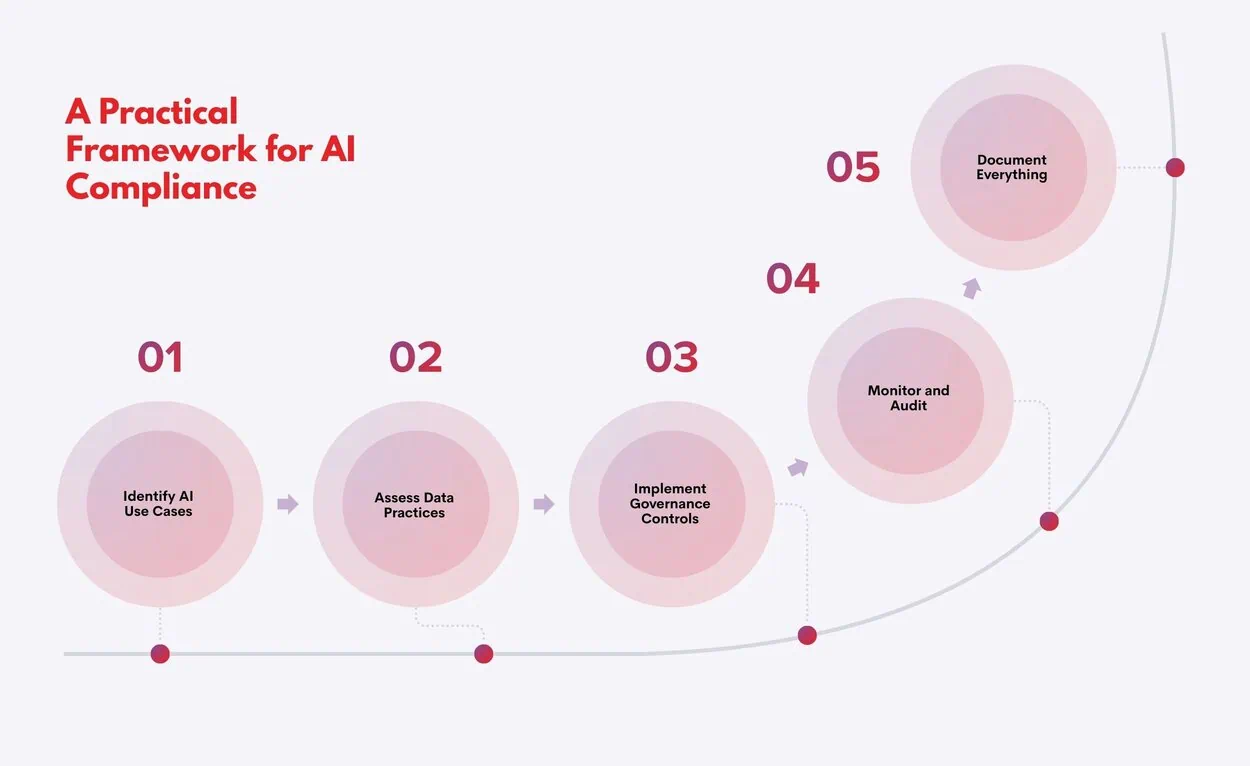
Organizations can follow a structured approach for the governance of AI systems:
Step 1: Identify AI Use Cases
Map all AI systems in use. Categorize them based on risk.
Step 2: Assess Data Practices
Ensure data collection and usage is compliant with Privacy Act regulations and international best practices.
Step 3: Implement Governance Controls
Establish roles and responsibilities.
Step 4: Monitor and Audit
Continuously assess the performance and compliance of AI.
Step 5: Document Everything
Document data sources, decisions made by AI models, and risks.
This approach aligns with both Australia AI Regulation and global frameworks.
The Role of Ethical AI in Business Growth
Ethical AI is often seen as a constraint. In reality, it can be a competitive advantage.
Organizations that prioritize responsible AI:
- Build stronger customer trust
- Reduce regulatory risks
- Improve long-term sustainability
Ethics and performance are not mutually exclusive. They complement each other if used correctly.
Industry-Specific Implications of AI Regulation
- Finance: The regulations in the finance industry are about transparency and fairness. Transparency is needed for the decisions taken by the AI system.
- Manufacturing: The AI system is implemented in the manufacturing industry for automation. Safety is ensured for the AI system.
- Retail: In the retail industry, it is important to ensure the use of the AI system for personalization. The data protection laws are adhered to.
- Public Sector: Accountability and transparency are required for the use of the AI system in the governance and citizen services sector.
- Transportation: Safety and liability are required for the autonomous and AI-driven vehicles.
Each industry faces unique challenges under government regulation of AI.
- Treating AI governance as a legal task only
- Ignoring data quality and data lineage issues
- Lack of proper documentation and audit trails
- Overlooking bias and fairness in models
- Relying on third-party AI systems without accountability
- Failing to monitor models after deployment
The Future of AI Regulation in Australia
Australia is moving toward a more structured regulatory model. This will likely include:
- Clear definitions of high-risk AI systems
- Mandatory compliance requirements for sensitive applications
- Stronger enforcement and penalty mechanisms
- Greater alignment with global regulatory frameworks
- Industry-specific guidelines for high-impact sectors
The transition will not happen overnight. But the direction is clear. Businesses that prepare early will have an advantage.
AI governance in Australia is no longer optional. It’s becoming an essential part of how businesses use technology.
The framework currently includes laws, ethics, and technology standards. These three areas come together to form a set of responsible AI.
However, organizations need to look beyond compliance and integrate AI governance into their operations.
The shift may seem complex. But it also creates an opportunity. Businesses that adopt responsible AI practices can build trust, reduce risk, and scale with confidence.
At iProgrammer Solutions, we help organizations dealing with the intricacies of AI implementation and regulation. We take a holistic approach by providing both technical and regulatory expertise.
Our experts help design and implement AI systems that are not only efficient but also compliant and responsible.
If you are looking for AI implementation or need help on how to comply, you can also check out our AI development services.