How AI Will Become the Operating System of Enterprise Software by 2027
- Jan 06, 2025
- The Role of AI in Enterprise Software
- Why AI Is Shifting from a Feature to the Foundational Layer
- What Traditional Software Architectures Fail to Solve
- The Enterprise Operating System: A New Mental Model
- Core Components of the AI-Driven Enterprise Stack
- Business Impact and ROI
- Governance, Trust, and Control
- Adoption Challenges and Solutions
- Enterprise Adoption by 2027: What Leaders Must Know
- Enterprise AI Adoption: A Snapshot
- Final Thoughts
- About iProgrammer
Enterprise software has always promised reliability and process control. It tracks sales, automates approvals, and stores data. Yet companies still struggle to make timely decisions. Software reports problems after they occur. It routes work according to rigid rules. It cannot interpret context.
That frustration isn’t abstract anymore. According to recent industry data, about 42% of large enterprises already have AI actively deployed, and 59% of those are accelerating investment in it. This shift isn’t experimentation anymore.
This trend signals a deeper transformation. AI is no longer just a feature bolted onto software. It is becoming the layer that directs how software behaves under uncertainty. It interprets signals, weighs risks, and shapes outcomes without human rewriting.
This blog maps that transformation. It explains why AI is moving from surface enhancement to enterprise operating system. It unpacks key architectural building blocks. It shows how this shift improves business outcomes. And it positions enterprise leaders to think beyond hype toward practical design and adoption.
The Role of AI in Enterprise Software

For years, “AI” in enterprise software meant smart chat boxes or analytics that highlighted patterns. These features were nice to have. They rarely changed how the system worked fundamentally.
That is no longer enough. The pace of business and data complexity demands systems that interpret situation and act instead of just report. AI in enterprise software now functions as the primary decision layer.
This shift affects everything:
- How data is consumed
- How decisions propagate through workflows
- How software adapts to new signals
- How responsibility is shared between machines and people
In this new paradigm:
- AI replaces brittle rule trees with learned responses
- Systems evolve based on outcomes, not static instructions
- Business logic emerges from patterns, not configuration
Most legacy enterprise systems were engineered for control. Every decision path had to be defined, tested, and deployed. That made systems predictable, but also rigid.
Two structural forces challenge that model:
- Unpredictable environments: Market conditions and customer expectations now change dynamically, often in ways no rulebook anticipates.
- Complex dependencies: Data feeds interconnect across teams, clouds, partners, and products. Static workflows cannot reconcile conflicting signals at scale.
AI addresses these gaps at the foundation. Instead of reacting to exceptions, it anticipates them. Instead of indexing rules, it weighs context. Instead of reporting status, it suggests action.
When AI becomes the operating layer:
- Code becomes reactive, not prescriptive
- Workflows become adaptive, not manual
- Outcomes improve through continual learning, not rewrites
This shift is structural, not incremental. It means enterprise success depends on how systems learn to behave rather than how they were taught to follow instructions.

Traditional enterprise architectures were designed under the assumption that workflow logic equals business logic. In practice, that worked until:
- Context changed faster than rules could be updated
- Exceptions outnumbered predictable cases
- Data volumes overwhelmed rule-based logic
- Business priorities shifted mid-cycle
Rule-based engines treat every scenario as a variation of something already defined. They provide consistency but lack agility. This rigidity produces:
- Bottlenecked decisions
- Fragmented data senses across departments
- Manual overrides that erode trust
- Costly reconfiguration cycles
AI in enterprise systems forces a rethink. Instead of prescribing how processes unfold, AI systems infer what matters. They reevaluate process paths based on live data, probabilities, and outcomes.
Legacy architectures can cope with known unknowns. They cannot manage unknown unknowns. AI bridges that gap.
Calling AI the operating system of enterprise software is not just catchy language. It reflects real architectural change.
An operating system in computing:
- Manages resources
- Coordinates actions across subsystems
- Abstracts complexity for applications
AI now performs analogous functions for enterprise ecosystems.
In this model:
- Data feeds become signals, not just stored records
- Models conduct decisions, not dashboards
- Workflows adapt, not just execute
- Outcomes improve, not just report
This transformation reorders the enterprise tech stack. Intelligence sits below the user interface and above hardware infrastructure. It becomes the layer where strategy, context, and execution converge.
Core Components of the AI-Driven Enterprise Stack
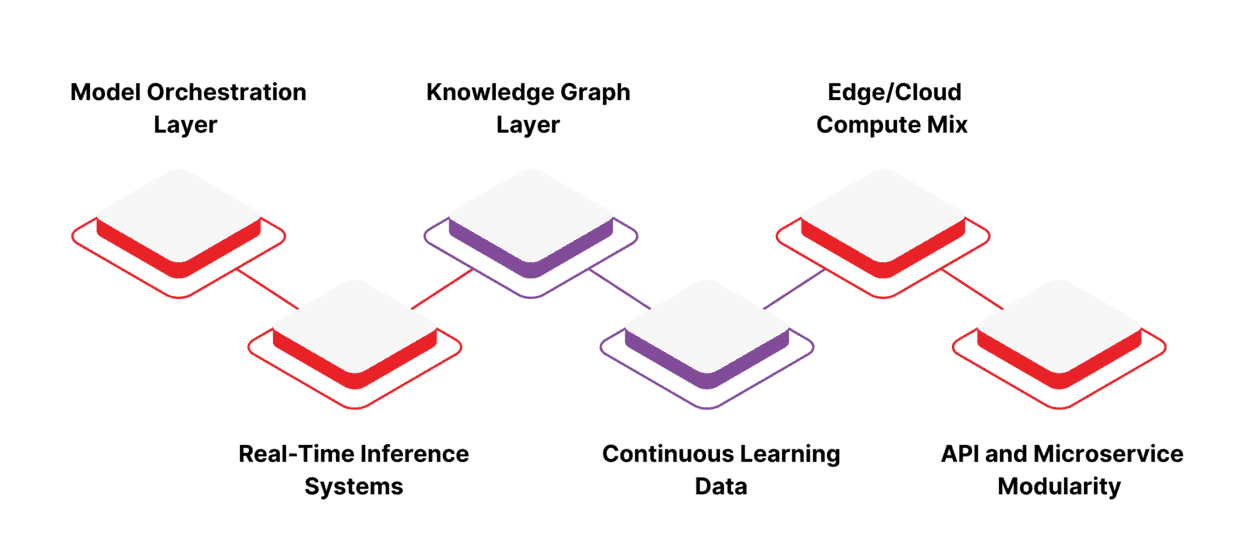
Here we break down the key pieces that make the “AI operating system” possible, why they matter, and what fails without them.
What it is:
A control plane that manages multiple AI models. It decides which models run when and with what context.
Why it matters:
Enterprises rarely depend on one model type. They use a mix of:
- Large language models for context and explanation
- Specialized models for prediction
- Small task-specific models for speed
Without orchestration, systems fall into one of two traps:
- Running the wrong model for the wrong job
- Running too many models inefficiently
What happens without it:
- Latency spikes
- Costs balloon
- Model outputs contradict one another
Business consequence:
Imagine a customer request that triggers a language model and a predictive analytics model with conflicting recommendations. Without a coordinated decision layer, the enterprise either picks arbitrarily or defers to human judgment—erasing any AI advantage.
Failure mode:
Uncoordinated models create ambiguity, not clarity. Users lose trust when AI systems give conflicting guidance.
Expanded view:
Orchestration also prioritizes models based on confidence thresholds. When confidence is low, it prompts a human review. This protects downstream decisions from cascading errors. The layer also logs contextual data for governance and auditability, meeting enterprise risk requirements.
What it is:
Infrastructure that delivers near-instantaneous decisions from models across environments.
Why it matters:
Enterprise decisions must often happen in milliseconds. Waiting for batch processing erodes relevance.
Tradeoffs managed here:
- Model size vs. speed
- Accuracy vs. latency
- Edge vs. central compute costs
Business consequence:
In high-velocity environments like pricing engines, supply chain routing, and fraud detection, delayed inference results in lost opportunities or elevated risk.
Failure mode:
Systems that rely on scheduled inference slow down decision loops and produce stale recommendations. In sales, this can mean quoting outdated prices. In supply chains, it means overlooking disruptions.
Expanded view:
Real-time inference systems make intelligence part of transactions, not post-hoc evaluation. They integrate lightweight models at the point of decision while reserving heavier computational tasks for asynchronous evaluation. This balance keeps both responsiveness and depth.
What it is:
A structured way of connecting entities, relationships, and contextual memory across systems.
Why it matters:
Enterprise decisions become meaningful only when connected to history, business context, and entity relationships.
Business consequence:
Consider a customer churn prediction. Raw data without relational context cannot explain why a customer left or what to do next. A knowledge graph provides that interpretation by linking accounts, interactions, outcomes, and sentiment.
Failure mode:
Without memory, AI is like a visitor with no context. It makes recommendations that ignore past actions or strategic priorities, reducing reliability.
Expanded view:
Knowledge graphs also enable cross-system reasoning. For instance, linking ERP like odoo, CRM, and supply systems allows AI to propose operational changes that reflect financial impact, customer sentiment, and delivery timelines simultaneously.
What it is:
A mechanism that captures outcomes to refine models over time.
Why it matters:
Static models degrade as data and business conditions change. Continuous learning ensures relevance.
Business consequence:
A forecasting model that never sees recent seasonal shifts will mispredict demand. A recommendation system that never sees feedback will stagnate.
Failure mode:
Models that do not learn compound errors over time. They drift from reality and produce harmful recommendations.
Expanded view:
Continuous learning requires careful governance. Retraining cycles must incorporate labels, validation sets, and human oversight. Done poorly, learning loops introduce bias or instability. Done right, they cultivate reliable adaptive systems.
What it is:
A distribution of processing between local edge devices and centralized cloud infrastructure.
Why it matters:
Not all decisions should travel to the cloud. Sensitive data, latency constraints, or compliance requirements often require localized intelligence.
Business consequence:
In manufacturing plants or retail outlets with poor connectivity, edge inference keeps operations live. Cloud compute handles heavy optimization and long-range strategy.
Failure mode:
Pure cloud dependency introduces latency and single-point failure risks.
Expanded view:
A hybrid strategy allows enterprises to balance responsiveness, cost, and governance. Local decision autonomy improves resilience. Central modelling drives strategic coherence.
What it is:
Exposing AI capabilities through lightweight interfaces that integrate with existing systems.
Why it matters:
Enterprises cannot rip and replace core systems overnight. Modular APIs allow incremental adoption.
Business consequence:
Instead of waiting months for a monolithic update, teams can embed intelligence into specific processes where it matters most.
Failure mode:
Monolithic integrations delay value realization and create brittle dependencies.
Expanded view:
Microservices ensure that AI enhancements can evolve independently. This reduces risk and accelerates iterative adoption.
AI’s value in enterprise software can be measured in outcomes rather than hype.
Reduced Manual Decision-Making
AI systems filter noise and highlight high-probability actions. Routine work is automated confidently, and humans focus on strategic exceptions. Productivity rises as decision paralysis decreases.
Faster Deployments and Iteration
Machine learning reduces the need for heavy customization cycles. Instead of writing new code for every variation, AI systems learn from data. This compresses deployment timelines and lowers technical debt.
Systems That Improve Without Rewrites
Legacy software ages. Intelligence can only be improved through new releases. In AI-native systems, learning loops mean continuous improvement. This significantly extends system lifespan and delivers compounded value.
Measurable Outcomes
Organizations already deploying AI report growth in productivity and faster response times. This isn’t speculative; enterprises are tracking real business KPIs tied to intelligent systems.
Autonomy without oversight is risk. Thoughtful governance is essential.
Decision Logs and Explainability
Systems must record how recommendations were generated and which data influenced them. Decision logs provide audit trails and support regulatory compliance.
Confidence Thresholds and Escalation Paths
AI should never act without guardrails. Confidence thresholds trigger human review when uncertainties arise.
Policy Enforcement
Governance layers encode corporate policies. This ensures that AI recommendations abide by risk parameters and legal boundaries.
Human-in-the-Loop Design
AI does not replace judgment. It informs decisions. Engineers and business leaders must collaborate to calibrate systems continuously.
Adopting AI as an enterprise operating system is not without obstacles.
Skill and Expertise Gaps
AI talent is scarce. Building internal capability requires investment in training, tooling, and culture.
Data Quality Bottlenecks
High-quality training data is the foundation of reliable outcomes. Poor data weakens models and erodes confidence.
Integration Complexity
Integrating intelligence across legacy systems requires thoughtful planning and modular design.
Strategic solution:
Focus on small, high-impact use cases first. Build trust and prove value. Then scale toward enterprise-wide intelligence.
Leaders must shift their questions from what the system can do to how it learns and adapts. This means investing earlier in:
- Decision architecture
- Data pipelines
- Continuous learning governance
- Modular API strategies
Too many organizations still treat AI as a project rather than a platform. By 2027, winners will treat intelligence as non-negotiable infrastructure, not optional feature.
Enterprise AI Adoption: A Snapshot
Here’s a comparison of where enterprise software stands today vs AI-native systems by 2027.
| Dimension | Traditional Enterprise Software | AI Operating System by 2027 |
|---|---|---|
| Decision Logic | Rule-driven workflows | Contextual, learned decisions |
| Adaptability | Manual reconfiguration | Continuous learning adaptation |
| Data Use | Retrospective reporting | Real-time signal interpretation |
| Deployment Speed | Release cycles | Continuous delivery of intelligence |
| Integration | Siloed systems | API-modular intelligence |
| Human Role | Executors | Strategic stewards |
AI is already reshaping enterprise software behavior. The story is no longer about adding intelligence for novelty.
The story is about building software that thinks and evolves.
By 2027, enterprises that treat AI as the operating system beneath workflows and data pipelines will outperform those that treat it as an optional add-on. This shift affects architecture, governance, talent, and business strategy.
Enterprise leaders should ask not just what AI can do, but how it becomes the backbone of their software environment.
At iProgrammer, we build enterprise AI foundations that go beyond proof of concept. Our approach to enterprise ai solutions prioritizes architecture, governance, and measurable outcomes.
We help companies embed intelligence across systems with continuous learning, robust integration, and scalable operations. Explore how we partner with enterprises to build AI-driven platforms.