Retrieval Augmented Generation: A Beginner’s Guide to Building AI Systems That Can Be Trusted
- Jan 06, 2025
- Why Language Models Struggle With Reliability
- What Is Retrieval Augmented Generation
- How the Retrieval Process Works
- Why Hallucination Cannot Be Solved by Scale Alone
- Static Knowledge Versus Dynamic Knowledge
- Core Components of a RAG System
- Levels of RAG Maturity
- Examples of Retrieval Augmented Generation in Practice
- Failure Modes Solved by Retrieval-Based Architectures
- RAG Compared to Traditional LLM Deployments
- RAG Compared to ETL Pipelines
- Step-by-Step Guide to a Basic RAG Demo Setup
- Design Considerations That Matter
- Common Mistakes in RAG Implementations
- When RAG Is the Right Choice
- The Role of RAG in AI’s Future
- Conclusion
- About iProgrammer Solutions

Every AI conversation begins with confidence and ends with a question. Can this answer be trusted? That question does not come from skepticism toward technology. It comes from experience. Organizations have seen intelligent systems generate convincing explanations that fall apart under scrutiny. The issue is not that the answers sound wrong. The issue is that they sound right even when they are not.
This gap between fluency and factual reliability has become the defining challenge of modern AI adoption. As language models move closer to operational systems, the tolerance for ambiguity shrinks. Business users expect AI to reflect reality, not approximation. They expect answers that align with internal documents, product logic, and verified sources.
The industry response has not been to abandon language models. Instead, it has been to rethink how they access knowledge. This rethink has led to retrieval augmented generation, an approach that prioritizes grounding over guesswork. Rather than expecting models to remember everything, systems are now designed to look up what they need at the moment they need it.
This guide explains the concept without hype. It focuses on mechanics, trade-offs, and real-world implications. The goal is understanding, not persuasion.
Large language models are statistical engines trained to predict text. They excel at pattern recognition across enormous datasets. This allows them to generate coherent, structured, and contextually appropriate responses. What they do not possess is an inherent understanding of truth or correctness.
When a model answers a question, it does not retrieve facts from a database. It predicts what an answer should look like based on learned probabilities. This works well for general language tasks. It becomes problematic when precision matters.
Another limitation lies in time. A model’s training data is frozen at a specific point. Any change in policy, pricing, documentation, or regulation after that point is invisible to the model. Fine-tuning can help, but it is slow and narrow in scope.
These constraints explain why models often hallucinate. They are not lying. They are completing patterns. Without access to authoritative references, guessing becomes unavoidable.
What Is Retrieval Augmented Generation
Retrieval augmented generation is an architectural approach that combines language models with external knowledge retrieval at inference time. Instead of relying solely on what a model learned during training, the system retrieves relevant information from a defined knowledge source before generating an answer.
The retrieved content is injected into the model’s context. The model then produces a response that reflects both the user’s query and the supporting material. This design allows responses to be anchored in actual documents, databases, or records.
The critical distinction is responsibility separation. The language model focuses on reasoning and articulation. The retrieval layer handles factual grounding. Together, they form a system that is flexible, current, and verifiable.
This approach reduces hallucinations not by restricting the model, but by informing it.

The retrieval process begins the moment a user submits a query. That query is converted into a numerical representation using an embedding model. This representation captures semantic meaning rather than exact wording.
The system then searches a vector database that contains embedded representations of documents or data chunks. The goal is to find content that is semantically closest to the query. This allows the system to surface relevant material even if phrasing differs.
Once relevant content is retrieved, it is assembled into a structured context. This context is passed to the language model as part of the prompt. The model uses it to generate a response that aligns with the retrieved material.
This pipeline allows AI systems to reason over information they were never trained on, without altering the model itself.
It is tempting to believe that larger models will eventually stop hallucinating. This belief misunderstands the nature of the problem. Hallucination is not caused by insufficient parameters. It is caused by missing information.
A model can only work with what it has. When required knowledge is absent, the model fills the gap with statistically plausible text. Increasing model size improves fluency, not factual access.
Even the largest models remain disconnected from live data. They cannot know which version of a document applies. They cannot verify claims against authoritative sources. Without retrieval, uncertainty remains unavoidable.
This is why architectural changes matter more than scale. Retrieval adds context that training cannot provide.
Knowledge stored inside model parameters is static. It reflects historical patterns rather than current reality. Updating it requires retraining or fine-tuning, both of which are resource-intensive.
Retrieved knowledge is dynamic. It can be updated independently of the model. Documents can change. Databases can refresh. Policies can evolve. The system remains accurate without retraining.
This distinction becomes critical in enterprise environments. Product catalogs, legal frameworks, and operational procedures change frequently. AI systems must reflect those changes immediately.
Dynamic retrieval turns AI from a static advisor into a living interface to organizational knowledge.
Core Components of a RAG System

A production-grade RAG System consists of several coordinated components. Each plays a specific role in ensuring accuracy and performance.
- First, documents are ingested and pre-processed. This includes cleaning, chunking, and embedding. Chunking ensures that information is granular enough for precise retrieval.
- Second, embeddings are stored in a vector database optimized for similarity search. This database becomes the system’s memory layer.
- Third, a retrieval mechanism selects relevant chunks based on semantic similarity and optional metadata filters.
- Finally, a language model generates a response using the retrieved context. Prompt design ensures the model relies on the provided information rather than speculation.
The quality of the system depends on balance. Strong generation cannot compensate for poor retrieval.
Levels of RAG Maturity
Early implementations focus on basic retrieval from static documents. These systems answer questions but lack nuance.
More mature systems introduce ranking, relevance scoring, and metadata awareness. They understand document types, dates, and authority levels.
Advanced implementations integrate feedback loops, confidence thresholds, and citation tracking. They can explain where information came from and how reliable it is.
At the highest level, retrieval becomes adaptive. Systems learn which sources perform best for specific query types and adjust accordingly.
Examples of Retrieval Augmented Generation in Practice
Customer support platforms benefit significantly from retrieval-based systems because product information evolves continuously. Instead of relying on static training data, retrieval-enabled assistants reference the latest documentation at the time of the query. This ensures responses remain accurate, consistent, and aligned with current policies, reducing escalations and corrective follow-ups.
In legal research, retrieval is essential for maintaining alignment with precedent. Systems first identify relevant cases or statutes from trusted sources before generating summaries or interpretations. This grounding ensures outputs reflect established legal context rather than generalized explanations.
Internal knowledge assistants use retrieval to surface organization-specific policies, onboarding materials, and technical guidance. Responses are generated using internal documents, ensuring consistency in language, standards, and compliance across teams.
Together, these use cases show how retrieval augmented generation moves AI from generic language output to context-aware, source-driven responses suitable for real-world deployment.
Without retrieval, models produce outdated answers. They contradict internal documentation. They invent edge cases.
Retrieval resolves these issues by grounding responses in authoritative sources. It ensures consistency across teams and channels.
This reliability is especially important in regulated industries, where incorrect answers create legal exposure.
By design, retrieval-based systems reduce risk.
RAG Compared to Traditional LLM Deployments
| Aspect | Traditional LLM Deployments | RAG-Based Deployments |
|---|---|---|
| Source of knowledge | Relies entirely on information embedded during model training | Retrieves relevant information from external sources at query time |
| Knowledge freshness | Fixed at the time of training or fine-tuning | Continuously up to date as source documents change |
| Handling of proprietary data | Requires fine-tuning or prompt stuffing, which is limited and brittle | Directly accesses internal documents, databases, or repositories |
| Response accuracy | High linguistic fluency but prone to factual errors | Higher factual grounding due to source-based context |
| Hallucination risk | Inherent and difficult to control | Significantly reduced through retrieval-based grounding |
| Explainability | Limited visibility into why an answer was generated | Easier to trace answers back to retrieved sources |
| Maintenance effort | Requires retraining or fine-tuning when knowledge changes | Knowledge updates occur independently of the model |
| Scalability | Scaling knowledge increases model size and cost | Knowledge scales through retrieval without changing the model |
| Enterprise readiness | Suitable for generic use cases and experimentation | Better suited for regulated, enterprise, and mission-critical systems |
| Prompt dependence | Heavily reliant on complex prompt engineering | Prompts are simpler and reinforced by retrieved context |
| Performance consistency | Output quality can vary significantly by query phrasing | More consistent responses due to structured retrieval |
| Cost structure | Higher costs when retraining or fine-tuning frequently | Lower long-term cost by separating model and knowledge layers |
| Security and access control | Limited control over what the model implicitly knows | Fine-grained control over which documents are retrievable |
| Best-fit use cases | Creative writing, ideation, general conversation | Knowledge-heavy tasks like support, compliance, and research |
Traditional LLM deployments rely on prompt engineering and fine-tuning. This approach assumes the model already knows enough.
In contrast, RAG treats knowledge as external and evolving. The model becomes a reasoning engine rather than a knowledge store.
This separation improves maintainability and scalability. Knowledge updates do not require model changes.
ETL pipelines are designed to move data into centralized systems for analysis and reporting. They extract data from source systems, transform it into structured formats, and load it into warehouses. This process supports dashboards, historical analysis, and performance tracking. ETL operates on predefined schemas and relies on batch or scheduled updates.
RAG pipelines follow a different logic. They operate at query time rather than on a fixed schedule. Instead of transforming data for aggregation, they retrieve relevant information to support reasoning. The focus is on unstructured content such as documents, policies, and text-heavy records. Responses are generated dynamically based on the user’s intent.
The outputs of these systems reflect their purpose. ETL pipelines power metrics, charts, and reports. RAG pipelines power conversations, explanations, and decision support. One system summarizes data trends. The other contextualizes information.
In practice, they often coexist. ETL continues to support analytical workloads. RAG extends access to knowledge that does not fit neatly into tables. Together, they form complementary layers in a modern data and AI stack.
Step-by-Step Guide to a Basic RAG Demo Setup
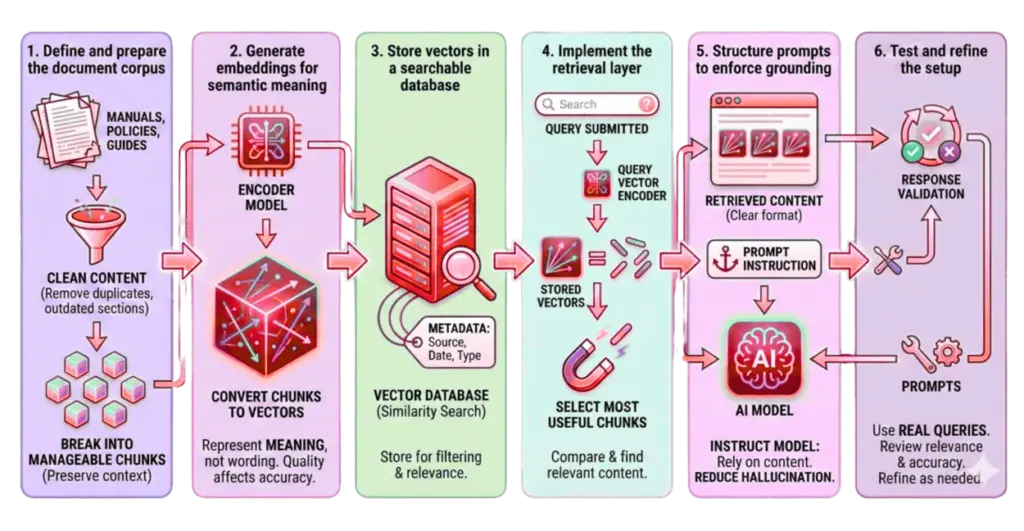
- Define and prepare the document corpus
Start by identifying the documents the system will reference. These may include manuals, policies, or internal guides. Clean the content to remove duplicates and outdated sections. Break documents into clear, manageable chunks that preserve context. - Generate embeddings for semantic meaning
Convert each document chunk into a vector using an embedding model. These vectors represent meaning rather than wording. Embedding quality directly affects retrieval accuracy. - Store vectors in a searchable database
Save the generated vectors in a vector database built for similarity search. Store metadata such as source, date, or document type. This helps improve filtering and relevance during retrieval. - Implement the retrieval layer
When a query is submitted, convert it into a vector. Compare it against stored vectors to find relevant content. Select only the most useful chunks for the response. - Structure prompts to enforce grounding
Insert retrieved content into the prompt in a clear format. Instruct the model to rely on this content when answering. This step reduces hallucination and keeps responses aligned. - Test and refine the setup
Validate responses using real queries. Review both retrieval relevance and output accuracy. Refine chunking, embeddings, or prompts as needed.
This setup establishes a solid base for building more advanced retrieval-driven systems.
Design choices determine whether a retrieval-based system feels reliable or unpredictable. Chunk size is one of the most critical factors. Large chunks often contain mixed concepts, which reduces retrieval precision. Very small chunks, however, strip away context and lead to incomplete answers. The goal is to balance specificity with meaning so each retrieved segment stands on its own.
Embedding selection plays an equally important role. Generic embeddings work for broad topics but struggle with specialized language. Domain-specific embeddings capture nuance more accurately and improve relevance during retrieval. The better the semantic match, the less the model has to infer.
Prompt design shapes how the model behaves. If instructions are vague, the model may revert to prior knowledge or guess. Clear guidance that emphasizes reliance on retrieved sources improves consistency and reduces unsupported responses. Prompting is not cosmetic. It is a control mechanism.
When these elements are treated casually, systems become fragile. Minor changes in data or queries can lead to unpredictable behavior.
One of the most common errors is retrieving too much information. Excess context overwhelms the model and dilutes relevance. Precision matters more than volume. Fewer, high-quality chunks lead to better answers.
Another frequent issue is neglecting document freshness. Outdated policies and obsolete documentation undermine trust quickly. Retrieval systems must reflect current knowledge to remain credible.
Many teams also skip structured evaluation. They do not measure retrieval accuracy or response grounding. Without clear metrics, systems stagnate and errors persist. Iteration becomes guesswork.
Effective RAG implementations require ongoing tuning and discipline. Reliability emerges from careful design, not one-time setup.
RAG is most effective when answers must reflect current and authoritative information. This includes enterprise knowledge bases, compliance documentation, customer support content, and internal policy systems. In these environments, accuracy matters more than creativity. Retrieval ensures that responses align with approved sources rather than assumptions.
RAG is less suitable for tasks where originality is the primary goal. Creative writing, ideation, or open-ended brainstorming benefit less from retrieval because external grounding adds limited value. In such cases, language fluency is often sufficient.
Choosing RAG should be a deliberate decision. Teams need to assess whether correctness, traceability, and freshness outweigh the cost of added architectural complexity. Fit determines success more than sophistication.
The Role of RAG in AI’s Future
As AI systems become embedded in operational workflows, grounding will no longer be optional. Users will expect answers that can be traced back to reliable sources. Confidence without evidence will not be acceptable in enterprise settings.
RAG in AI represents a structural shift rather than a feature upgrade. It changes how systems are designed, maintained, and trusted. Retrieval becomes part of the foundation, not an enhancement layered on later.
Future AI platforms will treat retrieval as a default capability. Systems will be built with the assumption that knowledge lives outside the model and must be accessed dynamically. This shift will define the next phase of enterprise AI adoption.
Reliable AI depends on more than advanced models. It depends on access to accurate and current information. Retrieval augmented generation addresses this need by connecting language models to authoritative knowledge at the moment of use.
By separating reasoning from knowledge storage, organizations gain flexibility and control. Systems can evolve as information changes without retraining models. This reduces risk, improves trust, and enables AI to move from experimentation into real business use.
At iProgrammer Solutions, we design AI architectures with reliability and enterprise readiness at the core. Our teams build retrieval-driven systems that integrate seamlessly with organizational data and workflows. Every solution is designed to scale without compromising accuracy.
We approach AI as long-term infrastructure rather than short-term experimentation. That perspective shapes how we design, implement, and support intelligent systems for our clients. Book a demo to learn more.