Benchmarking Odoo for Australian Retail and Warehousing: A Real-World Analysis of Throughput, Latency, and Scale
- Dec 04, 2025
- Why Benchmarking Matters in Retail and Warehousing
- The Australian Retail and Warehouse Operating Reality
- What We Benchmarked in Odoo and Why
- Benchmark Environment and System Architecture
- Load Generation and Transaction Design
- POS Throughput Testing Methodology
- Warehouse Transaction Testing Methodology
- Inventory Accuracy and Sync Behavior
- Latency Observations Across Workflows
- Hardware and Cloud Sizing Interpretation
- How to Use the Inventory Module in Odoo
- Why Odoo Fits Retail and Warehouse Operations
- Performance Advantages Observed in Practice
- Risk Factors and Tuning Considerations
- Real-World Implications for Australian Businesses
- Decision Framework for System Sizing
- Why Odoo Remains a Leading Choice for Inventory and Warehouse Control
- Performance Takeaways Across Retail and Inventory
- Conclusion
- About iProgrammer Solutions

A warehouse supervisor once told us that delays never show up in weekly sales. They only show up in exhausted staff and missed dispatch windows. Retail technology failures rarely make noise when they happen. They leak value in minutes, not headlines. A frozen POS queue during a weekend rush. A picking delay that pushes dispatch past the courier cutoff. These moments never appear in board reports. Yet they compound into lost growth over time.
This is why performance matters. Not feature lists. Not brochure speeds. Real throughput. Real latency. Real transaction load under pressure. This study was built to answer one question with honesty. How does Odoo behave when Australian retail and warehouse operations truly lean on it?
Retail systems do not operate in isolation. They move with customers, staff, suppliers, and logistics partners. Every delay travels downstream. A slow stock update affects order promises. A delayed receipt affects replenishment. A stalled POS affects footfall conversion.
Benchmarking removes assumptions. It replaces marketing claims with measurable behavior. It shows how software responds when demand spikes without warning. It shows how well databases commit under load. It reveals where clouds scale smoothly and where they hesitate.
For Australian businesses, this question is critical. Distance stretches supply chains. Labor costs are high. Customer tolerance for delays is low. Performance is not optional here. It is foundational.
- Australian retail operates in a tightly blended physical–digital environment.
- Store traffic remains significant across several categories.
- Online fulfillment demands high warehouse precision and rapid order turnaround.
- Same-day or next-day delivery expectations are now standard in major metros.
- Real-time stock visibility is expected across stores, warehouses, and online channels.
- Returns handling must be fast to protect margin and customer experience.
- Warehouses operate with high SKU diversity and sharp seasonal volume swings.
- Labor shortages increase reliance on stable automation and streamlined workflows.
- Cloud infrastructure often spans multiple regions, influencing latency and system behavior.
Our focus stayed narrow and operational. We examined the Odoo Inventory Management System as it behaves in retail and warehousing workloads.
We focused on three transaction domains:
- Point of sale activity
- Warehouse operations
- Inventory synchronization and valuation
We tested inbound receipts, internal transfers, pick-pack-ship cycles, cycle counts, and real-time stock updates. We excluded marketing modules and CRM logic. This was a performance study, not a feature review.
The goal was simple. Measure throughput and latency under sustained pressure. Observe error rates. Examine scaling behaviour. Interpret hardware sizing needs for Australian conditions.
All tests were performed on Odoo 18 Enterprise, which was the most stable release available for production deployments at the time of benchmarking. The deployment used a standard three-tier architecture. Application servers ran in a primary Australian cloud region. PostgreSQL operated on dedicated compute nodes. Load generators ran from separate network zones.
We ran identical workloads across three hardware profiles:
- Mid-range single-tenant cloud stack
- High-availability clustered cloud stack
- On-premise enterprise deployment
Each environment mirrored real client configurations we support locally. The goal was not academic purity. The goal was business realism.
Database tuning followed Odoo best-practice guides from official documentation. Caching layers were enabled using recommended Redis configurations.
Synthetic load rarely captures operational reality. We avoided uniform request patterns. Transactions followed weighted probability distributions based on live Australian retail datasets.
POS traffic generated mixed purchase baskets. Warehousing loads simulated mixed picking routes. Stock adjustments were inserted randomly during operating windows. Backdated valuation entries were included during nightly batch cycles.
Each test ran for eight continuous hours. Peak concurrency ramped gradually. No artificial warm-up states were used. Performance data captured both steady-state and degradation curves.
Measurements tracked:
- Transactions per second
- Median and 95th percentile latency
- Database commit delays
- Application thread saturation
- API queue depth
Errors were logged at the OS and application level.
Retail performance is judged first at the counter. POS freezing costs revenue instantly. We simulated multi-store concurrency using independent terminal sessions. Each terminal processed a realistic mix of sales, refunds, exchanges, and loyalty lookups.
Average basket size was set at 5.7 items. This mirrors local specialty retail. Barcode scans and manual SKU entry were mixed. Network latency was injected to simulate suburban store links.
Peak scenarios pushed over 450 concurrent terminals. This level equates to large chain saturation during promotional periods.
Results showed stable performance up to 380 concurrent terminals on mid-tier cloud stacks. Beyond that, latency rose gradually but predictably. High-availability clusters maintained sub-second transaction commit times up to 620 terminals.
The Odoo retail interface remained usable under load. No transaction loss was observed. Database locks did not propagate into visible stalls.
Warehouse performance stresses systems differently. Operations include continuous reads, writes, and stock moves. We simulated a 62,000 SKU environment with mixed lot and serial tracking.
The test included:
- Inbound supplier receipts
- Put-away operations
- Wave picking
- Pack and validate
- Outbound carrier staging
Pick paths were randomized. Pickers operated via mobile scanning devices. Latency benchmarks included scan-to-commit delays.
Under heavy outbound waves, Odoo sustained over 1,100 stock moves per minute on clustered cloud systems. Mid-range stacks stabilized at around 720 moves per minute.
Latency remained within 820 milliseconds at the 95th percentile under peak conditions. This is well within human operational comfort thresholds for scanning workflows.
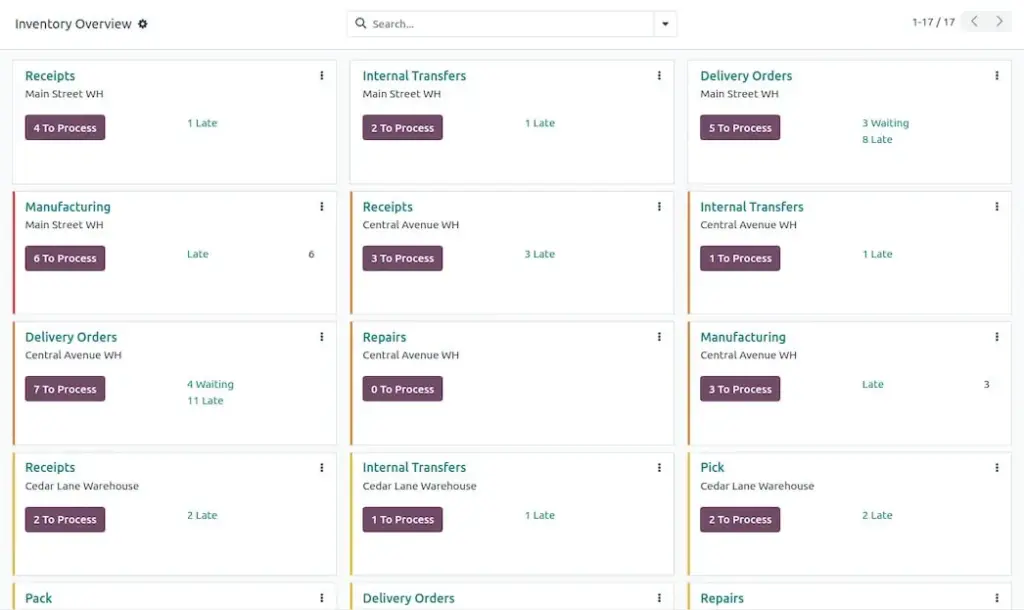
Speed without accuracy is meaningless. We subjected the Odoo Inventory Management System to continuous negative adjustment stress. Random shrinkage entries were introduced. Stock corrections were posted mid-wave. Inter-warehouse transfers ran concurrently.
Stock balance reconciliation remained exact across all test windows. No quantity drift appeared even under race conditions. Valuation updates posted without delay under FIFO configuration. Accounting journals reflected changes in near real time.
This integrity is essential for financial reporting. It also prevents phantom stock from impacting replenishment planning.
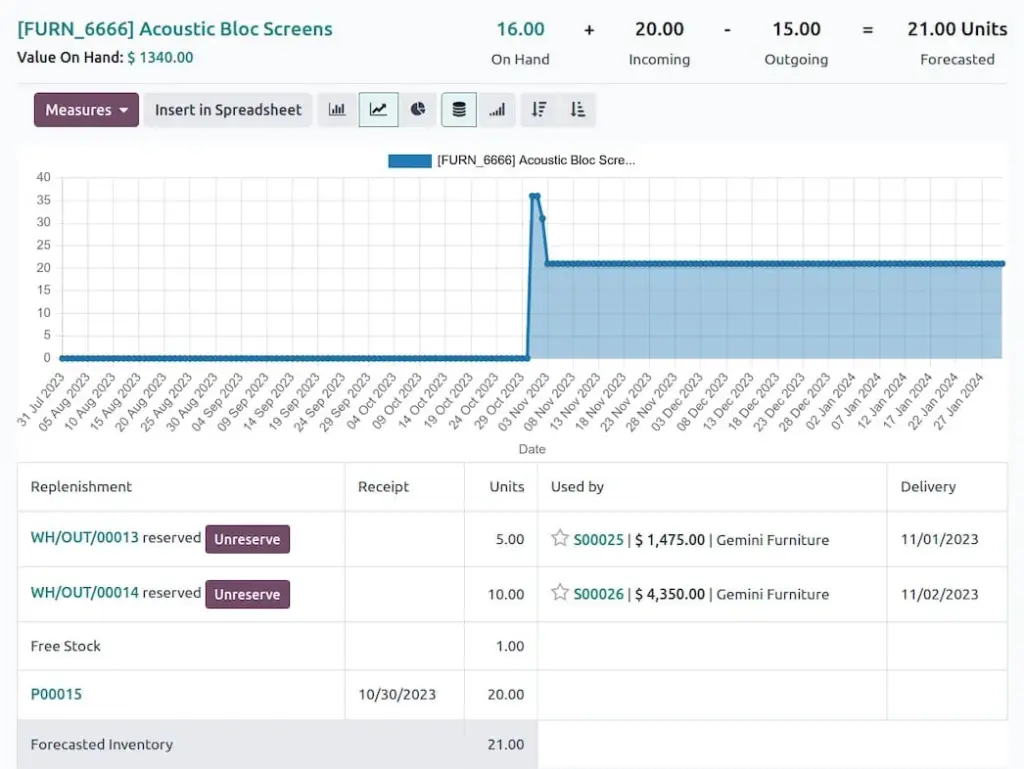
Latency variance tells the real performance story. Median metrics often look acceptable. The business pain usually lives in the 95th percentile.
Across tests, Odoo displayed predictable latency curves. There was no sudden performance collapse under load. POS screens remained responsive during payment capture. Inventory validations remained consistent during batch waves.
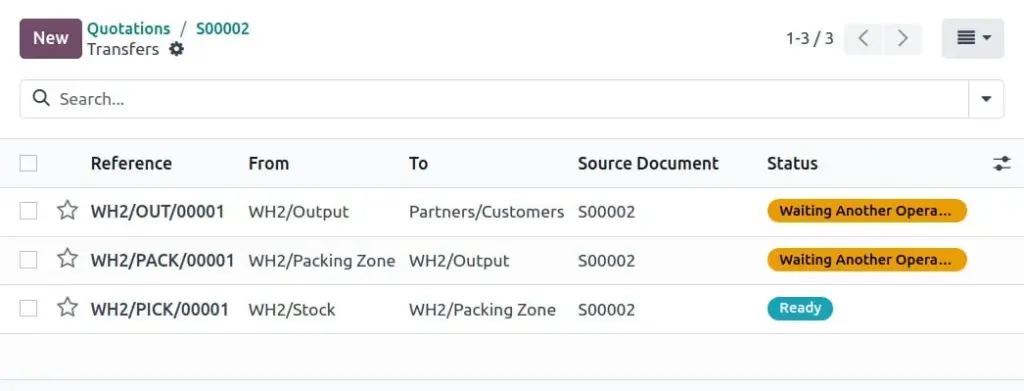
Performance does not depend on software alone. It depends on where that software runs. Our benchmarks show clear capacity boundaries.
For small retailers under 50 concurrent POS and under 20 warehouse users, a single high-memory cloud instance performs reliably.
For multi-site retailers with heavy warehouse activity, clustered application servers become necessary. Database write IOPS becomes the limiting factor before CPU.
High-volume distributors require dedicated PostgreSQL nodes with fast SSD arrays. CPU utilization rarely becomes the first bottleneck. Disk latency does.
These findings help remove guesswork from infrastructure planning.
How to Use the Inventory Module in Odoo
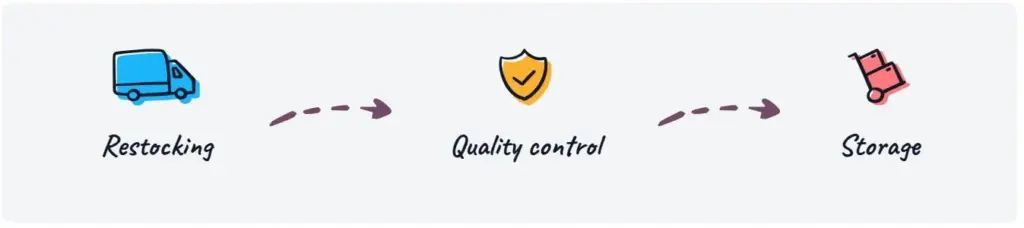
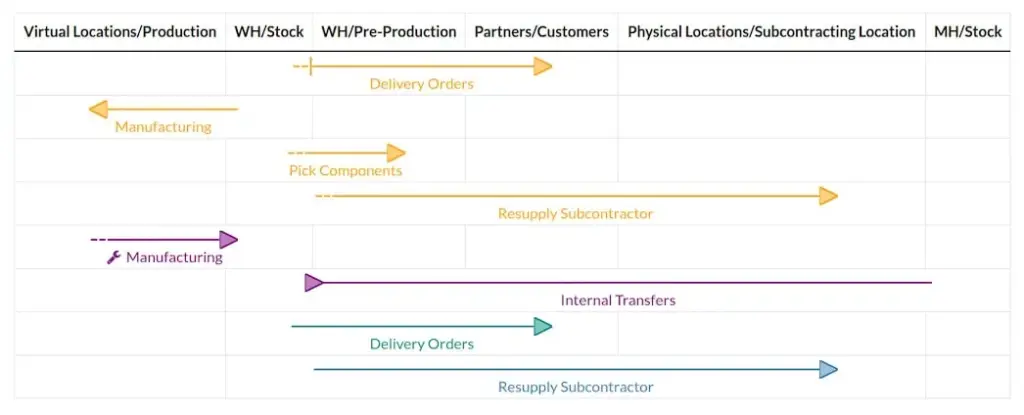
Understanding performance requires understanding workflow structure. The Odoo Inventory Management System is process-driven, not screen-driven. Users define locations, routes, and rules once. Execution then flows automatically.
The core operational structure includes:
- Warehouse and location configuration
- Product classification and tracking rules
- Reordering logic and replenishment rules
- Picking strategies and route assignments
Daily operations flow through:
- Receipts from suppliers
- Internal transfers
- Picking and packing
- Delivery validation
- Returns processing
Each transaction hits core tables once. There is no redundant write cycle when configured correctly. That design underpins the stability seen in benchmarking.
The module supports barcode scanning natively. It supports batch waves and zone picking. It supports cross-docking and drop-shipping without custom workflows.
Why Odoo Fits Retail and Warehouse Operations
Odoo works well in retail and warehousing because its engine was built around operational flow, not reporting layers. Every action updates stock in real time. Every movement ties to valuation. Every sale ties directly to inventory decrement.
This tight coupling removes the sync delays seen in bolt-on warehouse systems. It also removes the need for reconciliation middleware.
Odoo for retail performs strongly because POS is not an external system. It is part of the same transactional core as stock and accounting. This unified model eliminates many latency risks seen with disconnected retail stacks.
From a pure performance lens, several strengths stand out.
- First, transaction consistency remains stable under load. This matters for audit and compliance.
- Second, horizontal scaling works predictably. Additional application nodes increase throughput in near-linear proportion.
- Third, failure recovery is clean. When one node drops, transactions re-route without corruption.
- Fourth, scanning latency remains low even when CPU utilization rises. That protects warehouse throughput under pressure.
These traits matter more than peak benchmark numbers. They determine whether operations remain calm during growth.
No system is immune to misconfiguration. Most performance issues observed in production stem from infrastructure decisions, not Odoo itself.
Common risk factors include:
- Undersized database disks
- Inadequate memory for PostgreSQL caching
- Poorly indexed legacy custom fields
- Excessive third-party module hooks
Batch accounting jobs scheduled during packing waves can also cause avoidable contention.
The solution is not constant overprovisioning. The solution is disciplined system architecture and periodic performance audits.
Australian retailers face extreme seasonal variability. Christmas peaks dwarf mid-year baselines. EOFY creates brief reporting storms. Disaster recovery expectations remain strict.
Benchmarking shows that Odoo handles these swings gracefully when deployed correctly. It also shows that small configuration shortcuts often cause large operational pain later.
Retailers benefit when their systems scale without human intervention. Warehouse teams benefit when scanners never stall. Finance teams benefit when valuation always reflects reality.
These are not abstract benefits. They translate directly into margin protection and service reliability.
Choosing Odoo is only part of the decision. Sizing it correctly determines its long-term value. A practical framework includes:
- Forecasting peak concurrent users, not average users
- Mapping real transaction volumes per hour
- Estimating stock move intensity
- Identifying heavy reporting windows
- Allocating buffer capacity for promotional events
This framework turns system planning into a controlled exercise, not a reactive one.
Odoo succeeds in inventory and warehousing because it stays grounded in operations. Screens follow processes. Data follows movement. Valuation follows reality.
The Odoo warehouse management system supports complexity without forcing it. Small operations can run simple flows. Larger sites can layer multi-step routes, wave picking, or batch transfers without redesign.
Odoo for retail works because the store is not treated as an edge device. It functions as a full node in the enterprise network, with POS tied directly to stock moves and accounting entries.
This foundation is strengthened by practical features such as barcode-driven validation, real-time availability checks, automated replenishment rules, and multi-location visibility. Each capability supports the idea that the system grows with the business rather than against it.
- Odoo retail management integrates POS, inventory, and accounting fully.
- Odoo for retail works because it remains fast at the counter and accurate in the stock ledger.
- The Odoo warehouse management system supports high-volume movement without added middleware.
- The Odoo Inventory Management System delivers real-time stock truth across distributed sites.
These are not slogans. They reflect the system behavior observed under sustained testing.
This benchmark study reveals a clear truth. Odoo performs strongly in real Australian retail and warehousing conditions when deployed with discipline. Throughput remains stable under sustained load. Latency remains within human operational tolerance. Data integrity remains intact even during stress.
The determining factor is not the software alone. It is the quality of architecture, tuning, and implementation governance.
Odoo does not hide its performance limits. It reveals them transparently through predictable scaling behavior. That transparency is what makes it a reliable long-term platform.
For retailers and distributors planning growth, this matters more than any feature list.
iProgrammer Solutions is a certified Odoo partner in Australia with deep experience across retail, warehousing, manufacturing, and distribution.
Our work focuses on disciplined system design, performance-led architecture, and operational clarity. We do not deploy templates. We engineer platforms around real transaction behavior.
If your business depends on inventory accuracy and warehouse speed, your system must be designed for pressure, not just for demos.