Fintech App Development in Australia (2026): Cost, Compliance, Security & Architecture Guide
- Feb 10, 2026
- The Australian Fintech Environment: Opportunity with Conditions
- What Fintech App Development Really Involves
- Core Categories of Fintech Applications in Australia
- Planning Fintech App Development the Right Way
- Essential Features for High-Volume and Regulated Fintech Apps
- Security for Fintech Applications
- Data Governance, Privacy, and Consent Management in Australian Fintech
- How AI Is Transforming Fintech Applications
- API Integration with Fintech Apps
- Fintech App Development Cost in Australia
- What Actually Drives Cost?
- Why Choosing the Right Fintech App Developers Matters
- Step-by-Step Process to Hire the Right Fintech App Development Partner
- Technology Stack Considerations
- Integrations with Banking and Financial Systems
- Testing and Quality Assurance in Fintech Projects
- Deployment and Post-Launch Responsibilities
- Success Story
- Common Mistakes in Fintech App Development
- Common Fintech Risks and Mitigation
- Strategic Considerations for Fintech Product Decisions
- Future Trends Shaping Fintech App Development in Australia
- Conclusion
- How iProgrammer Approaches Fintech App Development

If you speak to leaders in Australian fintech, the conversation often starts the same way. The idea is solid. The market research looks promising. Early feedback is encouraging. Then reality follows. Payment flows break under load. Compliance slows release. Security gaps emerge. Costs rise. A simple product quickly becomes a high-risk decision.
In Australia, digital payment values projected to exceed AUD 200 billion in 2025 as consumers shift toward cashless transactions. Fintech apps are not regular digital products. They process money, identity, and trust at the same time. They also operate under strict regulatory expectations from day one.
This is why fintech app development cannot be approached like a standard mobile project. It demands deeper planning, sharper technical decisions, and teams that understand regulated systems.
This guide breaks down fintech app development in Australia with clarity. It covers cost structures, security realities, essential features, and delivery risks. It also explains how experienced fintech app developers think when building products that must scale and comply.
The Australian Fintech Environment: Opportunity with Conditions
The fintech regulatory environment provided by Australia is among the most stable globally. The trust level provided by consumers is high for digital financial services, while mobile banking and digital payment are at a mature level.
Key regulatory bodies shape fintech operations:
- ASIC governs financial services conduct
- APRA oversees prudential standards
- AUSTRAC enforces AML and counter-terrorism financing
- The Consumer Data Right governs data access and sharing
For product teams, this means compliance is not optional or phased later. It must be designed into the product from the first sprint.Fintech app development here rewards preparation. It penalizes shortcuts.
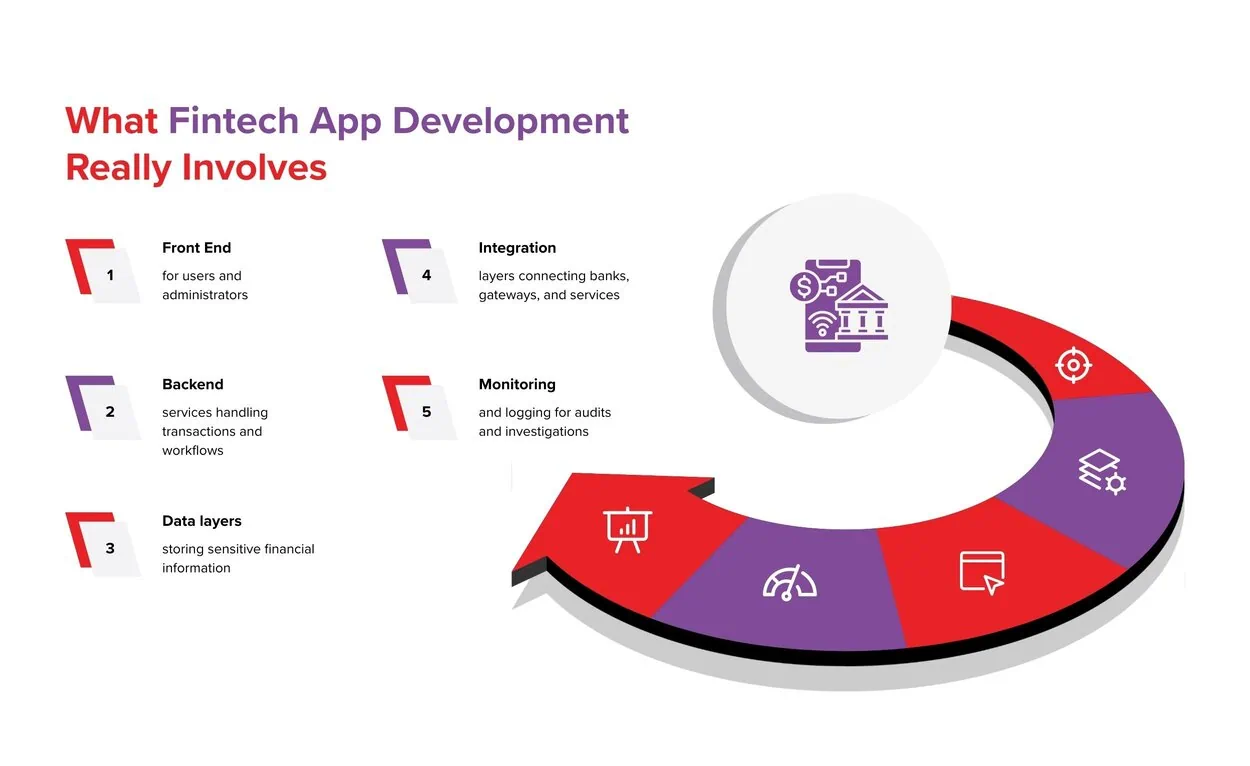
Fintech app development is systems engineering. The user interface is only one layer. A complete fintech product includes:
- Frontend interfaces for users and administrators
- Backend services handling transactions and workflows
- Data layers storing sensitive financial information
- Integration layers connecting banks, gateways, and services
- Monitoring and logging for audits and investigations
Each layer has regulatory and security implications.
Decisions made at the database level affect compliance. API design impacts scalability. Authentication choices influence fraud risk. This is why fintech mobile app development service providers must think beyond screens.
Core Categories of Fintech Applications in Australia
Understanding the category shapes everything from cost to architecture.
- These apps process real-time transactions and balances.
- They require high availability and low latency.
- Settlement handling and reconciliation are critical.
- These apps integrate market data and portfolios.
- Accuracy and performance are equally important.
- Compliance reporting is frequent and detailed.
- Lending products manage risk scoring, approvals, and repayments.
- They must maintain transparent decision trails.
- Regulatory reporting is continuous.
- These products monitor compliance rather than execute transactions.
- They require deep data visibility and rule engines.
- Insurance platforms manage policies, claims, and underwriting.
- Data accuracy directly affects financial exposure.
- These applications help users track spending, savings, and financial health.
- They aggregate data from multiple financial institutions using Open Banking.
- Data accuracy and consent management are central to user trust.
Each category increases development complexity in different ways.
Planning Fintech App Development the Right Way
Most cost overruns begin during planning.A strong fintech development plan covers:
- Regulatory scope assessment
- Data classification and storage rules
- Transaction volume assumptions
- Security threat modeling
- Integration dependencies
- Scalability requirements
Skipping this phase accelerates nothing. It only defers decisions until they are more expensive.
Essential Features for High-Volume and Regulated Fintech Apps
Fintech apps must handle scale and scrutiny at the same time. Features are not added for convenience alone. They are added to protect the business.
Identity and Access Management
- Strong user authentication is non-negotiable.
- This includes multi-factor authentication and role-based access control.
- Session management must be strict and monitored.
Transaction Monitoring and Logs
- Every financial action must be logged.
- Logs must be immutable and time-stamped.
- This supports audits, investigations, and dispute resolution.
Compliance Workflows
- Compliance cannot be a manual afterthought.
- KYC, AML, and reporting workflows must be automated.
- Manual intervention should be the exception, not the norm.
Performance and Load Handling
- Fintech apps experience spikes.
- Salary days, promotions, or market volatility can trigger load surges.
- Systems must scale predictably without degrading performance.
Data Encryption and Tokenization
- Sensitive data should never sit exposed.
- Encryption must be applied at rest and in transit.
- Tokenization reduces risk during data processing.
Security for Fintech Applications

Security failures in fintech are rarely dramatic at first. They start small. A misconfigured API. An exposed token. An overlooked permission. Fintech security must be layered.
Application-Level Security
- Secure coding standards
- Input validation
- API authentication and rate limiting
Data Security
- Encryption at rest
- Encryption in transit
- Tokenization of sensitive fields
Infrastructure Security
- Network segmentation
- Cloud security policies
- Access logging and alerts
Operational Security
- Incident response planning
- Breach notification workflows
- Regular penetration testing
Security is not a checklist. It is an ongoing discipline.
Data Governance, Privacy, and Consent Management in Australian Fintech
How data is governed often matters more than how features are built.
- Data Classification: Data can further be classified as sensitive, financial, or operational data.
- Consent Capture: The consent given by the users needs to be transparent, traceable, and specific.
- Consent Revocation: Revoked consent or expired consent has to be denied access to immediately.
- Access Control: Data access inside the organization has to adhere to the least privilege principle.
- Audit Visibility: All data access and changes must be logged for regulatory review.
- Data Retention: Even data retention periods are not based on convenience but rather on business or legal need.
- Secure Deletion: At the end of the life cycle, data is permanently deleted.

Artificial intelligence is no longer experimental in fintech. It’s operational. Australia’s fintech platforms are using AI in a measured way. Not because it’s trendy, but because it’s precise.
Fraud Detection and Risk Scoring
AI models analyse transaction patterns in real time. They detect anomalies faster than rule-based systems. This reduces false positives while maintaining strict controls.
Credit Assessment and Underwriting
Machine learning evaluates borrower behaviour beyond traditional credit scores. It improves approval accuracy without increasing exposure. Regulatory explainability remains essential.
Pesonalized Financial Insights
The insights enable users to better monitor their expenses and savings. The recommendations need to be transparent and compliant. The bias in the algorithm should be monitored.
Customer Support Automation
Response time is minimized through the use of AI chat and workflow routing. For complex questions, response paths must not be blocked. Human oversight cannot be removed from regulated conversations.
Operational Automation
The reconciliation, reporting, and reviews for anomalies are often automated. This minimizes errors as well as costs. API Integration with Fintech Apps
The modern fintech platforms are API-driven. They connect to banks, payment networks, credit bureaus, and identity systems. APIs extend capabilities but also introduce dependency risk.
Integration is not just technical wiring. It requires resilience planning from day one.
Most Preferred APIs Among Fintech Developers
| Open Banking APIs (CDR-Compliant) Secure bank data access with user consent. Essential in Australian fintech. |
Stripe Payments, subscriptions, and billing logic. Scalable and well-documented. |
| Braintree Card payments, wallets, and recurring billing. Suitable for high transaction volumes. |
Plaid Secure bank account connectivity and financial data access. |
| PayPal Domestic and cross-border digital payments. |
Credit Bureau APIs (Equifax, illion) Real-time credit scoring and reporting data. |
| Identity Verification APIs (Onfido, FrankieOne) Digital KYC, document checks, and AML screening. |
AUSTRAC Reporting Interfaces Automated regulatory reporting where required. |
What Strong Architecture Includes
- Retry logic
- Fallback workflows
- Rate-limit management
- API version control
- Monitoring dashboards
Fintech App Development Cost in Australia

Fintech app development in Australia is not priced like a typical mobile application. You are building a regulated financial system, not just a digital interface.
Costs vary based on scope, compliance exposure, and transaction complexity.
Estimated Cost Ranges
| Project Type | Estimated Cost (AUD) |
|---|---|
| MVP Fintech App | AUD 80,000 – 150,000 |
| Mid-Scale Product with Integrations | AUD 150,000 – 350,000 |
| Enterprise-Grade Fintech Platform | AUD 350,000+ |
- Regulatory Requirements
If your product touches on payments, lending, or financial advice, compliance design begins on day one. CDR readiness, AML/CTF obligations, and audit trails increase development depth. - Security Architecture
Encryption layers, secure authentication, fraud detection systems, and penetration testing are not optional in fintech. - API Ecosystem Integration
Bank feeds, payment gateways, identity verification, and credit bureaus all require secure integration work. - Scalability Design
Fintech apps have to handle spikes in transactions without failure. Infrastructure has to be built for peak load, not average load. - Ongoing Compliance & Maintenance
Since most apps are not like financial products, the need for ongoing monitoring, reporting updates, and version control is required for compliance.
Fintech App Cost Breakdown
| Cost Component | Impact on Budget | Why It Matters |
|---|---|---|
| Architecture Design | High | Prevents scaling and security failures |
| Compliance Features | High | Required for regulatory approval |
| Security Testing | Medium | Reduces breach and audit risk |
| Integrations | Medium | Enables banking and payment connectivity |
| Maintenance | Ongoing | Keeps systems secure and compliant |
Why Choosing the Right Fintech App Developers Matters
Fintech app developers influence outcomes more than tools.
Experienced teams:
- Anticipate regulatory questions
- Design for audit readiness
- Reduce technical debt
- Communicate risks early
Inexperienced teams often:
- Build before validating assumptions
- Underestimate compliance timelines
- Treat security as an add-on
A capable fintech mobile app development service protects the product long after launch.
Step-by-Step Process to Hire the Right Fintech App Development Partner

Choosing a fintech development partner is a strategic decision. It can impact regulatory timelines, system stability, and the long-term viability of an organization.
Below is a structured approach.
Step 1: Validate Fintech Experience
Ask for real fintech case studies. What matters more is the experience in regulated environments, not some generic app delivery.
Step 2: Assess Regulatory Understanding
The partner should understand the ASIC, APRA, and AUSTRAC obligations. Compliance awareness should be visible in their technical approach.
Step 3: Evaluate Security Discipline
Security must appear in architecture discussions early. Ask how they manage encryption, logging, and access control.
Step 4: Review Architecture Thinking
Scalability and maintainability should be explained clearly. Avoid partners that would probably end up being more UI or feature-centric.
Step 5: Check Testing Rigor
Ask about load testing, penetration testing, and compliance validation. Testing depth reflects delivery maturity.
Step 6: Understand Post-Launch Support
Fintech responsibility continues after launch. Monitoring, updates, and regulatory adaptation must be planned.
Step 7: Evaluate Communication Transparency
Strong partners raise risks early. They do not hide delays behind technical language.
Technology choices must support:
- Transaction integrity
- Performance under load
- Long-term maintenance
- Regulatory audits
- Backend systems should prioritize consistency.
- Databases must support transactional accuracy.
- Cloud providers must meet data residency expectations.
- Avoid experimental frameworks in core systems.
- Stability outlives novelty.
Fintech apps rarely function in isolation.
| Common integrations include: | Good architecture includes: |
|---|---|
Each integration introduces dependency risk. |
Resilience planning protects user trust. |
Testing and Quality Assurance in Fintech Projects
Testing in fintech cannot be theoretical. It must reflect how money, data, and users behave under pressure.
Quality assurance in fintech focuses on preventing silent failures. These failures rarely crash systems. They surface as incorrect balances, delayed settlements, or incomplete audit trails.
Functional Testing
Functional testing validates every core workflow. This includes onboarding, authentication, transactions, and reporting.
- Test cases must reflect real user behavior.
- Partial transactions, retries, and failed validations need coverage.
- Calculations must remain accurate across edge scenarios.
Even minor logic errors can create financial discrepancies.
Security Testing
Security testing identifies vulnerabilities before attackers do.
This includes API abuse, broken authentication, and data exposure risks.
- Penetration testing simulates real attack patterns.
- It validates assumptions made during development.
- Security testing must be repeated as systems evolve.
A one-time security check is not sufficient.
Performance and Load Testing
Performance testing measures how systems behave under stress.
Fintech platforms often face sudden transaction spikes.
- Testing must simulate peak volumes, not averages.
- Database performance must be monitored along with API latency and queue handling.
- Graceful degradation is just about as important as raw speed.
Slow systems erode trust even if they do not fail outright.
Compliance and Regulatory Testing
Compliance testing is a way of proving if the requirements set by regulators are followed in practice. This would include, among others, the following: Workflows for knowing your customer, rules of anti-money laundering, and triggers for reporting.
- Tests should confirm that the data is being captured, stored, and retrievable correctly.
- The state of audit trails should be complete in all respects, whatever the case may be.
- Most of the regulatory failures come to light during audits, rather than during development.
Automation and Manual Validation
Automated testing ensures that such consistency exists between releases. It reduces the chances of human error in repetitive scenarios.
- Manual testing remains essential.
- It captures edge cases and usability issues automation misses.
- In fintech, both approaches are required.
Automated testing improves consistency. Manual testing captures edge cases.
Launch increases responsibility. Every live transaction entails operational as well as regulatory risk.
Production Deployment Management: Releases should be staged. Rollback plans should be tested ahead of all releases to production.
Real-Time Monitoring: Transaction success rates, failures, etc. have to be monitored.
Log Analysis and Audit Readiness: Financial activities must always have immutable, searchable logs ready for audit and analysis.
Security Alerts and Response: Unusual access and behavior must trigger alert and follow prescribed incident response procedures
Compliance Reporting: Regulatory reports must remain accurate as transaction volumes and rules evolve.
Controlled Release Cycles: The updates should be subject to a specified process of approval, testing, and release.
Post-Release Validation: Critical workflows and data integrity need to be validated after each release.
A Melbourne-based digital lending startup targeting small businesses faced some problems. Manual loan processing slowed approvals. Compliance checks delayed onboarding. System performance struggled during peak demand.
- A secure lending platform with automated workflows.
- Integrated KYC and AML verification.
- Scalable backend architecture designed for volume.
- Loan approval time reduced by 60 percent
- Compliance reporting automated fully
- Platform handled three times peak load without issues
Common Mistakes in Fintech App Development
Many fintech projects struggle for the same reasons. The issues are rarely technical alone. They are strategic.
Underestimating Compliance Complexity: Regulatory requirements are often treated as documentation tasks. In reality, they shape system design and delivery timelines.
Deferring Security Decisions: Security is sometimes addressed after core features are built. This approach increases exposure and raises remediation costs.
Prioritising Cost Over Experience: Engaging with lower-cost teams that lack experience of working in fintech can cause unnecessary rework or delays.
Scaling Without Architectural Planning: Systems designed with an early user base in mind do not usually handle actual transactional volumes. Adding scalability later can be very costly.
Such errors can be averted by planning and making proper decisions.
| Risk | Impact | Mitigation |
|---|---|---|
| Compliance Failure | Severe | Early regulatory mapping |
| Security Breach | Critical | Layered security strategy |
| Scaling Issues | High | Load testing and architecture planning |
| Integration Downtime | Medium | Fallback workflows |
Fintech success is shaped by early trade-offs. Most are irreversible once development is underway.
Define Regulatory Exposure Early: Clarify which regulations apply before fixing scope, timelines, or launch targets.
Separate Validation from Scale: Early versions should prove demand without locking the product into fragile architecture.
Treat Security as a Design Constraint: Security should inform workflows and data handling, not sit outside them.
Plan Operating Costs, Not Just Build Costs: Monitoring, compliance, and maintenance define long-term viability.
Align Technology Choices with Business Risk: Frameworks and platforms should support audits, growth, and integration longevity.
Future Trends Shaping Fintech App Development in Australia
The next wave of fintech growth will reward adaptability, not speed alone.
- Open Banking Evolution: Data-sharing use cases are expanding beyond aggregation.
- Embedded Finance Growth: Non-financial platforms are introducing regulated financial features.
- Real-Time Payments: Instant settlement reduces tolerance for processing delays.
- Compliance Automation: Regulatory reporting is moving toward real-time enforcement.
- Architecture Modularity: Flexible systems adapt faster to regulatory and market change.
- Trust-Driven Adoption: Security, reliability, and transparency influence long-term usage.
Fintech app development in Australia is not about speed alone. It is about building trust into every layer of the product. Regulation, security, and scalability shape every decision. Costs reflect complexity, not ambition.
Businesses that approach fintech with realism succeed. Those that cut corners struggle to recover. With the right planning and the right development partner, fintech products can grow responsibly and confidently.
How iProgrammer Approaches Fintech App Development
Building fintech products comes with real responsibility. Systems handle money, identity, and trust. At iProgrammer, this awareness guides how projects are taken on and delivered.
Why teams choose iProgrammer for fintech app development:
- Regulation-aware delivery: Experience working within Australian compliance expectations, not around them.
- Security-first architecture: Security and data protection are built into system design, not added later.
- Scalable system design: Platforms are engineered to handle growth without rework or instability.
- Balanced product thinking: User experience, performance, and compliance are treated as connected priorities.
- Long-term ownership mindset: Systems are built to remain maintainable, auditable, and reliable post-launch.
This work spans both mobile and backend-heavy fintech platforms. Our mobile app development capabilities support secure, user-facing products, while our web application development expertise addresses complex integrations, workflows, and data requirements.