When Machines Learn Like Humans: Multimodal AI in Modern Manufacturing
- Jan 14, 2026
- What Is Multimodal AI?
- How Multimodal AI Interprets Manufacturing Signals Differently
- Multimodal AI vs Generative AI: A Clear Distinction
- Real-World Examples of Multimodal AI Applications
- Core Architectural Blocks Behind Multimodal AI Applications Systems
- Making Multimodal AI Tangible: Manufacturing Use Cases
- Multimodal Conversational Interfaces in Manufacturing
- Learning Across Modalities: A New Intelligence Paradigm
- Why Multimodal AI Applications Are Gaining Momentum
- Challenges and Considerations in Deployment
- Where iProgrammer Fits Into This Future
Manufacturing floors have always told stories. A machine hums differently before it fails. A vibration hints at imbalance. A surface defect appears before alarms trigger. For years, these signals remained fragmented. Cameras watched. Sensors measured. Logs recorded. Decisions relied on human judgment.
Multimodal AI changes that equation! Instead of working with isolated data, it brings vision, sound, text, and machine signals into a single line of reasoning. Systems begin to observe, interpret, and respond the way experienced engineers do, by connecting cues, not reacting to thresholds.
Today, more than 78% of manufacturing leaders report using AI weekly, and many expect it to drive the largest productivity boom in a century. Factories are no longer linear systems. They are complex environments where machines, people, and processes interact continuously. Single-mode AI struggles to keep up. Multimodal AI succeeds because it reflects how real manufacturing actually works.
This blog explores how multimodal AI is transforming manufacturing. It will explain its mechanisms, how it contrasts with generative AI, the foundational architecture supporting it, and where it provides significant benefits on the production floor.
What Is Multimodal AI?
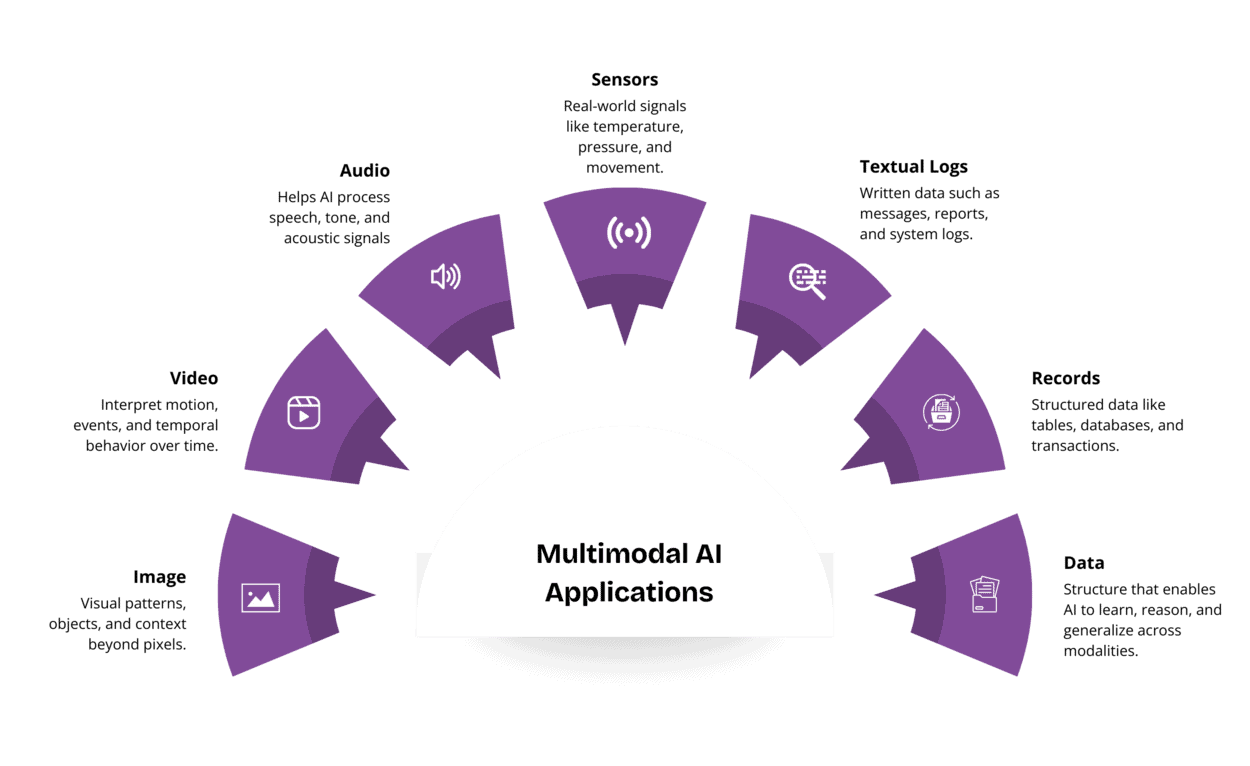
Multimodal AI refers to systems that analyze and interpret various forms of data at the same time. These kinds of data can comprise images, videos, audio files, sensor measurements, textual logs, and organized records.
Unlike traditional AI models trained on a single input type, multimodal systems integrate these inputs into a shared understanding. They do not treat vision, sound, and text as separate problems. They combine them into one decision-making process.
In a manufacturing context, this means a system can analyze camera footage, vibration signals, temperature data, and maintenance logs together. Each input adds context. Each improves confidence.
The value lies in correlation. A temperature spike alone may seem harmless. Combined with vibration anomalies and historical fault logs, it may signal an imminent failure. Multimodal AI is built to detect these patterns at scale.
This approach aligns closely with how human operators think. They do not rely on one signal. They observe multiple cues before acting. Multimodal AI brings that same layered reasoning into automated systems.
How Multimodal AI Interprets Manufacturing Signals Differently
| Signal Observed | Single-Modal Interpretation | Multimodal Interpretation | Operational Impact |
|---|---|---|---|
| Temperature spike | Possible overheating | Combined with vibration and visual misalignment, signals bearing failure | Maintenance scheduled before breakdown |
| Vibration increase | Threshold alert | Linked with acoustic change and past fault logs | False alarms reduced |
| Visual surface defect | Cosmetic issue | Correlated with thermal fluctuation during curing | Process adjustment made |
| Unusual sound | Noise anomaly | Matched with RPM variation and service history | Early fault confirmation |
| CCTV movement anomaly | Human activity | Cross-checked with access logs and audio stress cues | Safety intervention triggered |
Multimodal AI vs Generative AI: A Clear Distinction
Generative AI and multimodal AI are frequently mentioned in tandem, yet they address distinct issues.
- Generative AI focuses on creating content. It generates text, images, code, or audio based on learned patterns. Its strength lies in synthesis and expression. It is useful for documentation, design support, and chat interfaces.
- Multimodal AI emphasizes understanding and decision-making choices. Its main objective is to comprehend intricate environments via various inputs. Production might be a part, but it is not the main function.
In manufacturing, generative AI could assist in creating reports or clarifying discrepancies. Multimodal AI identifies the anomaly initially. A different significant distinction is found in grounding.
- Multimodal systems are tied to signals from the real world. They analyze real-time sensor information, visual streams, and activity records. Their outputs directly influence physical processes.
- Generative models can contribute to a multimodal system, yet they are not adequate by themselves. In the absence of multimodal perception, insights produced are devoid of situational awareness.
Grasping this difference assists organizations in making prudent investments. The real operational gains in manufacturing come from perception, correlation, and action.
Real-World Examples of Multimodal AI Applications
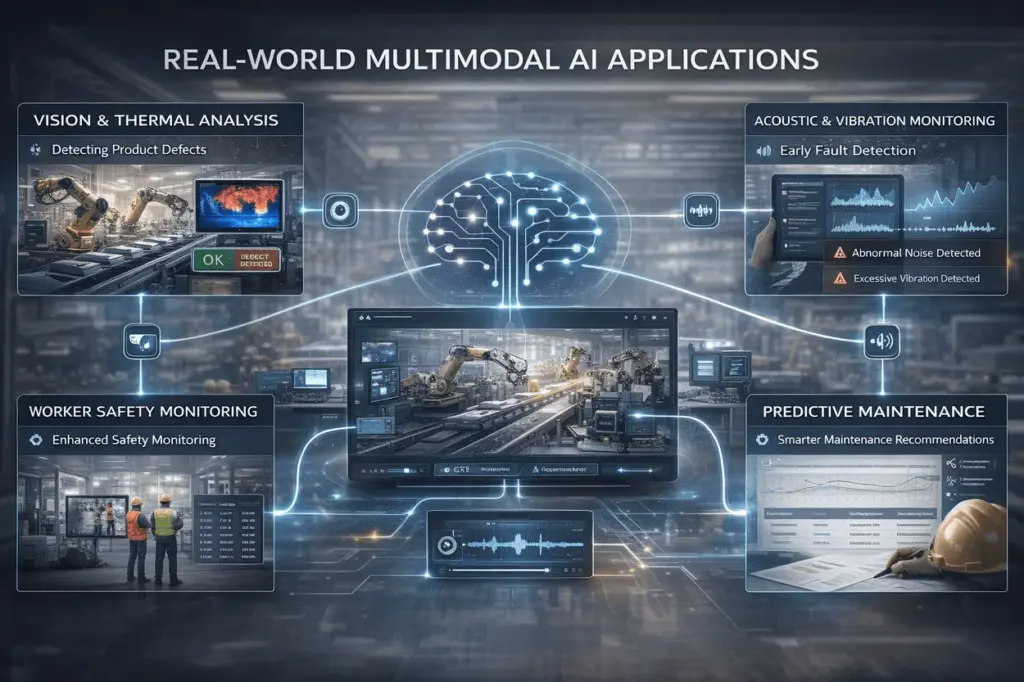
Multimodal AI is not theoretical. It is already embedded in high-performing manufacturing environments.
Some examples include:
- Vision systems paired with thermal sensors to detect product defects.
- Acoustic analysis combined with vibration data for early fault detection.
- CCTV footage analysed alongside access logs for worker safety monitoring.
- Maintenance recommendations generated using sensor trends and historical service records.
Each example relies on integration. No single data stream is sufficient. The intelligence emerges from combination.
These systems frequently function quietly behind the scenes. Their success is gauged not by visibility, but by minimized downtime, enhanced quality, and safer operations.
Core Architectural Blocks Behind Multimodal AI Applications Systems
Creating efficient multimodal AI involves more than just choosing the right model. It requires a well-structured architecture that enables data flow, context, and learning.
Let us examine the key components that make this possible.
Data Fusion Layer: Where Signals Meet
The data fusion layer is the foundation. It collects and synchronizes inputs from diverse sources.
In manufacturing, these sources may include:
- Industrial cameras
- IoT sensors
- PLC data streams
- Maintenance logs
- Operator notes
Each source operates at different frequencies and formats. The fusion layer aligns them in time and context. This alignment is critical. A vibration anomaly has little significance without understanding what the camera observed at that time.
Efficient data integration guarantees that the AI system perceives the same instance from various viewpoints. This establishes a deeper comprehension of occurrences as they develop.
Embedding Vectors and Contextual Memory
Once data is fused, it must be represented in a form machines can reason with. This is where embedding vectors come in. Embeddings transform unprocessed inputs into numerical formats that encapsulate significance and connections. Visual designs, auditory fingerprints, and written accounts all become similar in this common area.
Contextual memory builds on this by storing historical embeddings. The system does not just react to current inputs. It recalls similar past situations and their outcomes. This memory enables learning beyond static training. The AI enhances its capabilities as it faces additional situations. Eventually, it starts to identify subtle signs of failures or quality problems.
Knowledge Graph Integration
Manufacturing environments are regulated by regulations, connections, and limitations. Machines depend on components. Processes follow sequences. Safety protocols define boundaries.
Knowledge graphs encode this structured understanding. They map how entities relate to each other. When integrated with multimodal AI, they add reasoning depth.
For instance, when a sensor malfunction happens on a machine, the knowledge graph assists the system in comprehending subsequent effects. It recognizes the impacted processes and the potential safety hazards that might occur.
This integration bridges raw perception and operational logic. It guarantees that decisions are not only correct but also suitable for the context.
Real-Time Inference and Edge Computing
Manufacturing decisions often cannot wait for cloud round trips. Latency matters. Safety demands immediacy.
Real-time inference enables multimodal models to analyze data as it comes in. Edge computing moves this capability nearer to the origin.
Manufacturers enhance reliability and minimize latency by implementing models on edge devices. Systems remain operational even amid network interruptions.
This architecture enables ongoing surveillance without burdening central systems. It also improves data privacy by retaining sensitive information locally.
Closed-Loop Learning Feedback System
True intelligence requires feedback. Multimodal AI systems enhance when results are reintegrated into the model.
A closed-loop system records the outcomes of actions driven by AI. Did a predicted failure occur? Did a quality intervention succeed? Was a safety alert accurate?
This feedback refines future predictions. The system gains knowledge from both achievements and errors. With time, precision gets better, and false alerts lessen.
Closed-loop learning transforms AI from a static tool into a living system. It evolves with the factory.
Making Multimodal AI Tangible: Manufacturing Use Cases
The significance of multimodal AI becomes evident when utilized for actual manufacturing issues. Here are some real-world examples that demonstrate its influence.
| Use Case | Combined Data Inputs | AI Intelligence Applied | Business Outcome |
|---|---|---|---|
| Production anomaly detection | Camera + vibration + temperature | Pattern deviation detection across modalities | Fewer line stoppages |
| Quality inspection | Visual defects + thermal + vibration | Root-cause correlation | Lower rejection rates |
| Worker safety monitoring | CCTV + audio + access logs | Context-aware risk detection | Reduced safety incidents |
| Predictive maintenance | Sound + vibration + maintenance logs | Failure probability modeling | Planned maintenance cycles |
| Operator decision support | Sensor data + logs + visual feeds | Multimodal conversational response | Faster issue resolution |
Production Anomaly Detection Using Vision and Sensor Data
Traditional anomaly detection relies heavily on thresholds. When values cross limits, alerts trigger. This approach misses subtle patterns.
Multimodal AI combines visual inspection with sensor readings. Cameras detect surface changes or motion irregularities. Sensors provide vibration, pressure, and temperature data.
Together, they identify deviations that single systems overlook. The AI recognizes abnormal behavior even when individual signals appear normal.
This leads to earlier detection and fewer false positives. Production continues smoothly with fewer interruptions.
Multimodal Quality Checks Across Multiple Parameters
Quality defects rarely have one cause. Visual flaws may stem from thermal inconsistencies or mechanical stress.
Multimodal quality systems analyze images alongside temperature and vibration data. They correlate defect patterns with process conditions.
This approach helps identify root causes, not just symptoms. Quality teams gain insights that drive process improvements.
Over time, defect rates drop, and consistency improves. The AI learns what good quality looks like across dimensions.
Worker Safety Detection Using CCTV and Audio Signals
Safety incidents often provide warnings before they escalate. Loud voices, atypical movement behaviors, or unpermitted entry can indicate danger.
Multimodal AI monitors CCTV footage and audio inputs simultaneously. It identifies dangerous actions and environmental risks in real time.
Together with access logs and safety measures, the system provides alerts that are aware of the context. It differentiates between regular actions and true danger.
This improves safety without burdening teams with excessive noise. Workers benefit from proactive protection.
Predictive Maintenance Using Sound, Logs, and Vibration
Machines communicate through sound. Skilled technicians identify issues through auditory observation. Multimodal AI digitally records this knowledge.
The system forecasts failures with great precision by examining acoustic signals in conjunction with vibration data and maintenance records.
It recognizes not only that a part is deteriorating, but also the reasons behind it. Maintenance is transformed into a planned process rather than a reactive one.
Downtime reduces. Asset life extends. Maintenance teams operate with precision rather than haste.
Multimodal Conversational Interfaces in Manufacturing
As multimodal systems become intricate, interaction is essential. Operators require user-friendly methods to query and comprehend AI insights.
This is the area where multimodal conversational AI is significant.
These interfaces enable users to pose inquiries in natural language. The AI replies utilizing knowledge gathered from various data sources.
An operator might inquire about the reason a machine was stopped. The system explains using visual evidence, sensor trends, and historical context.
This conversational layer builds trust. It turns AI from a black box into a collaborator.
The strength of multi modal learning ai lies in its ability to generalize knowledge across data types.
A pattern learned from vibration may inform visual inspection. A defect detected visually may refine acoustic analysis. This cross-modal learning accelerates improvement. The system does not need explicit retraining for every scenario. It adapts through experience.
In manufacturing, this leads to faster deployment and broader coverage. One system supports multiple use cases without siloed models.
Why Multimodal AI Applications Are Gaining Momentum
The rise of multimodal AI applications in manufacturing is driven by necessity, not trend.
Factories generate vast amounts of diverse data. Ignoring this richness limits insight. Multimodal systems unlock value by connecting the dots.
They also align with digital transformation goals. As factories adopt smart sensors and connected systems, multimodal AI becomes the natural intelligence layer.
The result is operational clarity. Decisions rely on comprehensive insight rather than individual measurements.
Multimodal AI is powerful, but it is not simple.
- Data quality matters. Poor inputs lead to poor outcomes. Integration requires careful planning. Models must be trained with domain expertise.
- Scalability is another consideration. Systems should grow with operations without excessive retraining.
- Ultimately, governance is crucial. Explainability, auditability, and security need to be integrated from the beginning.
Organizations that tackle these issues with care achieve long-term benefits.
At iProgrammer, we approach AI as a system, not a feature. Our work in manufacturing intelligence focuses on building robust, scalable, and explainable multimodal solutions.
We combine deep engineering expertise with practical industry understanding. Our AI Product Consultants design architectures that integrate vision, sensors, text, and operational knowledge into cohesive systems.
From edge deployment to closed-loop learning, we help manufacturers move beyond experimentation. The goal is measurable impact, delivered with precision.