What is AI Crowd Management?
A Complete Guide for Smart Cities and Enterprises
- Oct 16, 2025
- Defining AI Crowd Management in the Modern Context
- From Manual Oversight to Intelligent Ecosystems
- The Role of AI in Crowd Management and Mega Events
- The Technology Stack Behind AI Crowd Management
- Key Capabilities of Modern Systems
- AI Crowd Management for Smart Cities
- AI Crowd Management for Enterprises
- Implementation Challenges and Best Practices
- Best Practices for Effective Implementation
- Data Governance and Ethical Frameworks in AI Crowd Management
- KPIs and ROI in AI Crowd Management
- The Future of Crowd Management
- Conclusion
- iProgrammer: Pioneering AI-Driven Crowd Intelligence

Human gatherings are dynamic, unpredictable, and often unstable, whether they take place at sporting events, transport hubs, corporate campuses, or festivals. The traditional approach to crowd management has been reactive. Security staff watch multiple screens, radio calls often escalate, and control rooms respond only after congestion or commotion occurs.
AI crowd management changes this. It substitutes proactive comprehension for reactive oversight. Organisations and authorities can anticipate crowd dynamics, identify immediate anomalies, and make quicker, data-driven decisions to safeguard people and resources by combining computer vision, Internet of Things sensors, and advanced analytics.
This blog explores AI crowd management, its functioning, and its increasing necessity for both intelligent cities and major corporations.
Defining AI Crowd Management in the Modern Context
AI crowd management is the intelligent correlation of crowd flow, density, and behaviour using artificial intelligence, computer vision, and IoT data streams. It not only monitors people but also understands movement patterns, predicts potential bottlenecks, and initiates corrective actions automatically.
Traditional crowd management systems were designed to count, not comprehend. They offered post-event data or basic live feeds, leaving decision-makers to interpret the situation manually. In contrast, AI-driven systems integrate visual feeds from CCTV cameras with data from motion, thermal, and environmental sensors. The output is a continuously updated understanding of how people move through physical spaces — whether a city square, a train station, or an enterprise campus.
The AI crowd monitoring system is a vital part of this ecosystem. It makes use of computer vision techniques to determine crowd density, identify potentially hazardous clustering, and identify odd movement patterns like abrupt dispersal, hostile conduct, or panic-related behaviours. These insights are continuously enhanced by machine learning, which gains accuracy over time as it processes more data.
AI crowd management systems transform sensor data and unprocessed video feeds into actionable insights, giving businesses, event organisers, and city officials an early warning system that improves operational efficiency and safety at the same time.
From Manual Oversight to Intelligent Ecosystems
Crowd management has changed significantly. Previously, it depended mainly on human alertness. Security personnel stationed at strategic locations, two-way radios managing groups, and physical examinations of surveillance video. This responsive model frequently faced challenges in averting incidents in real time, especially during major events when human perception couldn’t handle thousands of concurrent actions. With the rapid pace of urbanization and the increasing frequency of mega-events, the demand for automation expanded. This resulted in the period of smart crowd management systems driven by analytics, IoT, and machine learning.
By utilizing machine learning for crowd management, systems started to learn from past crowd behaviours, recognize frequent congestion areas, assess dwell times, and even forecast peak movement times. This learning cycle allows systems to predict risks before they occur. For example, by identifying a distinct crowd density trend that often occurs before bottlenecks, AI can notify ground personnel moments before congestion becomes apparent to individuals. These crowd management solutions now operate as digital ecosystems rather than standalone monitoring tools.
The Role of AI in Crowd Management and Mega Events
When large gatherings occur, be it a worldwide sports event, spiritual gathering, or concert festival, preserving crowd order in terms of timing, distance, and interaction is tough. AI currently stands at the core of this coordination.
AI offers two essential benefits: immediate awareness and forecasting abilities. Real-time awareness allows systems to recognize areas of overcapacity, detect unusual movement patterns, or sense escalating crowd energy before it becomes chaotic. On the other hand, predictive modelling uses real-time data and historical event information to predict how the crowd will change over the next few minutes. This enables actions to be taken before traffic jams, panic attacks, or security concerns occur.
Predictive crowd flow modelling has become a crucial element of modern event management. By examining how numerous people engage with their environment — access points, obstacles, exits, and even climatic factors — AI can predict future movement trends. Control teams can later redirect flows, adjust gate schedules, or activate automated messaging systems.
AI-powered crisis management and crowd safety management systems are crucial for facilitating prompt, coordinated responses during major events. When an anomaly is detected, like rapid crowd acceleration or uneven heat accumulation, the system can autonomously sound ground crew alerts, modify digital displays to direct movement, and notify emergency services.
For example, the Tokyo Olympics demonstrated how AI-powered crowd analysis can manage large crowds while upholding safety protocols. Similar artificial intelligence programs have been tested at significant religious gatherings, like the Kumbh Mela in India, where forecasting models helped to prevent stampedes by anticipating dangerous crowd densities.
The Technology Stack Behind AI Crowd Management
A contemporary crowd management system relies on a carefully organized stack that combines hardware sensors, analytical software, and cloud infrastructure.
1. Computer Vision and CCTV Integration
Cameras act as the visual detectors for AI crowd control. To count people, gauge crowd density, and monitor movement patterns, advanced vision models examine live video feeds. These systems, in contrast to traditional video analytics, can distinguish between panic-induced behaviour and normal movement, even in challenging weather or low light levels.
2. IoT Sensors and Environmental Inputs
IoT devices — thermal sensors, LiDAR units, and acoustic detectors — complement cameras by capturing environmental conditions. For instance, a spike in CO₂ levels or sudden vibration readings may indicate overcapacity or unrest. Integrating this data enriches the AI model’s context awareness.
3. Machine Learning and Predictive Analytics
At the core lies the machine learning engine. It learns continuously from data to recognize movement patterns and predict behaviour. This enables real-time alerts, congestion forecasting, and dynamic threshold setting.
4. AI + IoT + Digital Twins for Cities
Digital Twins replicate physical spaces in virtual environments. By feeding IoT and camera data into these models, cities and enterprises can simulate various scenarios — from rush-hour pedestrian flows to emergency evacuations. The combination of AI, IoT, and Digital Twins enables adaptive decision-making at urban scale.
5. Cloud and Edge Computing
Crowd monitoring requires processing with minimal latency. Edge computing facilitates fast, local decision-making, whereas cloud infrastructure oversees extended analytics and data protection.
6. Drone-Based Crowd Monitoring
Aerial visibility offers another dimension of intelligence. Drones fitted with AI vision technology can deliver immediate aerial insights, monitor activity over extensive landscapes, and transmit that information to centralized displays.
Key Capabilities of Modern Systems
Automation, integration, and contextual awareness are characteristics of the shift from surveillance to intelligence. Contemporary systems not only observe; they make choices.
Key capabilities include:
- Real-Time Visualization Dashboards: Integrated interfaces display movement trends, anomaly indicators, and active density maps.
- Smart Evacuation Routes in Real Time: AI can rapidly determine and update the safest routes in an emergency, directing people with mobile alerts or public displays.
- Heatmaps and Congestion Analytics: Operators can identify areas and periods of congestion with the aid of layered data visualisation.
- Automated Threshold Alerts: When occupancy or energy thresholds are exceeded, AI systems can instantly sound an alert.
- Behavioural Anomaly Detection: Systems can evaluate posture or group behaviour in addition to metrics, which can highlight potentially hazardous situations or conflicts.
These AI-driven insights enhance general situational awareness when combined with crowd control management techniques like physical barriers, event planning, or signage.
These same characteristics translate into improved visitor satisfaction, optimal space utilisation, and worker safety for businesses. What was once manual observation has become continuous intelligence.
AI Crowd Management for Smart Cities
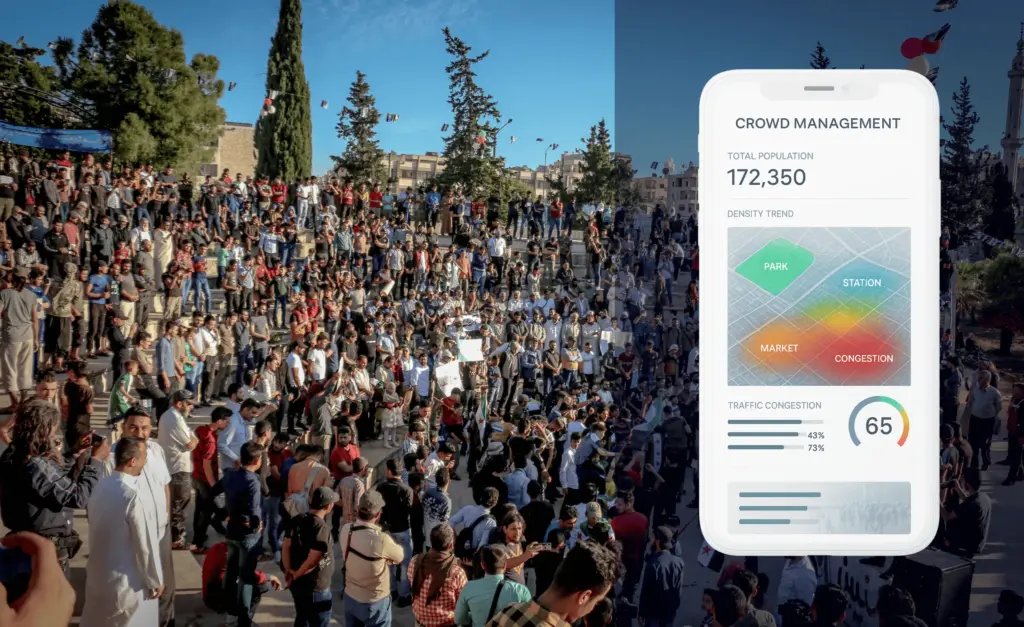
In the context of smart cities, AI-powered crowd management goes well beyond just event locations. It turns into a vital component of transportation planning and city management.
AI is used by smart cities to control pedestrian traffic at busy crosswalks, transit hubs, and subway stations. When AI crowd management is integrated with traffic systems, it helps control vehicle and pedestrian movement, improving signal timings, reducing traffic, and making areas more walkable. These systems are used by law enforcement to monitor crowd safety during festivals, public gatherings, and protests. They can find possible flashpoints and assign staff proactively rather than reactively by using predictive analytics.
By incorporating AI data into city digital twins, urban planners can gain long-term insights about infrastructure needs. They can simulate how a new shopping centre or public park will influence foot traffic before construction starts.
Examples include Singapore leverages AI for continuous crowd monitoring in transport corridors; Dubai integrates predictive analytics into event management dashboards; Barcelona’s smart city architecture uses environmental sensors and AI to improve public space utilization.
Data tells the story clearly. Research has indicated that human accuracy in extended visual monitoring can fall by more than 15% within just 30 minutes of sustained observation. This does not hold true for AI-based systems, which have uniform accuracy regardless of time, location, or workload.
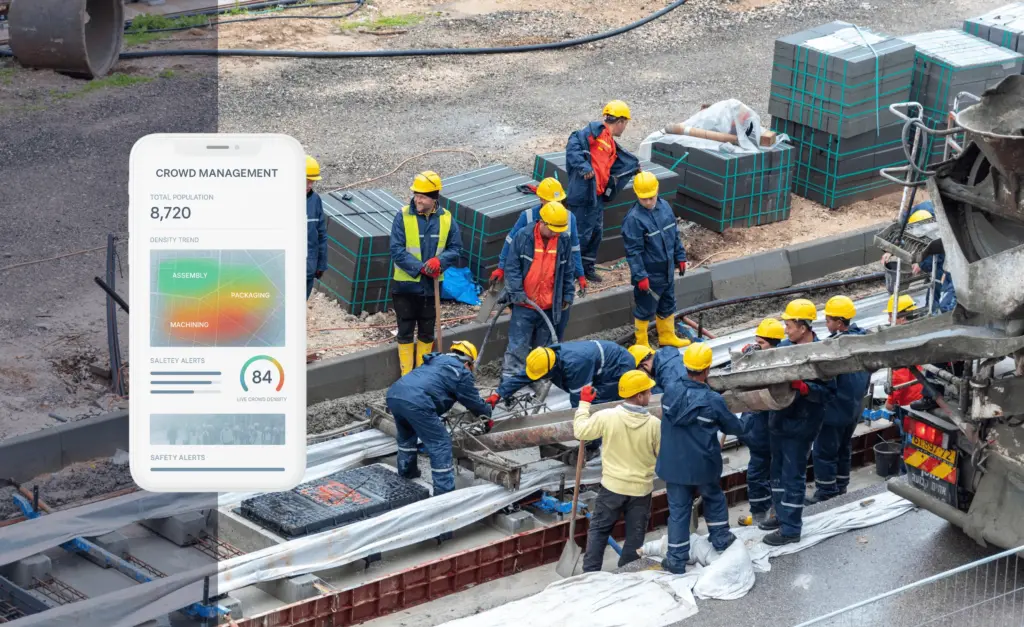
While smart cities benefit at scale, enterprises too are recognizing the power of AI-driven crowd oversight within their own environments.
Extensive campuses, manufacturing facilities, airports, and retail centres accommodate thousands of individuals each day. An advanced crowd management system improves safety and operational effectiveness in these areas.
In manufacturing plants, AI can track crowd density in critical areas, ensuring adherence to safety standards. In corporate environments, it can assess space usage trends to enhance designs or energy consumption. Retail environments can gain enhanced understanding of customer movement, time spent, and engagement areas — facilitating improved design and staffing choices.
These crowd management solutions also strengthen emergency preparedness. During fire drills or real evacuation events, AI systems can simulate exit flows, calculate optimal escape paths, and relay live updates to on-ground teams.
For enterprises, the advantage is not just safety — it’s continuity, efficiency, and data-driven facility management.
Implementation Challenges and Best Practices
Adopting AI-based crowd management is an organizational and infrastructural transformation. The challenge is less in implementing sensors or software and more in harmonizing systems, individuals, and regulations with a new approach to intelligence-led safety.
Significant implementation difficulties frequently arise at three different levels.
- Infrastructure fragmentation — numerous cities and organizations utilize legacy surveillance systems with incompatible equipment or obsolete analytics. Incorporating AI layers throughout these ecosystems necessitates systematic mapping, network enhancements, and data normalization.
- Operational readiness — crowd control staff, experienced in visual observation, require training to understand AI-generated insights and convert them quickly into effective actions on the ground.
- Budget and governance alignment — major implementations require clear definitions of responsibility, upkeep, and long-term cost-sharing between departments or agencies.
Best Practices for Effective Implementation
Start with pilot deployments: Before implementing AI crowd analytics across the city or company, test it in high-risk or densely populated areas like stadium entrances, transit routes, or manufacturing assembly lines.
- Prioritize data quality: Predictive accuracy depends on the accuracy of the data inputs, so make sure that cameras are positioned correctly, sensors are calibrated, and data workflows are clearly defined.
- Adopt phased rollouts: To enable continuous learning, adaptations, and staff acclimatisation without interfering with ongoing business operations, introduce the system gradually.
- Promote cross-functional collaboration: Encourage cross-functional cooperation by providing unified performance metrics to urban planners, IT departments, and safety teams to facilitate integrated decision-making.
- Invest in change management: Employees can better understand AI insights and respond to them with confidence if they receive organised training and clear communication.
- Maintain transparency: Inform stakeholders about objectives, methods, and data handling to build trust and promote acceptance.
Data Governance and Ethical Frameworks in AI Crowd Management
As AI systems gain visibility into public movement, the question of how data is handled becomes central to both trust and legitimacy. Modern crowd management systems increasingly adopt privacy-preserving architectures. Instead of identifying individuals, algorithms focus on non-personal attributes such as density, trajectory, and clustering. Video feeds can be processed at the edge — directly on local devices — ensuring that sensitive imagery never leaves the site. Data retention policies define clear expiry cycles, and anonymization ensures that personal identities remain protected.
Compliance with global and national regulations — such as the GDPR in Europe and India’s Digital Personal Data Protection Act (DPDP) — is essential. These frameworks encourage transparency about data collection, processing intent, and retention duration. Equally important is algorithmic accountability: ensuring that models remain unbiased, auditable, and explainable. Regular audits and stakeholder transparency build public confidence and reduce the risk of misuse or misinterpretation. Here, AI crowd management becomes an instrument of responsible intelligence, where civic safety and privacy coexist. Ethical frameworks ensure that innovation safeguards human dignity as effectively as it safeguards public spaces.
KPIs and ROI in AI Crowd Management
The true measure of an AI crowd management system lies in the outcomes it enables in terms of safety, efficiency, and operational foresight. Decision-makers increasingly evaluate these systems through quantifiable performance indicators.
Typical indicators of success include:
- Reduced emergency response time — faster detection and coordination during incidents or evacuations.
- Improved crowd flow rate — smoother movement through bottlenecks and entry/exit points.
- Lower incident frequency — fewer cases of congestion, panic, or non-compliance.
- Faster evacuation efficiency — optimized route guidance and reduced clearance time during drills or real emergencies.
- Smoother pedestrian–vehicle synchronization — balanced coordination between human and vehicular movement in smart cities.
- Reduced congestion duration — improved throughput and shorter peak density periods.
- Higher commuter or visitor satisfaction — enhanced experience through better movement planning and reduced wait times.
- Optimized space utilization — data-driven layout improvements across campuses, terminals, or retail environments.
- Better resource allocation — more efficient deployment of personnel and safety assets based on predictive insights.
- Compliance with safety and regulatory norms — continuous monitoring that ensures adherence to prescribed capacity and safety standards.
The Future of Crowd Management
The evolution of AI-driven crowd intelligence is still in its early chapters. The coming decade will witness an even deeper fusion of technologies and disciplines.
- Edge AI and 5G: Ultra-low latency networks will allow instant analysis of video and sensor data, making response times nearly instantaneous.
- Behavioural Analytics: Systems will evolve beyond counting and density to interpret emotion, intent, and sentiment in crowd behaviour.
- Simulation and Training Models: Digital twin technology will allow planners to simulate various crowd scenarios for pre-event training and optimization.
- Privacy and Ethics: With growing capabilities come responsibilities. Future systems will emphasize anonymized data processing, algorithmic transparency, and bias mitigation to ensure ethical crowd crisis management.
In this next phase, AI crowd management will shift from being an assistive technology to an autonomous layer of safety infrastructure — capable of sensing, deciding, and acting without constant human intervention. Cities and enterprises alike will rely on it as the invisible backbone of their safety and mobility systems.
Crowd management has always been about balance — between freedom of movement and the need for order. The infusion of AI into this domain redefines that balance through foresight.
By transforming static video feeds into predictive intelligence, AI crowd management replaces reaction with anticipation. It enables operators to understand how crowds move, how risks evolve, and how safety can be maintained without disrupting natural flow.
Whether in a city square, a concert arena, or an enterprise campus, the new era of crowd intelligence is about balance between people, space, and data. It’s about creating environments that not only respond to human movement but also learn from it to become safer and more efficient over time.
At iProgrammer Solutions, we design and deploy advanced AI systems that make public and enterprise environments safer, smarter, and more efficient. Our AI crowd management platform integrates computer vision, IoT, and analytics to deliver real-time visibility and predictive control.
From density mapping and incident alerts to behavioural analytics and digital twin integration, our solutions empower decision-makers with actionable intelligence at scale. Trusted by forward-looking organizations, we combine engineering precision with ethical AI design, ensuring every solution enhances safety while respecting privacy.