Fine-Tuning vs RAG vs Hybrid Models: Choosing the Right Approach
- April 28, 2026
- Why This Decision Is Bigger Than It Looks
- Fine-Tuning: Teaching the Model How to Think in Your Context
- RAG: Letting the Model Access Knowledge Instead of Memorizing It
- Fine-Tuning vs RAG: A Practical Comparison
- When to Use RAG vs Fine-Tuning in AI Applications
- Hybrid Models: Where Real-World Systems Converge
- Hybrid AI Architecture Best Practices
- Decision Framework for RAG vs Fine-Tuning vs Hybrid
- Performance, Cost, and Scaling Realities
- Common Pitfalls That Derail AI Projects
- The Evolving Landscape of AI Model Customization
- Conclusion: Choosing with Clarity, Not Assumption
- About iProgrammer Solutions
- FAQs
The conversation around fine-tuning vs RAG vs hybrid models has picked up a lot lately, and for good reason. It mirrors a situation that played out not too long ago, when a team was showcasing us an AI assistant they had built.
They had built an AI assistant for internal operations. It could answer questions, generate summaries, and even draft responses for clients. The demo looked sharp. The outputs were fluent. Everyone was convinced this would reduce hours of manual effort.
Then someone asked a simple question- “Can it pull the latest policy update from last week?”
It couldn’t. The call went silent for a moment. Not because the system failed, but because it failed in a way that looked correct. That is the moment most teams underestimate and where the discussion around fine tuning vs RAG stops being theoretical. It becomes operational. It becomes expensive. And if handled poorly, it becomes hard to fix later.
Most systems do not fail because the model is weak. They fail because the architecture was not designed for how the system would actually be used. This blog is a breakdown of how these approaches behave when systems move from controlled demos to real-world usage. If you are building AI that needs to scale, adapt, and stay trustworthy, the architecture you choose will decide how far you can go.
Why This Decision Is Bigger Than It Looks
Most teams begin with a model. Few begin with a system.
Large language models are trained on vast datasets. They are excellent at generating language. But they are not aware of your business logic, your internal knowledge, or your compliance requirements. That gap shows up quickly in production environments.
- A sales assistant misses product nuances
- A support bot references outdated documentation
- A compliance tool cannot justify its answers
The problem is not intelligence. It is alignment. This is where LLM optimization techniques come into play. They are not about making models smarter. They are about making them useful in context.
The three dominant approaches are:
- Fine-tuning
- Retrieval-Augmented Generation (RAG)
- Hybrid architectures
Each approach addresses a different layer of the problem. Understanding that separation is critical before making any decision.
Fine-Tuning: Teaching the Model How to Think in Your Context
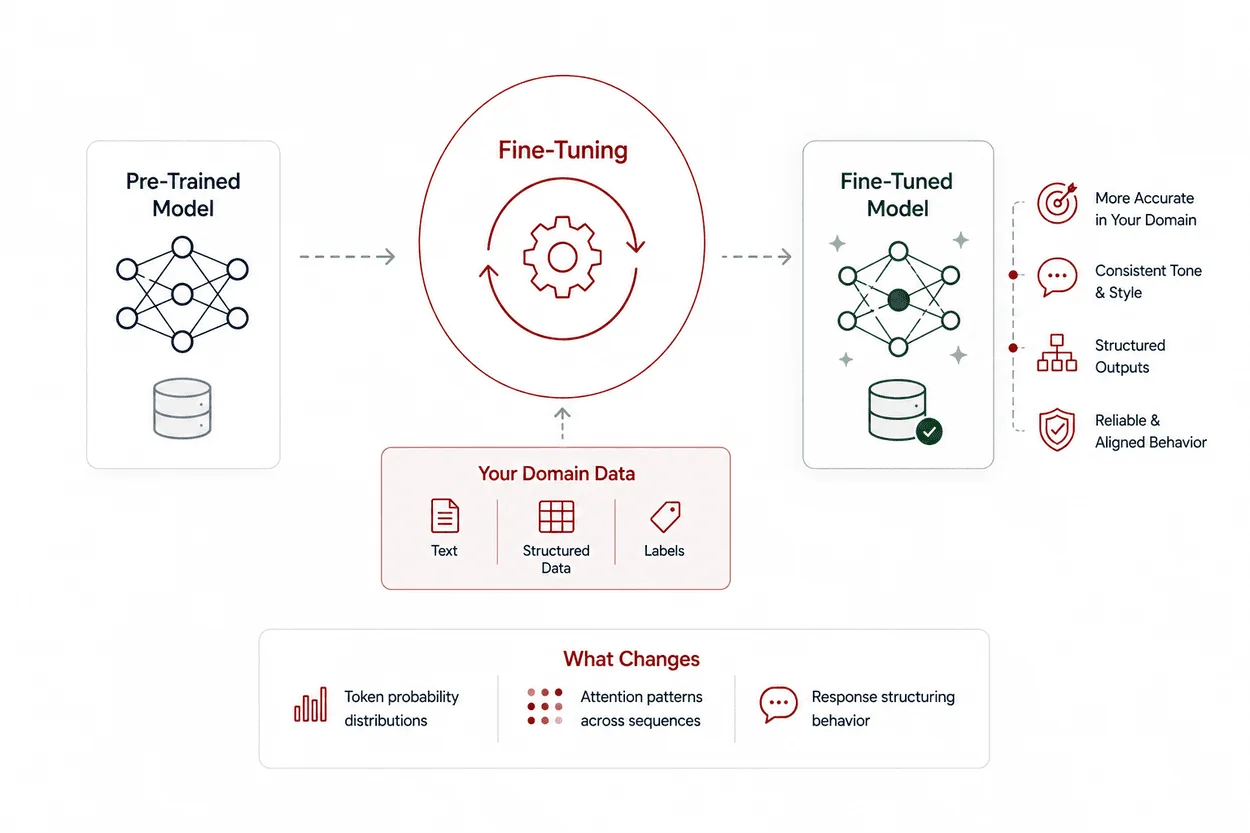
Fine-tuning changes the model itself. You take a pre-trained model and train it further on your domain data. This process adjusts internal weights so the model begins to internalize patterns specific to your use case.
It is not just learning new information. It is learning how to respond.
What Actually Changes During Fine-Tuning
At a technical level, fine-tuning modifies:
- Token probability distributions
- Attention patterns across sequences
- Response structuring behavior
Over time, the model becomes biased toward your domain. This is why fine-tuned systems often feel more “on-brand” or “context-aware.” They are not retrieving knowledge. They are generating based on learned patterns.
Where Fine-Tuning Performs Exceptionally Well
Fine-tuning excels when behavior matters more than knowledge freshness.
- Structured outputs like contracts, reports, or classifications
- Domain-heavy reasoning such as legal or medical interpretation
- Consistent tone and formatting across large volumes
For example:
- A legal assistant that extracts clauses in a fixed structure
- A finance model that classifies transactions with high precision
- A marketing assistant that writes in a strict brand voice
In these cases, variability is a problem. Fine-tuning reduces that variability.
Where Fine-Tuning Breaks Down
Fine-tuning introduces rigidity. Once knowledge is embedded, updating it requires retraining. That creates several challenges:
- Data dependency: You need large, clean, labelled datasets
- Training overhead: Retraining cycles can take hours or days
- Model drift: Over time, real-world data changes, but the model does not
- Overfitting risks: Too much specialization can reduce general reasoning
- Knowledge staleness: Updates require retraining, slowing adaptation to new data
There is also an architectural implication. Fine-tuned models become part of your core enterprise AI architecture. They require version control, monitoring, rollback strategies, and evaluation pipelines. This is not a one-time effort. It is an ongoing system.
RAG: Letting the Model Access Knowledge Instead of Memorizing It
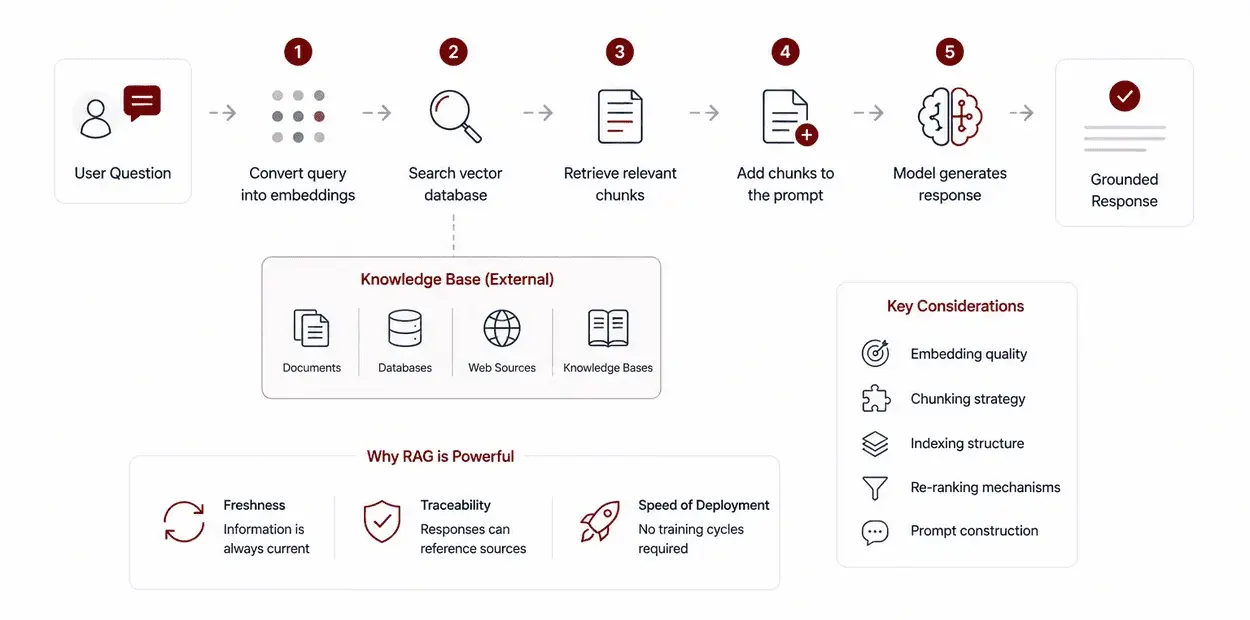
Retrieval-Augmented Generation takes a different path. Instead of teaching the model everything, it gives the model access to information at runtime. When a user asks a question:
- The system converts the query into embeddings
- It searches a vector database
- It retrieves relevant chunks of information
- These chunks are added to the prompt
- The model generates a response grounded in that context
The model remains unchanged. The knowledge layer becomes external. If you want to understand the mechanics in more detail, this beginner’s guide to Retrieval-Augmented Generation explains the retrieval pipeline clearly.
What Makes RAG Powerful
RAG is built for environments where information changes frequently.
- Product updates
- Policy revisions
- Market data
- Knowledge base expansion
Instead of retraining, you update the data source. This gives RAG three key advantages:
- Freshness: Information is always current
- Traceability: Responses can reference sources
- Speed of deployment: No training cycles required
The Hidden Complexity of RAG Systems
RAG looks simple on the surface. In practice, it is a system design problem. Performance depends on several factors:
- Embedding quality: Poor embeddings lead to irrelevant retrieval.
- Chunking strategy: Large chunks reduce precision. Small chunks lose context.
- Indexing structure: Flat indexes scale poorly. Hierarchical indexing improves retrieval.
- Re-ranking mechanisms: Initial retrieval is often noisy. Re-ranking improves relevance.
- Prompt construction: How retrieved data is injected into prompts affects output quality.
Each of these layers requires tuning. This is why many RAG implementations underperform. Not because the concept is flawed, but because the system is incomplete.
Beyond these layers, RAG systems also face subtle failure modes that are easy to miss in early testing. Retrieval can surface partially relevant documents that introduce noise into the prompt. When this happens, the model often produces answers that are coherent but contextually incorrect.
There is also the risk of prompt injection through retrieved content, where malicious or poorly structured data influences the final output. In addition, context window limits can force systems to truncate useful information, especially when multiple documents are retrieved. These issues do not appear in controlled demos but become visible under real usage conditions.
Where RAG Falls Short
RAG improves knowledge access. It does not enforce behavior.
- It cannot guarantee structured outputs
- It struggles with deep domain reasoning
- It depends heavily on retrieval accuracy
- It introduces latency due to additional steps
RAG answers questions better. It does not necessarily solve complex tasks better.
Fine-Tuning vs RAG: A Practical Comparison
The fine tuning vs RAG discussion becomes clearer when viewed through system behavior.
| Dimension | Fine-Tuning | RAG |
|---|---|---|
| Core Purpose | Behavioral alignment | Knowledge access |
| Model Modification | Yes | No |
| Knowledge Updates | Requires retraining | Instant via data updates |
| Latency | Low | Moderate to high |
| Explainability | Limited | Strong with citations |
| Data Requirement | High-quality labeled data | Structured knowledge base |
| Best Use Case | Repetitive, structured tasks | Dynamic information retrieval |
The key takeaway is simple.
- Fine-tuning controls how the model behaves.
- RAG controls what the model knows at the moment of response.
When to Use RAG vs Fine-Tuning in AI Applications
Choosing the right approach requires clarity about the problem you are solving.
| Use Fine-Tuning When | Use RAG When |
|---|---|
|
|
Many teams struggle here because they try to solve both problems with one approach. That is where systems begin to break.
Designing for Context Quality
Most teams assume better models will improve output quality. In practice, context quality has a larger impact than model choice.
In RAG and hybrid systems, the model is only as good as the context it receives. Poor context leads to confident but incorrect answers, even with strong models.
Key factors that influence context quality include:
- Chunk relevance over chunk size: Smaller chunks improve precision, but risk losing semantic continuity. Larger chunks preserve meaning but introduce noise. Balancing this is critical.
- Context ordering: The sequence in which retrieved documents are injected affects how the model prioritizes information. Earlier tokens often carry more weight.
- Redundancy control: Repeated or overlapping chunks can bias the model toward certain answers, reducing response diversity and accuracy.
- Noise filtering: Not all retrieved data should be passed to the model. Filtering low-confidence results improves output consistency.
High-performing systems treat context construction as a first-class layer, not a byproduct of retrieval.
Hybrid Models: Where Real-World Systems Converge
In production environments, most use cases are not purely behavioral or purely knowledge-driven. They are both.
For example-
- A healthcare assistant needs medical reasoning and updated clinical guidelines.
- A legal tool needs structured logic and current case references.
- A sales copilot needs positioning consistency and real-time CRM data.
This is where hybrid models become necessary.
How Hybrid Architectures Work
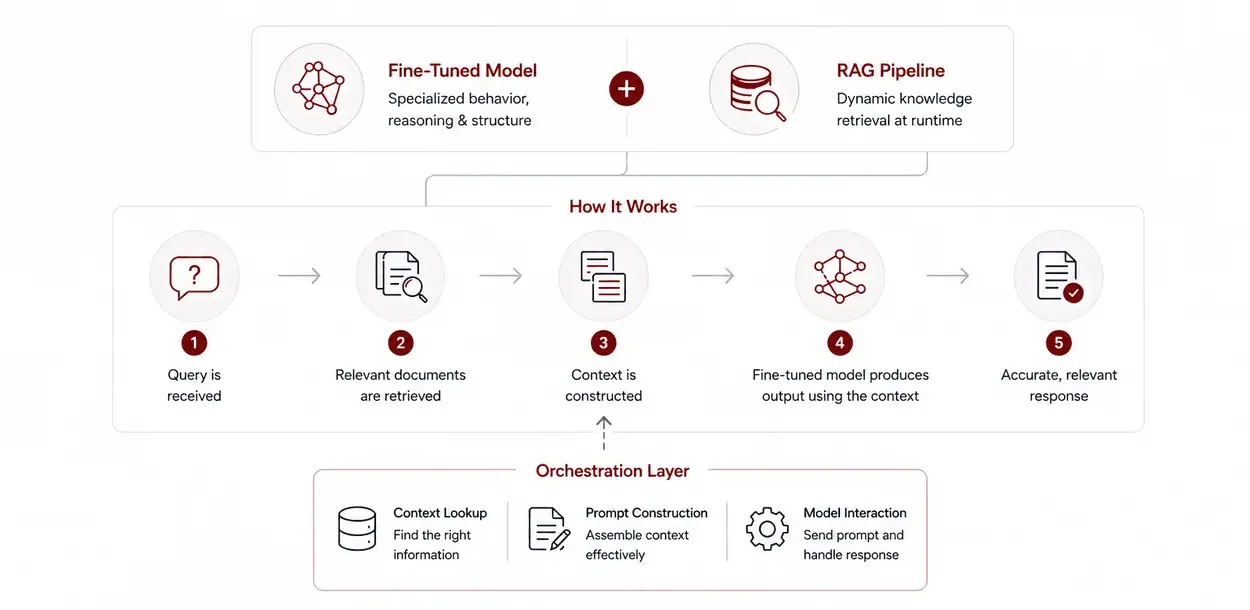
A hybrid system combines:
- A fine-tuned model for behavior and reasoning
- A RAG pipeline for dynamic knowledge retrieval
The flow looks like this:
- Query is received
- Relevant documents are retrieved
- Context is constructed
- Fine-tuned model produces output based on the retrieved context
This results in creating a system that is both specific and flexible.
On a practical level, any hybrid solution needs an orchestration layer, whose main responsibilities include context lookup, prompt creation, and interacting with the model. That is why the orchestration layer becomes very important when it comes to selecting the correct context.
Hybrid systems offer great power and flexibility, but require careful engineering.
- Define clear boundaries: Separate duties. Fine-tuning involves logic and reasoning, while RAG revolves around retrieving data.
- Optimize retrieval first: Even the most advanced models will perform poorly when they receive insufficient context; hence, optimizing embeddings, chunking, and indexing is vital.
- Control latency: The introduction of various layers by hybrid models implies managing the latency effectively, such as through caching and parallel retrieval techniques.
- Build evaluation pipelines: Measure precision@k, recall@k, response accuracy, hallucination, and latency regularly.
- Plan for iteration: Any hybrid model is iterative, implying that starting simple is always better than complicating things right from the start.
Decision Framework for RAG vs Fine-Tuning vs Hybrid
| Factor | RAG | Fine-Tuning | Hybrid |
|---|---|---|---|
| Knowledge Volatility | High | Low | Mixed |
| Behavioral Precision | Medium | High | High |
| Time to Market | Fast | Moderate | Slower |
| Cost Structure | Operational | Upfront | Combined |
| System Complexity | Medium | High | Very High |
| Best Fit | Knowledge access | Task specialization | Complex enterprise systems |
This table helps frame the RAG vs fine tuning vs hybrid decision based on real constraints.
Performance, Cost, and Scaling Realities
A generative AI models comparison is incomplete without operational context.
| Latency |
|
| Cost |
|
| Scalability |
|
Ignoring these factors leads to systems that work in demos but fail in production.
Latency Engineering: The Hidden Constraint in AI Systems
Latency is often treated as a secondary concern during development. In production, it becomes a defining constraint.
Each architectural choice adds latency:
- Retrieval pipelines introduce search and ranking delays
- Larger prompts increase generation time
- Hybrid orchestration adds multiple processing steps
Without optimization, response times degrade quickly as systems scale.
Effective strategies include:
- Asynchronous retrieval: Fetch documents concurrently instead of fetching sequentially
- Context caching: Store frequent queries and responses to reduce repeated computation
- Adaptive retrieval depth: Adjust the number of retrieved documents based on query complexity
- Model routing: Assign small models for easy queries and large models for difficult queries
Latency is not just a performance metric. It directly impacts adoption. Slow systems lose user trust, regardless of accuracy.
Common Pitfalls That Derail AI Projects
Even well-designed initiatives fail due to avoidable mistakes.
- Solving the wrong problem: Rather than identifying metrics for the models, companies look at the models’ capabilities, leading to solutions that perform well by themselves, but not when placed into production because of how important accuracy, latency, and impact are.
- Underestimating data preparation: Fine-tuning requires clean data, and RAG needs structured documents with good embedding; most cases go wrong because of inadequate data processing pipelines.
- Choosing hybrid too early: Hybrid models necessitate orchestration logic, retrieval pipelines, and model dependencies. Without testing the basic use case, one gets a complicated system with latency accumulation and more failure points.
- Ignoring observability and evaluation: AI systems degrade through subtle drops in retrieval precision, increased hallucination rates, and inconsistent outputs, and without tracking metrics like precision@k, response accuracy, latency, and user feedback loops, these issues remain invisible until adoption declines.
- Overlooking system integration: AI models rarely operate in isolation, and without tight integration into existing systems like CRMs, ERPs, or internal tools, teams face data silos, inconsistent context injection, and fragmented user experiences that limit real business value.
The Evolving Landscape of AI Model Customization
The conversation around AI model customization is shifting. Organizations are moving from model-centric thinking to system-centric thinking. Emerging trends include:
- Shift from models to systems: The focus is moving from selecting or tuning individual models to designing end-to-end systems that combine retrieval, generation, orchestration, and evaluation layers to deliver consistent performance in real-world conditions.
- Retrieval-aware fine-tuning: Emerging approaches train models with awareness of retrieved context, improving how they interpret external knowledge and reducing conflicts between static training data and dynamic information sources.
- Context-aware prompt orchestration: Prompting is evolving into a dynamic control layer where inputs are structured based on user intent, retrieval outputs, and session context, enabling better reasoning without modifying model weights.
- Rise of smaller, specialized models: Smaller models fine-tuned for specific tasks are gaining traction due to lower latency, reduced cost per token, and better control, especially in enterprise environments where efficiency and predictability matter.
- Stronger evaluation and guardrails: Modern systems incorporate layered controls including pre-generation filters, in-generation constraints, and post-generation validation, along with metrics like hallucination detection, response scoring, and policy enforcement.
- Continuous adaptation over static deployment: AI systems are shifting toward iterative improvement cycles where retrieval pipelines, prompts, and model behavior are continuously refined using real-world feedback, rather than relying on one-time training and deployment.
Conclusion: Choosing with Clarity, Not Assumption
The fine tuning vs RAG decision is rarely about choosing one over the other. It is about understanding where your system is most likely to fail.
If failure comes from inconsistent reasoning, fine-tuning becomes critical. If it comes from outdated or missing information, RAG is the better foundation. When both risks exist, hybrid systems provide a path forward, but only with the right level of control and discipline.
The difference between a working prototype and a reliable AI system is not the model. It is the architecture decisions made early and refined over time.
About iProgrammer Solutions
At iProgrammer Solutions, we design AI systems that go beyond prototypes. Our focus is on building scalable, production-ready architectures that align with real business needs.
From RAG pipelines to fine-tuned models and hybrid systems, we help organizations make decisions that hold up under real-world pressure. If you are planning to build AI systems that are reliable, scalable, and aligned with real business needs, explore our AI development services.
Choose RAG when your system needs access to frequently changing or large external knowledge sources without retraining. Opt for fine-tuning when you need consistent behavior, structured outputs, or deep alignment with domain-specific patterns.
A production-grade RAG pipeline depends on clean data ingestion, high-quality embeddings, and well-structured chunking for effective retrieval. It also requires efficient indexing, relevance re-ranking, and monitoring to maintain performance over time.
Hybrid architectures increase flexibility by combining retrieval and learned behavior, making systems more adaptable to varied use cases. However, they introduce trade-offs in latency, infrastructure cost, and orchestration complexity that must be actively managed.
Embeddings define how well semantic similarity is captured, directly influencing retrieval accuracy. Poor embedding quality leads to irrelevant context, which degrades the final response even if the model itself is strong.
Evaluation ensures the system continues to meet accuracy and relevance benchmarks as inputs and conditions evolve. Without it, performance drift and silent failures can undermine reliability in production.
As a Content Strategist, I craft narratives that make technology feel approachable and purposeful. Whether it’s a new AI solution or a legacy service, I focus on creating content that’s clear, structured, and aligned with what matters to our readers.