How is AI transforming Financial Services in Australia? Use Cases & Challenges
- May 19, 2026
- Why Australia Is a Strong Ground for AI in Finance
- Key AI Use Cases in Australian Financial Services
- How Banks in Australia Use AI for Fraud Detection
- Regulatory Landscape in Australia
- Challenges of AI in Financial Services Australia
- Challenges vs Mitigation Strategies
- The Technical Shift Behind AI Adoption
- How AI Systems Are Deployed and Operated in Financial Services
- The Role of RAG and Hybrid AI Models
- AI Tools and Platforms Used in Financial Services
- What the Future Looks Like
- Conclusion
- About iProgrammer Solutions
- FAQs
Walk into any mid-sized bank in Australia and sit with their operations team for a day. You will hear concerns about reconciliation delays, fraud alerts that trigger too late, compliance reviews that take weeks, and customer queries that pile up faster than they can be resolved.
That is where the conversation of AI in financial services starts. AI employs techniques such as machine learning, data modeling, and intelligent automation to analyze financial information, find patterns, and aid in decision-making. This allows it to provide real-time insights in transactions, risk assessment, compliance, and customer interactions that traditional methods would be unable to manage.
In Australia, financial organizations are not embracing AI due to its popularity. They are embracing AI as it offers solutions for the existing problems that the traditional models cannot handle. The transformation is slow, but it can be seen in core banking, wealth management, insurance, and the fintech industry.
This blog breaks down how AI in financial services is actively transforming the Australian market. It addresses practical applications, regulatory requirements, and technical issues that need to be considered by decision-makers.
Why Australia Is a Strong Ground for AI in Finance
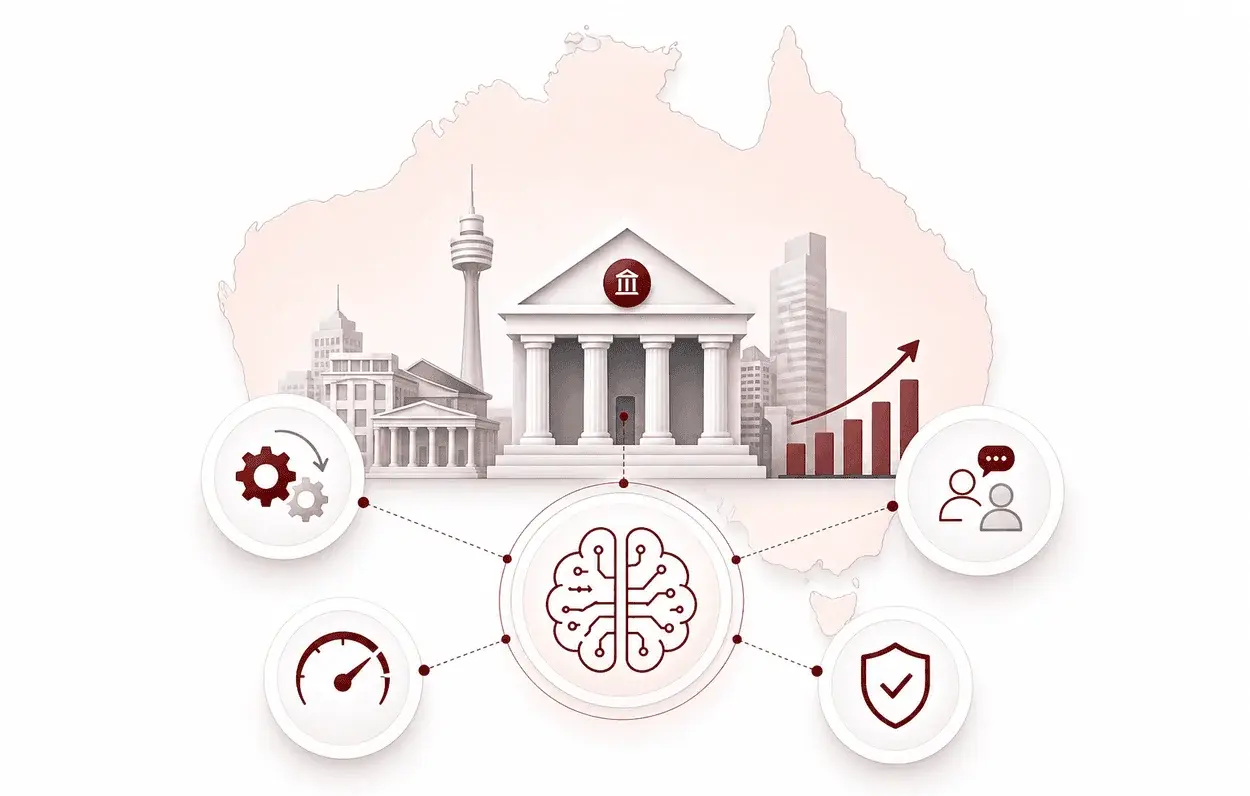
Australia has a unique financial landscape. There is only a handful of big banks in the banking sector. These include CBA, Westpac, NAB, and ANZ, In addition, there has been some progress in developing payment systems, lending technology, and digital wealth management services by fintechs.
This creates a dual pressure. Large companies have to upgrade their legacy models without affecting their operations. Fintech organizations have to expand quickly while staying compliant. AI fits into this tension naturally.
- It reduces manual workload in high-volume processes
- It improves decision accuracy in lending and risk
- It enables real-time responses across customer channels
- It supports compliance in a highly regulated environment
The rise of AI in finance industry in Australia is not just about automation. It is about enabling systems to respond faster than traditional rule-based architectures.
Key AI Use Cases in Australian Financial Services
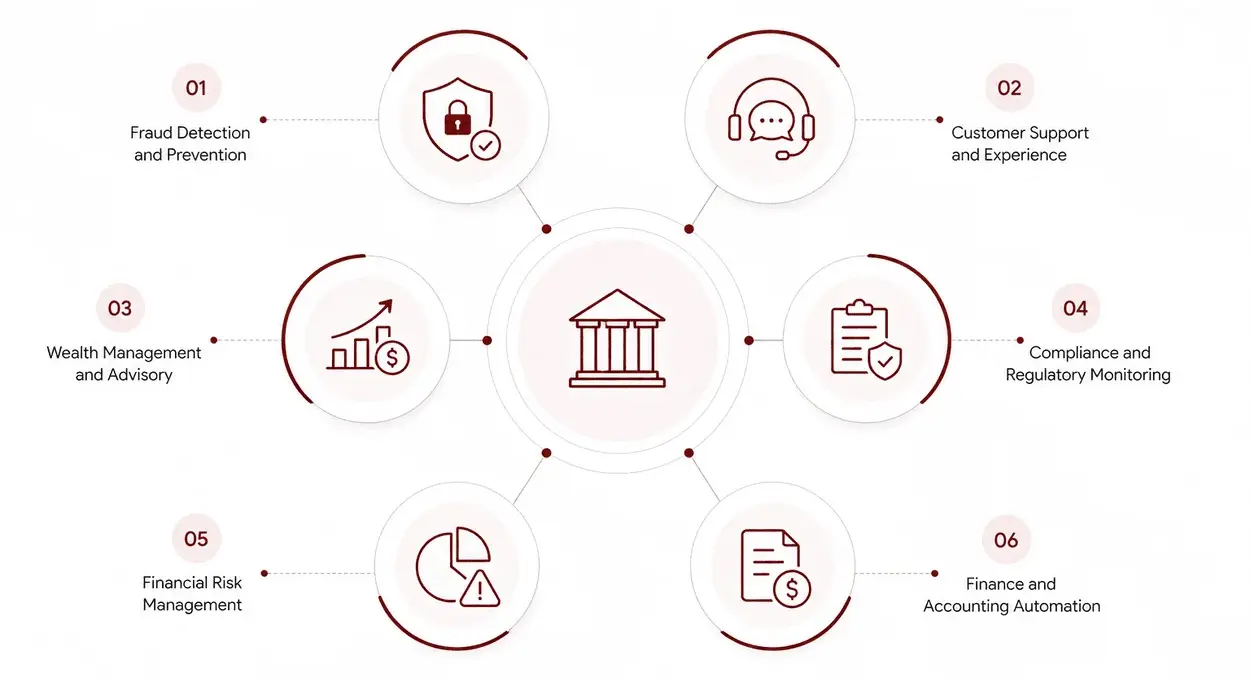
AI adoption in Australia is not theoretical. It is embedded into multiple functions across financial institutions. Each use case solves a specific operational bottleneck.
1. Fraud Detection and Prevention
Fraud is one of the biggest drivers for AI adoption. Australian banks deal with increasing digital transaction volumes. This makes traditional rule-based fraud systems insufficient.
AI models analyze transaction patterns in real time. They detect anomalies based on behavior rather than static thresholds.
How it works:
- Machine learning models track spending behavior
- They flag deviations instantly
- Systems adapt based on new fraud patterns
- Alerts are prioritized based on risk scoring
This has significantly improved AI fraud detection Australia capabilities. Banks now reduce false positives while improving detection rates. This directly impacts customer trust and operational efficiency.
2. Customer Support and Experience
Customer expectations in Australia have shifted. People expect instant responses across mobile apps, chat, and call centers. AI-driven systems are helping banks handle this scale.
Use cases include:
- AI chatbots for common queries
- Voice assistants for IVR systems
- Automated ticket classification
- Sentiment analysis for escalations
These systems reduce load on support teams. At the same time, they improve response times.
However, the real value lies in context awareness. AI systems now understand customer intent better than rule-based bots. This is where AI in banking and finance is redefining customer interaction.
3. Wealth Management and Advisory
Australia has a growing demand for personalized financial advice. Traditional advisory models are expensive and not scalable.
AI is changing this.
Key capabilities:
- Portfolio optimization based on risk appetite
- Real-time market analysis
- Personalized investment recommendations
- Automated rebalancing
Robo-advisors are becoming more sophisticated. They are no longer limited to basic asset allocation.
They now integrate behavioral data, market signals, and macroeconomic indicators. This improves accessibility to wealth management services across customer segments.
4. Compliance and Regulatory Monitoring
Compliance is one of the most complex areas in financial services. Australian regulations require strict monitoring of transactions, reporting, and customer data handling. AI is helping institutions manage this complexity.
Applications include:
- Transaction monitoring for suspicious activity
- Automated reporting for regulatory bodies
- Document processing using NLP
- Risk scoring for compliance breaches
This is where AI compliance banking solutions are gaining traction. Rather than performing manual audits, businesses can adopt AI-driven audit systems. This approach minimizes errors and increases audit preparedness.
5. Financial Risk Management
Financial risk management is central to financial services. AI technology is enhancing organizations’ ability to manage financial risks.
Capabilities include:
- Credit scoring using alternative data
- Market risk prediction using real-time analytics
- Liquidity risk monitoring
- Stress testing using simulation models
The role of AI in financial risk management is expanding rapidly. Risk modeling systems depend largely on past data. AI models incorporate dynamic variables. This improves prediction accuracy.
6. Finance and Accounting Automation
Back-office work is something that is often neglected. Yet, it is extremely resource-consuming. And now, AI is transforming this field too.
Use cases include:
- Automated reconciliation
- Invoice processing
- Expense categorization
- Financial forecasting
The adoption of AI in finance and accounting reduces manual effort and improves accuracy. This also frees up teams to focus on strategic activities rather than repetitive tasks.
AI Use Cases Across Financial Functions
| Function Area | AI Application | Key Benefit | Impact Level |
|---|---|---|---|
| Fraud Detection | Real-time anomaly detection | Reduced fraud losses | High |
| Customer Support | AI chatbots and voice assistants | Faster response times | High |
| Wealth Management | Robo-advisory and portfolio optimization | Personalized investment strategies | Medium |
| Compliance | Automated monitoring and reporting | Reduced regulatory risk | High |
| Risk Management | Predictive analytics | Improved risk assessment | High |
| Finance & Accounting | Automation and forecasting | Operational efficiency | Medium |
How Banks in Australia Use AI for Fraud Detection
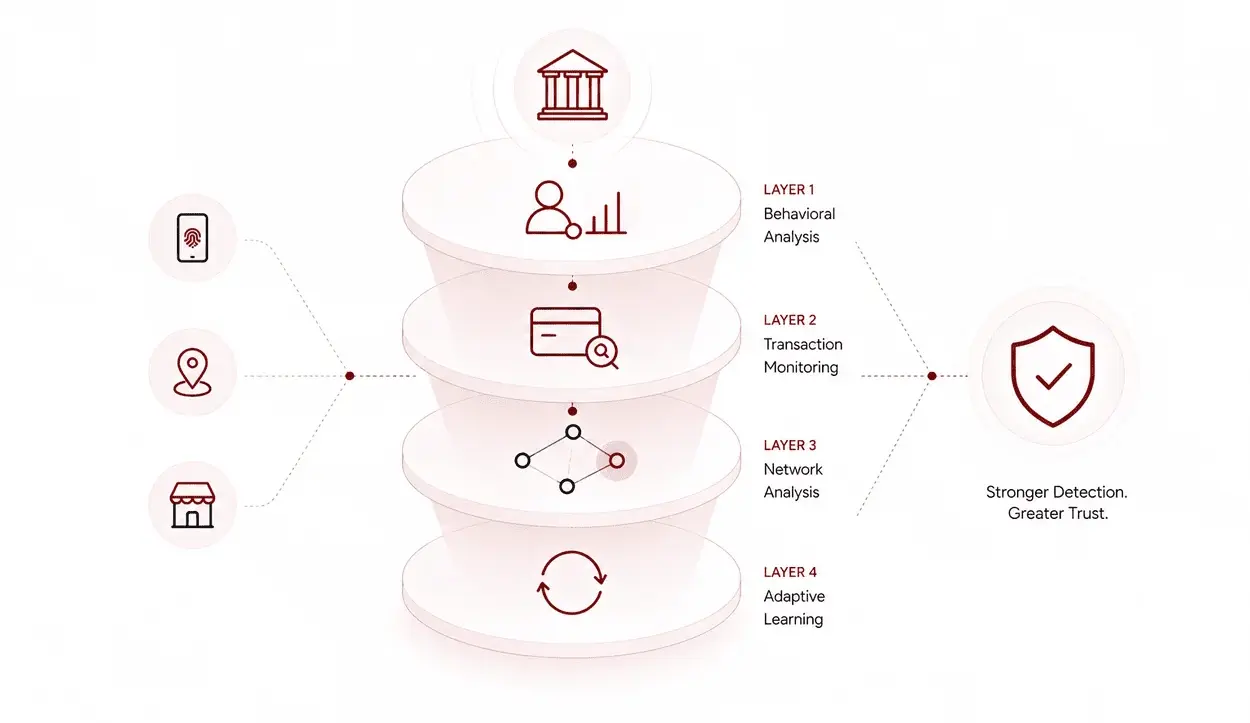
Fraud detection deserves deeper attention because it directly impacts revenue and trust.
Australian banks use layered AI models.
Layer 1: Behavioral Analysis
Tracks user spending habits and device usage patterns.
Layer 2: Transaction Monitoring
Evaluates each transaction in real time.
Layer 3: Network Analysis
Identifies connections between fraudulent accounts.
Layer 4: Adaptive Learning
Updates models based on new fraud cases.
This multi-layered approach improves detection rates significantly. External data sources also find applications within banks. This includes device fingerprints, geographic location, and merchant data. The outcome is an effective fraud detection mechanism that continuously evolves.
Regulatory Landscape in Australia
The implementation of AI within the financial services industry has to conform to rigorous regulations. Australia has a clear regulatory structure.
Key regulators include:
- The Australian Prudential Regulation Authority (APRA)
- The Australian Securities and Investments Commission (ASIC)
- The Reserve Bank of Australia (RBA)
These bodies ensure compliance with risk management, data privacy, and operational resilience guidelines.
Key regulatory considerations:
- Data Privacy: AI applications have to adhere to data protection regulations. Customer data usage must be transparent.
- Model Explainability: Banks need to interpret their AI algorithms. This is crucial in granting credit and issuing fraud warnings.
- Bias and Fairness: AI should not have a discriminatory effect.
- Operational Risk: AI technologies should be reliable and auditable.
Regulations do not impede AI implementation. It shapes how AI is implemented.
Challenges of AI in Financial Services Australia
While there are many advantages, implementing AI is no easy task.
1. Legacy System Integration
Many Australian banks operate on legacy infrastructure. Integrating AI with these systems is complex.
- Data silos limit model performance
- APIs may not support real-time processing
- System upgrades require significant investment
2. Data Quality and Availability
AI models depend on high-quality data.
Challenges include:
- Incomplete datasets
- Inconsistent formats
- Limited access to external data
Poor data quality leads to inaccurate predictions.
3. Model Transparency
AI models often act as black boxes.
This creates issues in regulated environments.
Institutions must ensure:
- Clear decision logic
- Audit trails
- Explainable outputs
4. Talent Shortage
AI expertise is limited. Financial institutions compete with tech companies for talent. This slows down implementation.
5. Cost of Implementation
AI adoption requires investment.
Costs include:
- Infrastructure
- Data engineering
- Model development
- Ongoing maintenance
Return on investment must be clearly defined.
6. Cybersecurity Risks
AI systems introduce new attack surfaces.
Threats include:
- Data poisoning
- Model manipulation
- Adversarial attacks
Security must be integrated into AI architecture.
Challenges vs Mitigation Strategies
| Challenge | Description | Mitigation Strategy |
|---|---|---|
| Legacy Systems | Outdated infrastructure | API-based integration layers |
| Data Quality | Inconsistent data | Data governance frameworks |
| Model Transparency | Black-box decision making | Explainable AI models |
| Talent Shortage | Limited skilled professionals | Hybrid teams and partnerships |
| Implementation Cost | High initial investment | Phased AI adoption |
| Cybersecurity Risks | Vulnerabilities in AI systems | Secure AI pipelines and monitoring |
The Technical Shift Behind AI Adoption
Every AI application case study has its own architectural underpinning. Banks are progressively transitioning from monolithic solutions that were never intended for real-time intelligence.
The contemporary architecture for AI is based on modularity and interoperability. This will help financial institutions develop their systems without affecting basic functionality. Some of the most important elements in this context are:
- Data lakes for centralized storage: Such architectures provide centralized storage for all types of data. It includes transactional data, customer communication records, and even external datasets in their raw and processed forms.
- Real-time data pipelines: In real-time data processing, the streams keep working on ingesting and processing data. This is important for fraud detection and trading applications.
- Machine learning platforms: Platforms that facilitate the process of training, deploying, and managing machine learning models are used here. They allow for version control, monitoring, and re-training as well.
- API-driven microservices: AI capabilities can be offered as services to integrate with other channels including mobile applications, core banking systems, and other third-party platforms.
- Feature stores and model registries: This ensures uniformity of environments for training and serving. It prevents drift and increases robustness in production.
This shift enables horizontal scalability across systems. It also allows institutions to deploy AI capabilities incrementally rather than through large system overhauls.
More importantly, it supports continuous model updates. Models can be retrained using new data without affecting live systems.

This architecture reflects how AI systems are integrated within financial services environments.
- Data flows from multiple sources into centralized storage layers. It is then processed and transformed into features used for model training.
- Trained models are deployed as scalable services. These services interact directly with core banking systems and customer-facing applications.
- Performance, latency, and prediction quality metrics are monitored constantly. If any drift occurs, retraining pipelines get initiated automatically.
- The audit and compliance framework ensures that all decisions are traceable and compliant with regulatory requirements.
How AI Systems Are Deployed and Operated in Financial Services
Developing an AI model is just half of the battle won. Deploying and running the models effectively is where things can get tricky.
MLOps practices have been formally adopted by financial services companies. This will ensure accuracy and compliance of the models.
Key operational layers include:
- Model deployment and inference pipelines
Models are deployed as scalable services. High transaction rate with minimal latency is needed especially in fraud detection and trades. - Monitoring and observability
Machine Learning Models are continually observed and measured based on performance, latency, and prediction. - Model drift detection
Financial data changes rapidly. Models can become outdated if underlying patterns shift. Drift detection mechanisms trigger retraining workflows when performance drops. - Retraining and version control
Periodic retraining with new data is performed to update models. Versioning ensures that any changes made are tracked, and it becomes easier to fall back on older versions. - Human-in-the-loop systems
When human involvement is critical in the decision process, the AI system alerts human operators about these decisions. - Latency and scalability optimization
Real-time use cases require optimized inference pipelines. Some common techniques include model quantization and distributed serving. - Auditability and compliance tracking
Every AI decision must be traceable. Logs, model versions, and input data are recorded to support regulatory audits.
This layer of operations is what distinguishes experimental AI from production AI. The system makes sure that the AI provides value consistently without compromising regulatory and performance requirements.
The Role of RAG and Hybrid AI Models
Conventional AI is built on pre-trained datasets. These datasets quickly become outdated in dynamic financial environments. Modern systems are moving towards hybrid approaches that combine multiple intelligence layers.
RAG (Retrieval-Augmented Generation) is becoming increasingly relevant in financial services.
It combines:
- Real-time data retrieval: Real-time data is collected from an organization’s internal database, transactional systems, or legal regulations.
- Language model capabilities: LLMs interpret and generate responses based on retrieved context. This ensures responses are both accurate and context-aware.
This approach significantly improves reliability in use cases where static knowledge fails. For example, in compliance workflows, RAG systems can reference the latest regulatory updates instead of relying on outdated training data.
In customer support, they can pull account-specific information while maintaining conversational accuracy.
Hybrid AI models go beyond RAG. They combine:
- Rule-based systems: These enforce strict business logic and regulatory constraints.
- Machine learning models: These handle prediction tasks such as risk scoring and anomaly detection.
- LLM-based reasoning layers: These manage interpretation, summarization, and decision support.
This layered approach ensures that critical financial operations remain deterministic where required, and adaptive where beneficial.
It also reduces the risk of unpredictable outputs in high-stakes environments. As a result, institutions achieve a balance between control, flexibility, and scalability.
AI systems in financial services rely on a combination of infrastructure, model development frameworks, and operational monitoring tools.
- Cloud Platforms
AWS, Microsoft Azure, and Google Cloud are used to manage large-scale data pipelines and deploy AI models. They provide secure, compliant environments suited for financial workloads. - Machine Learning Frameworks
Tools like TensorFlow, PyTorch, Scikit-learn, and XGBoost are used to build models for fraud detection, risk scoring, and financial forecasting. - MLOps and Model Lifecycle Management
Platforms such as MLflow, Kubeflow, and SageMaker pipelines handle model training, versioning, deployment, and retraining workflows. - Monitoring and Observability Tools
Systems track model performance, latency, and drift using tools like Prometheus, Grafana, and Datadog. This ensures models remain accurate and reliable in production.
These components work together to support scalable, auditable, and production-ready AI systems within regulated financial environments.
What the Future Looks Like
AI adoption in Australian financial services is still evolving.
Key trends to watch:
- Hyper-personalization: AI will use behavioral and transactional data to deliver highly tailored financial products and advisory experiences at an individual level.
- Real-time decision systems: Lending, fraud detection, and trading decisions will shift to event-driven, low-latency systems operating in milliseconds.
- Autonomous finance operations: Core back-office functions like reconciliation and compliance checks will become largely self-operating, with humans handling exceptions.
- AI governance frameworks: Institutions will strengthen model monitoring, auditability, and bias control to meet regulatory and operational requirements.
- Open banking integration: AI will leverage shared data ecosystems to enhance insights, personalization, and API-driven financial services.
- Privacy-first AI models: Techniques like federated learning will enable model training without exposing sensitive customer data.
- Continuous model optimization: Models will be retrained on live data, ensuring accuracy and adaptability to changing financial conditions.
- Predictive risk management: AI will shift risk functions from reactive reporting to early signal detection and proactive intervention.
- Human-AI collaboration: AI will augment decision-making with insights and simulations, improving speed and accuracy without replacing control.
- Enterprise-scale AI adoption: The focus will move from isolated pilots to fully integrated, production-grade AI systems with measurable impact.
The focus will shift from experimentation to operational maturity.
The transformation driven by AI in financial services in Australia is grounded in real operational needs. It is not driven by hype.
Banks, insurers, and fintech companies are solving specific problems. Fraud detection, compliance, risk management, and customer engagement are the primary areas of impact.
However, adoption is not straightforward. Legacy systems, regulatory constraints, and data challenges require careful planning. Choosing the right partner is equally important. Ultimately, organizations that approach AI with a structured strategy will see the most value.
At iProgrammer Solutions, we work closely with financial institutions to build AI systems that are not just functional but production-ready.
Our approach focuses on:
- AI integration without governance risk
- Scalable architectures aligned with regulatory requirements
- Real-time data systems for financial operations
- Hybrid AI models tailored for banking workflows
We combine deep engineering expertise with practical industry experience. This ensures that AI solutions deliver measurable impact. Get in touch to learn more about our offerings.
As a Content Strategist, I craft narratives that make technology feel approachable and purposeful. Whether it’s a new AI solution or a legacy service, I focus on creating content that’s clear, structured, and aligned with what matters to our readers.